
AC Duct Cleaning in Dubai: The Complete Building Guide
AC duct cleaning in Dubai sits in an awkward position. Almost every building needs it, almost nobody can tell whether it has been done properly, and the market prices it anywhere from a few hundred dirhams to several thousand for what looks like the same job. This guide explains what the work actually involves, how often it is genuinely needed, how a competent contractor proves the result, and how to read a quotation without relying on the price alone. For the scope Freeline works to, see how Freeline cleans an air distribution system.
Key Takeaways
- Duct cleaning is a mechanical process verified by inspection. Before and after imagery from inside the duct is the only meaningful evidence of what was done.
- The UAE dust load and near continuous cooling season mean systems here accumulate faster than the intervals quoted in imported guidance suggest.
- Filters, coils and ductwork are one system. Cleaning ducts while ignoring filter grade and coil condition means the ducts reload within months.
Why Dubai Systems Load Faster Than Most
Air conditioning in Dubai runs for most of the year rather than seasonally, so the total volume of air passing through a system is far higher than in a temperate climate. Every cubic metre carries a small quantity of dust, and the arithmetic accumulates quickly across a cooling season that barely pauses.
Run hours are worth quantifying rather than assuming. A residential system in Dubai may operate for the equivalent of several years of continuous running within one calendar year of ownership, and the ductwork sees every hour of that airflow whether anyone is home or not.
The dust itself is the second factor. Fine desert particulate is abundant, it is carried on the wind, and it is small enough to pass through low grade filtration rather than being caught by it. Buildings near construction activity, and Dubai has a great deal of it, receive an additional and much coarser load.
Construction dust deserves separate mention because it behaves differently. It is heavier, more abrasive and often present in enormous quantity during fit out, which is why systems commissioned during an active construction phase can be measurably dirty within their first year of operation.
Filtration grade is where most buildings quietly lose the battle. An air filter chosen for low pressure drop and low cost will pass a significant fraction of fine particulates straight through to the ductwork behind it, and the ducts then act as the filter the system never had.
Humidity completes the picture. Coastal humidity combined with cooled surfaces produces condensation, and dust settling on a damp surface behaves very differently from dust settling on a dry one. It adheres, it compacts, and in the wrong conditions it supports microbial growth rather than simply sitting there.
The practical consequence is that intervals borrowed from European or North American guidance underestimate the requirement here. A system running eleven months a year in a dusty coastal environment is not comparable to one running four months a year inland, and treating the two the same produces disappointing results.
Understood properly, AC duct cleaning in Dubai is a condition driven task rather than a scheduled one, and the buildings that spend least on it over a decade are usually the ones that inspect most often.
None of this means every building needs cleaning annually. It means the interval should be set from inspection rather than from a published figure, because the variation between a sealed office tower and a villa near a construction site is enormous.
That is the central argument of this guide. AC duct cleaning in Dubai should be driven by the condition of the system rather than by a calendar, and condition can only be established by looking inside the ductwork.
How Often AC Ducts Actually Need Cleaning
Inspection is inexpensive relative to cleaning, which is what makes an evidence led interval affordable. A camera survey costs a fraction of a full clean and frequently establishes that the work can safely wait another year, which is a saving rather than a cost.
There is no single universal interval, and a contractor offering one has not asked enough questions about the building. The useful approach is to inspect, set an interval from what the inspection shows, then let subsequent inspections move it up or down.
Filters are the variable that most changes the answer. A system with appropriate filtration, changed on schedule, loads its ductwork far more slowly than an identical system running cheap filters left in place too long, and filter discipline is much cheaper than duct cleaning.
Cost behaviour also argues for inspection led intervals. Cleaning a moderately loaded system is straightforward and quick, whereas leaving it until the ducts are heavily compacted turns the same job into a longer and more intrusive exercise, so deferring the work rarely saves what owners expect.
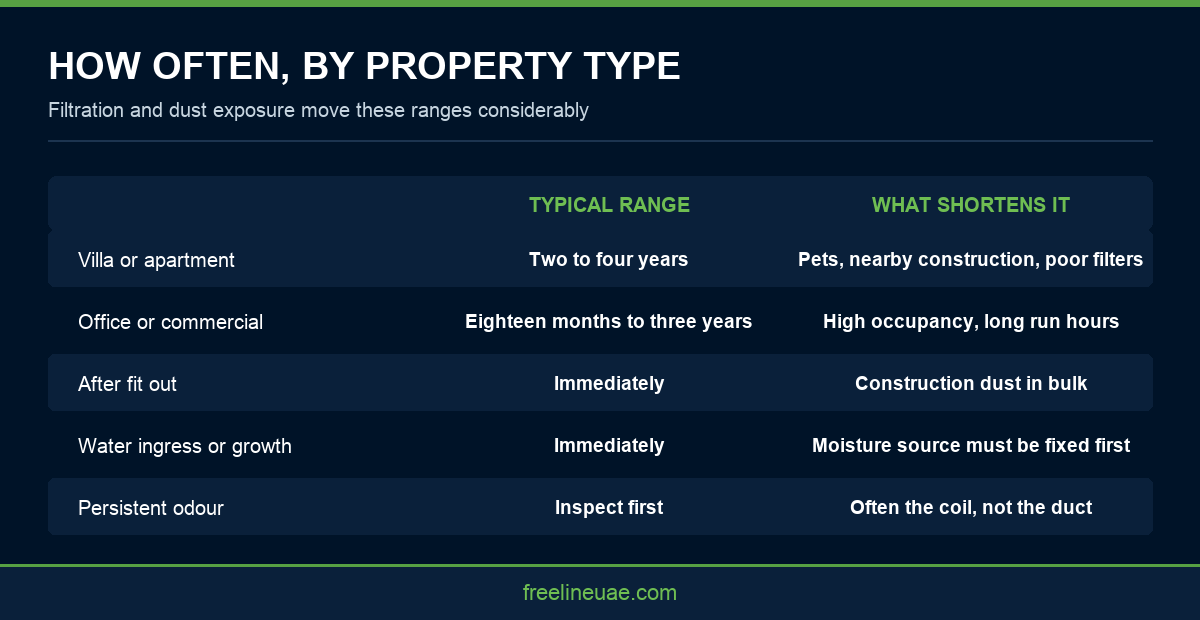
Certain events override the calendar entirely. Water ingress into ductwork, visible microbial growth, a pest problem, or a persistent odour that survives filter replacement all warrant inspection immediately rather than at the next scheduled point.
Residential villas and apartments
Most homes fall somewhere between two and four years for a full duct clean, provided filters are changed on schedule and the property is not adjacent to construction. Homes with pets, heavy occupancy or nearby earthworks sit at the shorter end of that range.
The strongest signal is not time but observation. Visible dust discharge from supply grilles, uneven cooling between rooms, or a smell when the system starts after a period of disuse all indicate that inspection is overdue regardless of the date on the last invoice.
Offices and commercial premises
Commercial systems are larger, run longer and serve more people, so they justify closer attention. Many offices work on an eighteen month to three year cycle for ductwork, with filters and coils handled far more frequently within that period.
Kitchens and food areas within commercial premises need separating from the general system in any assessment, because grease laden extract is a different problem with its own standards and belongs with kitchen extract cleaning rather than with comfort cooling ductwork.
Occupancy complaints are the usual trigger in practice. Where several occupants report stuffiness, dust or odour and the cooling itself is working correctly, the distribution system rather than the plant is normally the place to look first.
After construction or refurbishment
Any building that has undergone fit out or major refurbishment with the system running should be cleaned afterwards, irrespective of its age. Construction dust enters in quantities that a normal cycle is not designed to absorb, and leaving it in place shortens the life of everything downstream.
What Proper Duct Cleaning Involves
Standards give useful structure even where they are not enforced locally. The methodology published by industry bodies for duct cleaning centres on source removal, meaning contamination is physically taken out of the system rather than treated in place, and that principle is the one to hold a contractor to.
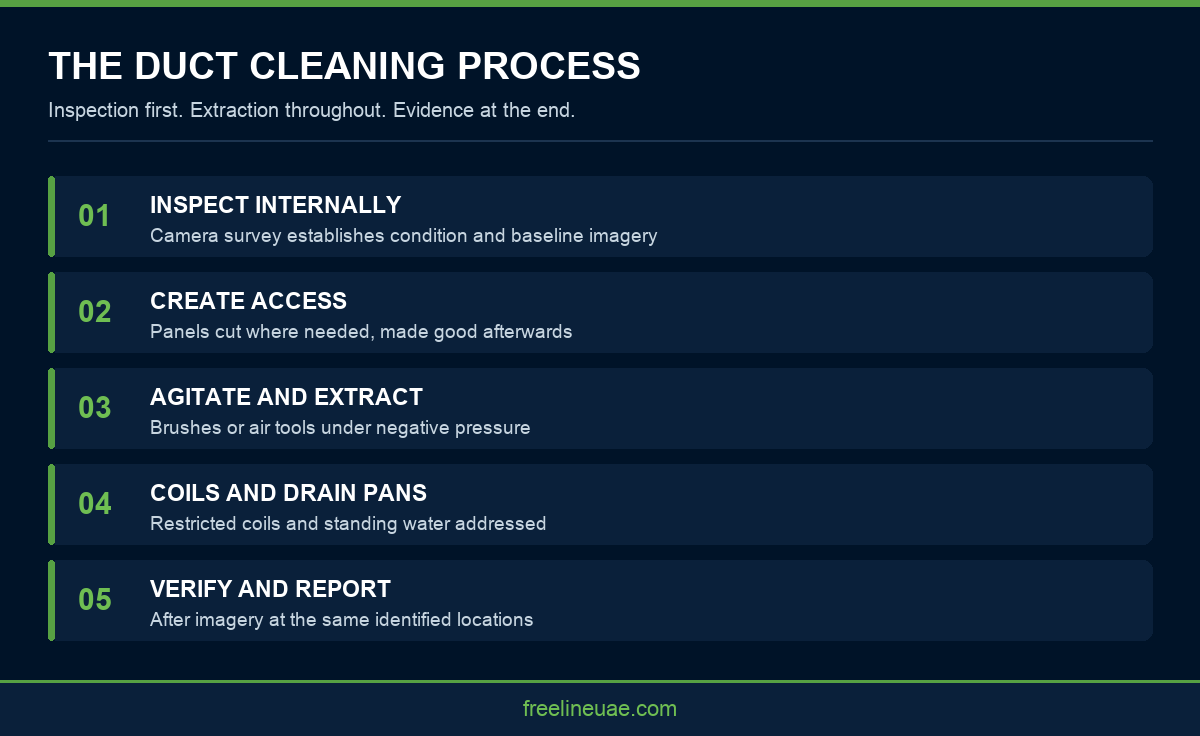
Access is the practical constraint on all of this. Ducts require access panels to be cleaned properly, and buildings frequently have too few. A competent contractor will tell you where panels need to be created and will make good afterwards, which is a legitimate cost rather than an upsell.
Flexible ductwork behaves differently from rigid and is often the weak point in an otherwise sound system. Its internal surface is ribbed rather than smooth, it traps material readily and it is easily damaged by aggressive mechanical cleaning, so it sometimes warrants replacement rather than cleaning.
Disinfection, where it is applied at all, comes after cleaning rather than instead of it. Applying a biocide over a layer of accumulated dust treats the surface of the dust, and any product sprayed into a duct that will carry breathing air deserves scrutiny before it is agreed.
Inspection before anything else
Competent work begins with a camera inside the ductwork, not with a quotation. Inspection establishes the actual condition, the duct construction, the access available and whether cleaning is even the correct remedy for the symptom being reported.
This step also produces the baseline imagery that makes the finished work verifiable. Without a before condition recorded, the after condition proves very little, and the client is left accepting an assurance rather than reviewing evidence.
Mechanical agitation and extraction under negative pressure
The recognised approach is to dislodge material from duct surfaces using brushes or compressed air tools while the system is held under negative pressure by a powerful extraction unit, so that everything released is captured rather than redistributed into occupied space.
Negative pressure is the part that distinguishes real duct cleaning from an expensive redistribution exercise. Agitating a duct without adequate extraction moves the contamination somewhere else in the building, frequently into the rooms the work was meant to benefit.
Coils, drain pans and filters
Where a building also runs ventilation plant supplying fresh air, that equipment loads from outside air directly and often carries the heaviest dust burden in the whole installation, so it deserves inspection alongside the recirculating ductwork.
Ductwork is only one component. Cooling coils accumulate a compacted layer that restricts airflow and reduces efficiency, drain pans collect standing water, and both are common sources of odour that duct cleaning alone will not resolve.
How the Result Should Be Proved
The deliverable of duct cleaning is evidence, and the evidence is visual. Before and after imagery taken at the same identified locations inside the ductwork is the only practical way for a building owner to see what was actually achieved, because nobody is going to climb into the system themselves.
Video is more useful than stills for the main runs. A short recording travelling along a duct shows continuity of condition, whereas a still can be framed to show the cleanest section of an otherwise untouched branch without technically misrepresenting anything.
Location labelling matters as much as the images. A report containing attractive photographs with no indication of where in the system they were taken cannot be verified, compared against a later clean, or used to demonstrate that a particular branch was reached at all.
Grilles and diffusers should appear in the report too. They are the only part of the system an occupant ever sees, and a building where the visible grilles have been cleaned while the branches behind them have not will feel improved for a few weeks and then revert.
Coverage is the detail that separates thorough contractors from selective ones. It is entirely possible to clean the accessible main runs, photograph those, and leave the branches serving individual rooms untouched, and the resulting report will look excellent.
Sampling of surface deposits is available where a specific concern exists, for instance where growth is suspected rather than simply dust. It is not needed routinely, and a provider recommending laboratory analysis on every visit is adding cost without adding much decision useful information.
Airflow measurement adds a useful objective dimension where the original complaint concerned uneven cooling. A demonstrable improvement in delivered air at a previously weak outlet is a harder result to argue with than any photograph.
Keep the reports. A dated series of internal images from consistent locations across several cleans tells you how quickly the system reloads, which is the information that sets a sensible interval and identifies a filtration problem that keeps recreating the same condition.
What It Should Cost and How to Read a Quote
Pricing in this market varies enormously, and the variation is usually explained by scope rather than by rate. Duct count and length, access difficulty, whether coils and drain pans are included, whether access panels will be created, and whether before and after reporting is provided all move the figure substantially.
The cheapest quotations in a tender typically differ in the same predictable ways. They cover accessible main runs rather than the full system, exclude coil cleaning, provide no imagery, and create no access panels, which means they clean the parts that are easy to reach and report on those.
Out of hours working affects the figure as well. Offices and retail units usually require evening or weekend attendance, and containment takes longer in occupied space, so the same physical scope costs more in a live building than in an empty one.
Ask for the quotation to be structured by component rather than as a single figure. Ducts, coils, drain pans, grilles, filters and access provision priced separately makes gaps visible immediately, and it allows a genuine comparison between providers who are otherwise describing different work.
Beware of pricing by unit count alone. Two buildings with the same number of indoor units can carry very different quantities of ductwork depending on layout, so a per unit rate is a convenient shorthand that frequently misprices the actual work in one direction or the other.
Filter supply is worth pricing alongside the cleaning. Better filtration slows reloading, so upgrading filter grade at the point of cleaning extends the interval before the next one, and filter supply and installation handled by the same provider avoids a mismatch between what was fitted and what the system needs.
Be cautious of a price quoted without a site visit. Duct length cannot be estimated over the phone, so a figure produced without inspection is a price for attendance rather than for a defined and measurable piece of work.
Choosing an AC Duct Cleaning Company in Dubai
Getting AC duct cleaning in Dubai right is mostly about asking five questions before the work rather than assessing the result afterwards, since by then the ductwork is closed again and the evidence is whatever the contractor chose to record.
Method is the first question and it is diagnostic. Ask how the ducts will be agitated, what extraction equipment will be used, whether the system will be under negative pressure and where access panels will be created. Specific answers indicate an established procedure.
Evidence is the second. Ask to see an anonymised example report from another building before appointing anyone. A provider proud of their documentation will send one immediately, and a provider who cannot produce an example is telling you exactly what yours will look like.
Scope breadth is the third. Ducts, coils, drain pans and filters form one system, and a provider addressing only the ducts will leave the causes of the most common complaints in place. Where the work sits alongside HVAC servicing, the same party sees the whole picture.
Continuity is worth protecting once you find a competent provider. A contractor returning to the same building holds the previous imagery, can show how quickly the system reloaded and can advise whether the interval should move, which is information a new provider cannot reconstruct.
Insurance and working practice matter in occupied buildings. Duct cleaning is disruptive, it involves working at height and in ceiling voids, and it generates noise and dust if containment is poor. A provider who has not raised these points has not thought about your building.
Where duct cleaning is bought alongside routine building upkeep, the interval can be set from accumulated evidence rather than renegotiated from scratch each time, and filter changes stay aligned with the cleaning cycle instead of drifting out of step with it.
Freeline has delivered HVAC and duct services across Dubai, Sharjah and Abu Dhabi since 2012, covering ductwork, coils, filters and the associated services under one coordinated scope.
What Duct Cleaning Will Not Fix
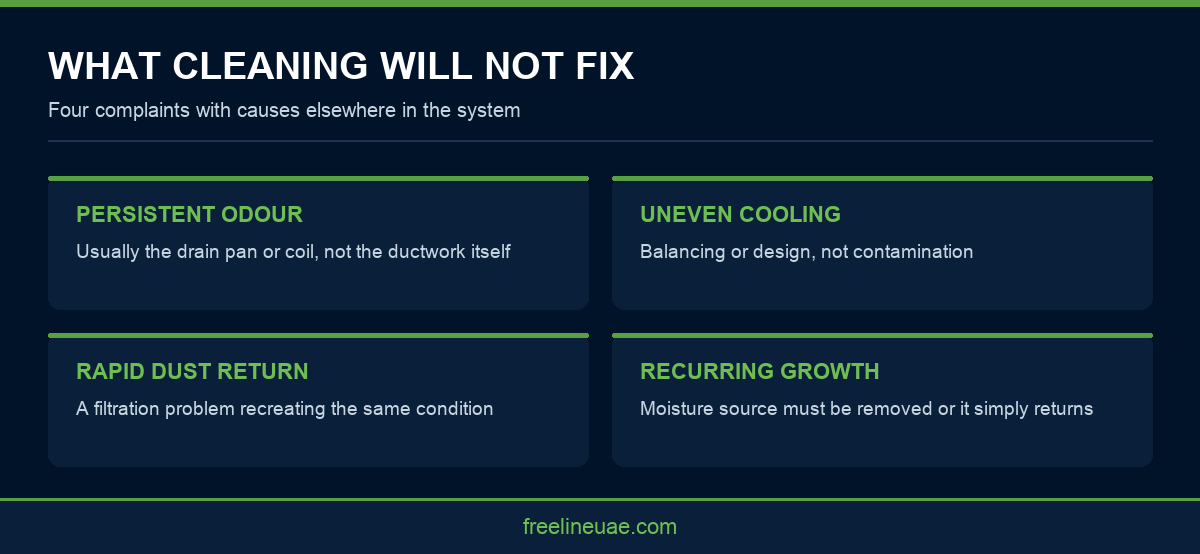
Managing expectations honestly is part of doing this work well, and several common complaints have causes that duct cleaning does not address. Persistent odour frequently originates at the drain pan or the coil rather than in the ductwork, and cleaning ducts alone will not resolve it.
Noise complaints are a further example. Airflow noise is usually a velocity or design matter, and while a severely restricted system can be noisy, cleaning it will not quieten a duct that was undersized when it was installed.
Uneven cooling between rooms is often a balancing or design issue rather than a contamination issue. Where a system was never commissioned correctly, or where partitions have been added since, no amount of cleaning will deliver air the ductwork was not sized to carry.
Allergy and respiratory complaints are the hardest expectation to manage honestly. Cleaning removes accumulated material and can help, but indoor air quality depends on filtration, fresh air rates, humidity and housekeeping as much as on duct condition, and no single intervention addresses all of them.
Recurring dust discharge shortly after a clean usually indicates a filtration problem rather than poor cleaning. If the filter grade is inadequate or filters are not being changed, the system will reload quickly and the owner will reasonably but incorrectly blame the contractor.
Insulation faults sit in the same category. Where duct insulation has failed, surfaces run cold enough to condense in humid conditions, and until the insulation is repaired the system will keep producing the moisture that caused the original complaint.
Microbial growth needs its moisture source removed. Cleaning and treating a duct that is periodically wet from a failed drain, a leaking pan or an insulation defect simply resets a clock, and the growth returns because the underlying condition was never corrected.
Duct construction itself sets a limit in some buildings. Internally lined ductwork, where insulation sits on the air side rather than outside the duct, cannot be cleaned as aggressively as bare sheet metal, and where that lining has degraded the honest recommendation is replacement rather than repeated cleaning.
This is why inspection before quotation matters so much. A provider who looks first can tell you when duct cleaning is the wrong purchase, and that conversation is far more valuable than a discount on work that was never going to solve the problem.
Conclusion
AC duct cleaning in Dubai is worth doing properly and easy to buy badly, because the finished work is invisible without a camera. Insist on inspection before quotation, mechanical agitation with extraction under negative pressure, coils and drain pans included in scope, access panels created where needed, and before and after imagery from identified locations. If your system has never been inspected internally, or complaints persist after a previous clean, contact Freeline for a survey.
