
AC Duct Cleaning in Sharjah: A Building Owner’s Guide
AC duct cleaning in Sharjah deals with the same dust and the same cooling season as anywhere else in the UAE, but the building stock is different. Sharjah carries a high proportion of older residential blocks and villa compounds, many of them altered repeatedly over decades. That history shapes what a duct clean finds, how long it takes and how often it is genuinely needed. This guide is written for owners and managers of those buildings. For the scope Freeline works to, see how Freeline cleans an air distribution system.
Key Takeaways
- The method is identical across the emirates. What changes in Sharjah is building age, duct construction and how much of the original system documentation survives.
- Older buildings are more likely to contain flexible or internally lined ductwork, which cannot be cleaned aggressively and sometimes needs replacing instead.
- Filtration discipline changes the required interval more than anything else. Cheap filters left in place too long reload ductwork within months of a clean.
What Makes Older Sharjah Buildings Different
A significant share of Sharjah’s residential stock has been in service for decades, and ductwork ages in ways that affect cleaning directly. Joints loosen, insulation degrades, and internal surfaces become rougher and better at holding the dust that passes over them.
Duct construction is the detail that matters most. Older installations frequently include flexible ductwork, whose ribbed internal surface traps material readily and which is easily torn by aggressive mechanical cleaning. Where it has degraded, honest advice is replacement rather than repeated cleaning.
Internally lined ductwork presents a similar constraint. Where insulation sits on the air side rather than outside the duct, the surface cannot be brushed as firmly as bare sheet metal, and a contractor who treats it identically will damage it while claiming a thorough result.
Alteration history compounds all of this. Buildings reconfigured over many years accumulate branches serving rooms that no longer exist, dampers left in unknown positions and sections added without records, none of which appear on any drawing the owner is likely to hold.
The practical conclusion is that an internal inspection matters more in older stock than in new. A quotation issued without one is pricing a system nobody has looked inside, and in a building of this age that is a genuine commercial risk for both parties.
How Often Ducts Need Cleaning Here
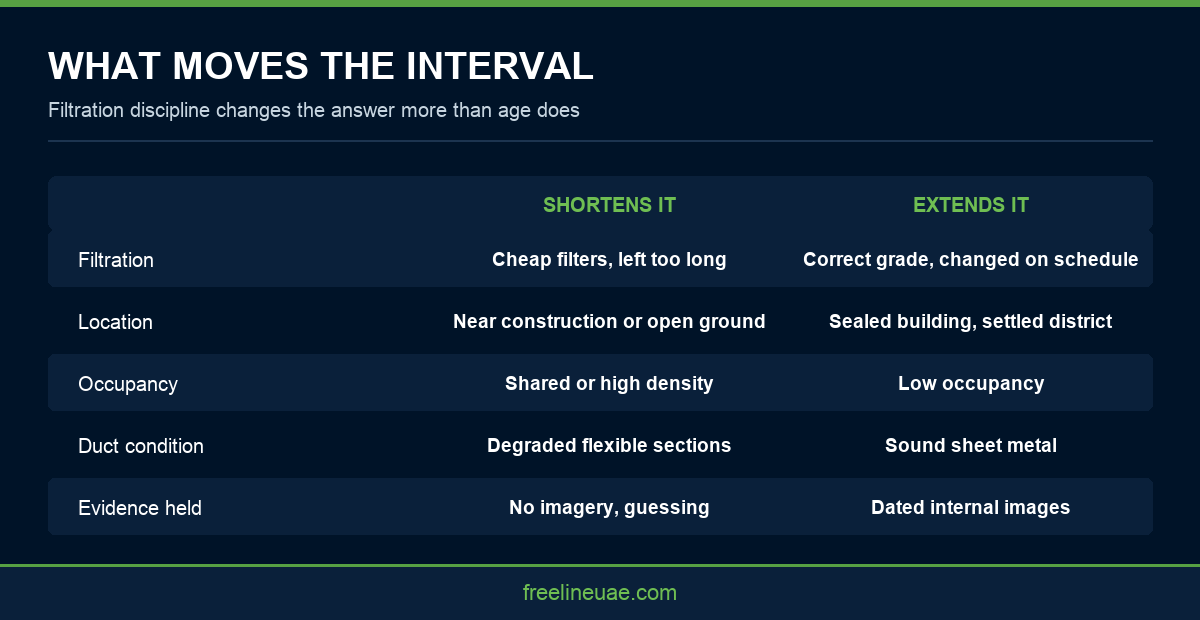
There is no universal interval and any contractor offering one has not asked enough about the building. Most residential properties fall somewhere between two and four years, with the position inside that range set by filtration, occupancy and proximity to dust sources.
Filtration is the variable that moves the answer furthest. A system running appropriate filters changed on schedule loads its ductwork far more slowly than an identical system running the cheapest available air filter left in place well past its useful life.
Proximity to construction or open ground shortens the interval considerably. Sharjah has areas of active development and areas of established housing near open land, and both deliver a heavier and coarser dust load than a sealed building in a settled district.
Occupancy patterns matter in shared accommodation especially. Higher occupancy means more cooking, more movement and more airborne material generally, and buildings of that type often justify closer attention than their age alone would suggest.
Run hours are worth quantifying rather than assuming. A system in Sharjah operates for the great majority of the year, so the ductwork sees an enormous volume of air annually regardless of how lightly the property itself feels used.
Certain findings override the calendar entirely. Water ingress into ductwork, visible growth, evidence of pests or a persistent odour that survives a filter change all warrant inspection immediately rather than at the next scheduled point.
What the Work Should Involve
Competent work starts with a camera inside the ductwork rather than with a quotation. Inspection establishes actual condition, duct construction, available access and whether cleaning is even the right remedy for the symptom the owner has described.
Where fresh air ventilation plant serves the building, it draws directly from outside and usually carries the heaviest dust load of anything in the installation, so it belongs in the inspection alongside the recirculating ductwork.
Cleaning itself means mechanical agitation of duct surfaces using brushes or air tools while the system is held under negative pressure by an extraction unit. Negative pressure is what separates cleaning from redistribution, because agitating a duct without adequate extraction moves contamination into the rooms below.
Access panels are usually needed and are frequently absent in older buildings. Creating openings and making good afterwards is legitimate work rather than an upsell, and it makes every subsequent clean faster because the access exists from then on.
Coils, drain pans and grilles belong in the same scope. Coils accumulate a compacted layer that restricts airflow, drain pans hold standing water, and both are common sources of odour that duct cleaning on its own will not resolve for the occupants.
Where flexible ductwork is found to be degraded, the correct recommendation is replacement of those sections. Cleaning damaged flexible duct produces debris, reduces its remaining life and rarely improves the airflow the occupants were complaining about in the first place.
Proving the Work Was Actually Done
The deliverable is visual evidence, because nobody is going to inspect the ductwork themselves. Before and after imagery taken at the same identified locations inside the system is the only practical way an owner can see what was achieved behind a closed ceiling.
Location labelling is what makes the imagery usable. Attractive photographs with no indication of where they were taken cannot be verified, compared against a later clean, or used to establish that a particular branch was reached at all during the visit.
Video suits the main runs better than stills. A short recording travelling along a duct demonstrates continuity of condition, whereas a single frame can be composed to show the cleanest part of an otherwise untouched section.
Coverage is where selective contractors differ from thorough ones. It is entirely possible to clean and photograph the accessible main runs while leaving the branches serving individual rooms untouched, and the resulting report will look convincing to anyone who does not ask about coverage.
Airflow measurement adds an objective dimension where the original complaint concerned uneven cooling between rooms. A demonstrable improvement in delivered air at a previously weak outlet is considerably harder to dispute than any photograph.
Keep the reports over time. A dated series of internal images from consistent locations shows how quickly the system reloads, and that trend is what sets a sensible interval rather than repeating the work on a guess every few years.
Choosing a Contractor for a Sharjah Property
Method is the first question and it is diagnostic. Ask how ducts will be agitated, what extraction will be used, whether the system will run under negative pressure and where access panels will be created. Specific answers indicate an established procedure.
Evidence is the second. Ask to see an anonymised example report from another building before appointing anyone, because a provider proud of their documentation will send one immediately and a provider who cannot is describing what yours will look like.
Ask directly how flexible and lined ductwork will be handled. In older Sharjah buildings this is not a hypothetical question, and a contractor without a considered answer will either damage the ductwork or avoid cleaning it while charging for both.
Scope breadth is the fourth. Ducts, coils, drain pans and filters form one system, and where duct cleaning sits alongside routine HVAC servicing the same party sees the whole picture rather than one component of it.
Insurance and working practice matter in occupied blocks. The work involves ceiling voids, working at height, noise and dust if containment is poor, and a contractor who has not raised those points has not thought about your residents.
Freeline has operated across the UAE since 2012 with a branch in Al Nahda serving Sharjah, and delivers duct cleaning alongside coils, filters and its wider services under one coordinated scope.
Conclusion
AC duct cleaning in Sharjah rewards a contractor who inspects before quoting, because the age and alteration history of the building stock make internal condition genuinely unpredictable. Insist on a camera survey first, mechanical cleaning under negative pressure, a considered approach to flexible and lined ductwork, coils included in scope, and before and after imagery from identified locations that you can actually check afterwards. Contact Freeline to arrange an internal inspection of your building and a scoped proposal.
