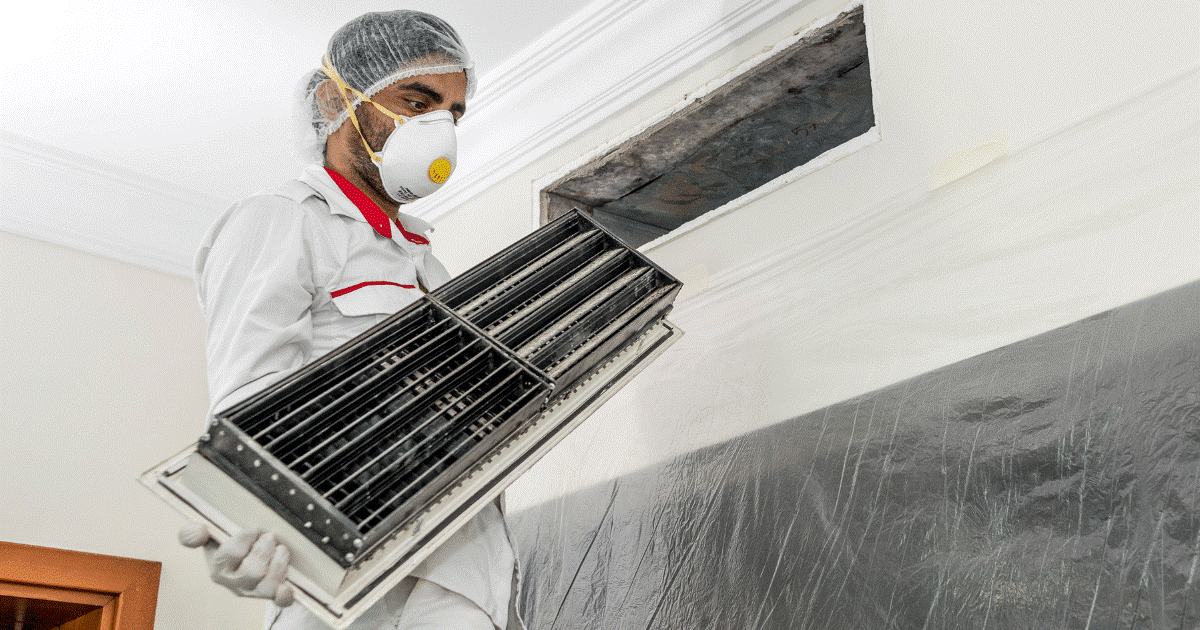
HVAC Duct Cleaning Services in Sharjah for Commercial Sites
HVAC duct cleaning services in Sharjah look superficially similar to residential work and are procured completely differently. Commercial systems are larger, run longer, serve people who did not choose to be there, and cannot usually be switched off during business hours. The technical method is the same. The specification, the shutdown planning and the evidence requirements are not. This article covers how facilities teams should scope, programme and verify the work, and where commercial procurement most often goes wrong. For the scope Freeline works to, see how Freeline services an HVAC plant.
Key Takeaways
- Commercial procurement fails on specification rather than on price. A scope that does not define coverage, access provision and evidence will be delivered to the cheapest reading of it.
- Shutdown windows drive the programme. Cleaning under negative pressure needs the system available, and that conflicts directly with occupied operating hours.
- Fresh air handling plant usually carries the heaviest dust load in the installation, because it draws directly from outside rather than recirculating.
Why Commercial Systems Load Differently
Commercial installations move far more air than residential ones and they run for longer, often continuously in facilities with extended operating hours. The total volume passing through the ductwork over a year is the driver, and it dwarfs anything a villa system handles.
Fresh air plant is the component most often underestimated. Air handling units drawing outside air take the full dust load directly rather than the reduced load of recirculated air, so they foul faster than anything else and are frequently the source of a complaint blamed on the ductwork.
Filtration grade is the lever most facilities underuse. A low resistance air filter chosen to protect fan energy will pass a substantial fraction of fine dust into the ductwork behind it, and the ducts then perform the filtration the plant was never specified to do.
Industrial and warehouse environments add process contamination on top of ambient dust. Packaging fibres, product dust and vehicle exhaust from loading areas all enter the system, and they behave differently from ordinary dust once they reach a cooled surface.
Occupancy density matters too. A busy office generates more airborne material than a lightly used one, and facilities with food preparation, retail activity or high footfall load their systems considerably faster than a quiet administrative floor.
The consequence for procurement is that a single interval applied across a mixed portfolio will be wrong in both directions. Some systems will be cleaned too often and others left far too long, which is why condition based scheduling repays the inspection cost quickly.
Specifying the Work Properly
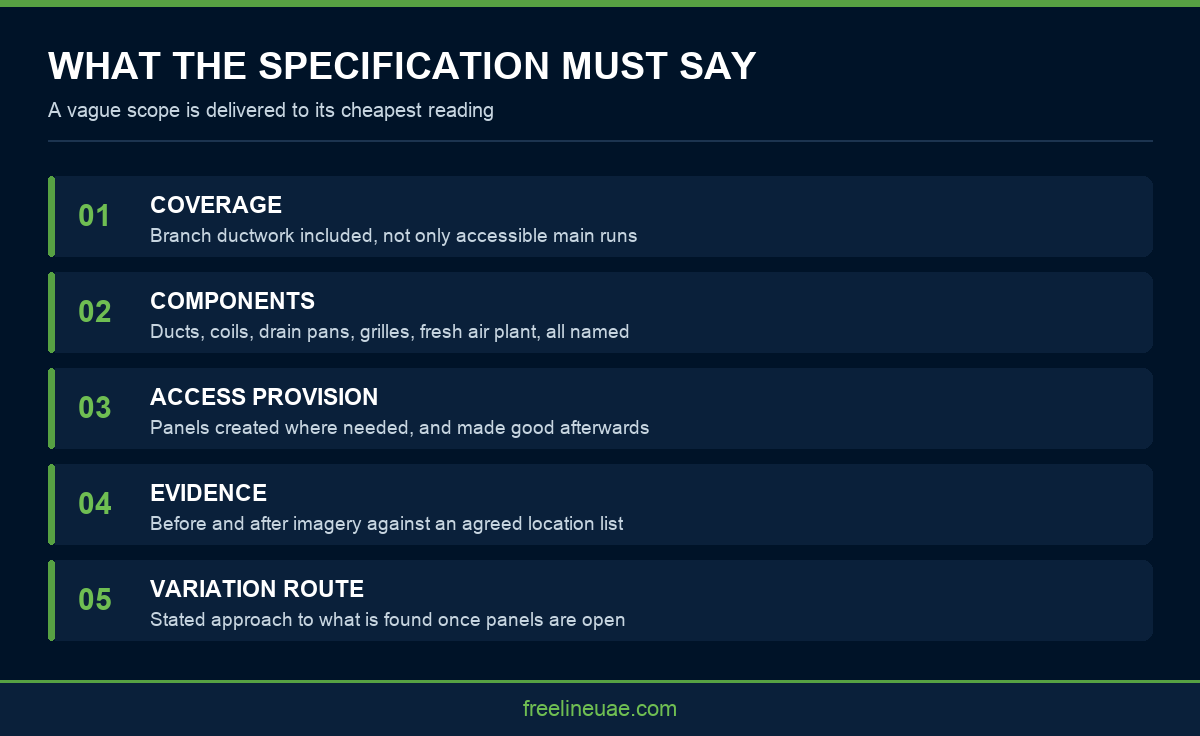
Coverage is the specification item that matters most and the one most often left vague. A scope should state that branch ductwork is included, not only accessible main runs, because the difference is invisible at completion and enormous in delivered value.
Access provision should be explicit. Ductwork cannot be cleaned properly without openings, and a specification that is silent on access panels invites a contractor to clean what is reachable and leave the rest, entirely within the letter of the document.
Component breadth belongs in the scope as well. Ducts, cooling coils, drain pans, grilles, diffusers and fresh air plant should each be named, because a scope that says duct cleaning will reasonably be read as excluding everything that is not literally ductwork.
Evidence requirements should be written in rather than assumed. Requiring before and after imagery at identified locations, and stating that coverage will be checked against a location list, changes what contractors price for and removes the incentive to clean selectively.
Programme constraints belong in the document too. Stating the available shutdown windows, their duration and how many can be used per month lets contractors price realistically rather than discovering the constraint after award and requesting more time.
Finally, specify the variation route. Degraded flexible ductwork, failed insulation and wet drain pans are all common discoveries once panels are open, and a stated approach to additional work avoids a negotiation halfway through a shutdown window.
Planning the Shutdown
Cleaning requires the system to be available, and in a live commercial building that means working when the building is not. Evening, overnight and weekend windows are normal, and the programme should be built around the facility calendar rather than the contractor’s convenience.
Zoning is what makes larger sites practical. Treating one air handling unit and its associated ductwork at a time keeps the remainder of the facility in service, though it lengthens the overall programme and needs the isolation to be genuinely reliable.
Containment planning protects the occupied areas. Duct cleaning generates dust if extraction is inadequate or if grilles are removed carelessly, and in a facility with sensitive equipment or stock the containment method deserves as much scrutiny as the cleaning method.
Sequencing across zones needs thought where systems interconnect. Cleaning one air handling unit while an adjacent zone continues running can pull loosened material across the boundary, so isolation between zones should be verified rather than assumed.
Reinstatement time is routinely underestimated. Ceilings must go back, grilles must be refitted, access panels made good and the system run and checked before occupation resumes, and a programme that ends at the cleaning stage will overrun into business hours.
Critical areas need identifying in advance. Server rooms, laboratories, clinical spaces and anywhere with a continuous process may not tolerate the shutdown or the dust, and discovering that during the first window converts a planned outage into an incident.
Verifying Delivery Across a Large Site
Verification on a commercial site has to be systematic rather than illustrative. A handful of attractive photographs proves nothing across a facility with hundreds of metres of ductwork and several air handling units serving different zones.
The workable approach is a location list agreed in advance. Each identified point receives a before and after image, the list is checked at completion, and any point not evidenced is treated as not cleaned until the contractor demonstrates otherwise.
Airflow measurement adds an objective layer that photographs cannot provide. Recording delivered air at representative outlets before and after gives a numerical result, which matters where the original complaint concerned comfort rather than visible dust.
Fresh air plant deserves its own evidence. Because it fouls fastest, it is the component where a contractor cutting corners will save the most time, and it is also the component whose condition most directly affects indoor air quality for occupants.
Sampling has a narrow but real place on commercial sites. Where growth is suspected rather than simple dust accumulation, surface sampling supports a decision that photographs cannot, though it should not become a routine line item on every visit.
Retain the records against the asset register. A dated series of imagery and airflow figures per zone allows the next interval to be set from evidence, and it shows which parts of a site are deteriorating faster than others and why.
Choosing a Commercial Provider in Sharjah
Capacity is the first question. Commercial work needs extraction plant sized for large ductwork, enough crews to complete a zone within a shutdown window, and the ability to work nights and weekends consistently rather than as an exception.
Method is the second and it should be described in specifics. Ask how negative pressure will be maintained across large duct runs, what containment will be used at grilles, and how fresh air handling units will be treated differently from recirculating ductwork.
Documentation is the third. Ask to see an anonymised commercial report covering a comparable site, because a provider used to facilities work will have location lists, zone breakdowns and airflow figures rather than a folder of untitled photographs.
Coordination is the fourth. Where duct cleaning sits alongside planned HVAC servicing and wider building upkeep, shutdown windows can be shared across several tasks instead of the facility losing its systems repeatedly through the year.
Insurance and site competency close the list. Commercial duct cleaning involves work at height, ceiling voids, out of hours access and sometimes restricted areas, and the provider should evidence cover and method for all of it before award.
Freeline has operated across the UAE since 2012 with a branch in Al Nahda serving Sharjah, and delivers commercial duct and HVAC work alongside its wider services under one coordinated programme.
Conclusion
HVAC duct cleaning services in Sharjah succeed on specification and shutdown planning far more than on rate. Define coverage including branch ductwork, name every component in scope, require access provision, build the programme around real shutdown windows, and verify against an agreed location list rather than a photograph folder. If your facility has never had its fresh air plant inspected internally, contact Freeline for a survey and a zoned proposal built around the shutdown windows your facility can realistically offer.
