Commercial Kitchen Duct Cleaning: A Scope of Work Guide
Tenders for commercial kitchen duct cleaning in Dubai are usually won on price and lost on specification. When a scope says clean the kitchen extract system, every bidder is free to interpret that as the hood and the accessible ductwork, and the cheapest reading wins. This article sets out the clauses that remove that ambiguity, so that competing quotations describe the same work and can be compared honestly rather than on a headline figure that conceals what each bidder intends to do. For the scope Freeline works to, see how Freeline degreases a canopy and its ductwork.
Key Takeaways
- Anything not named in the scope will be treated as excluded. Components, coverage, access and evidence all need writing down explicitly.
- The riser is the clause that matters most, because it is the section most often omitted and the one carrying the greatest fire risk.
- A stated variation route prevents a negotiation at two in the morning when the panels are open and the kitchen reopens at six.
Clause One: Name Every Component
A scope that says extract cleaning invites the narrowest interpretation. The document should list the components individually, because a contractor pricing against a list cannot later argue that an item was outside the intended scope of the work.
A kitchen hood is the item everyone assumes is included, and it is also the item that a narrow scope will treat as the whole job, which is precisely why the remaining components have to be written down individually.
The list should read: grease filters, hood interior, plenum behind the filters, horizontal ductwork, vertical riser, extract fan and impeller, any pollution control or ecology unit including its cells, and the discharge point and surrounding roof area.
Each of those items loads at a different rate and some are commonly omitted as a matter of habit. The fan and the ecology unit cells are the two most frequently left out, and both produce visible consequences when neglected for long enough.
Where the premises also runs comfort cooling, keep it in a separate scope. Extract systems and ductwork cleaning are governed by different considerations entirely, and combining them in one clause produces a document that satisfies neither requirement properly.
Make up air deserves a line even though it is not part of the extract. If the supply cannot replace what the extract removes, the kitchen runs in deficit and the hood stops capturing properly, and that is worth identifying during a survey even if it falls outside the cleaning scope.
Where a site has several kitchens, each system should be scheduled separately rather than described collectively. A single line covering all kitchen extract across a hotel invites the contractor to price an average and deliver it unevenly.
Clause Two: Define Coverage, Not Just Components
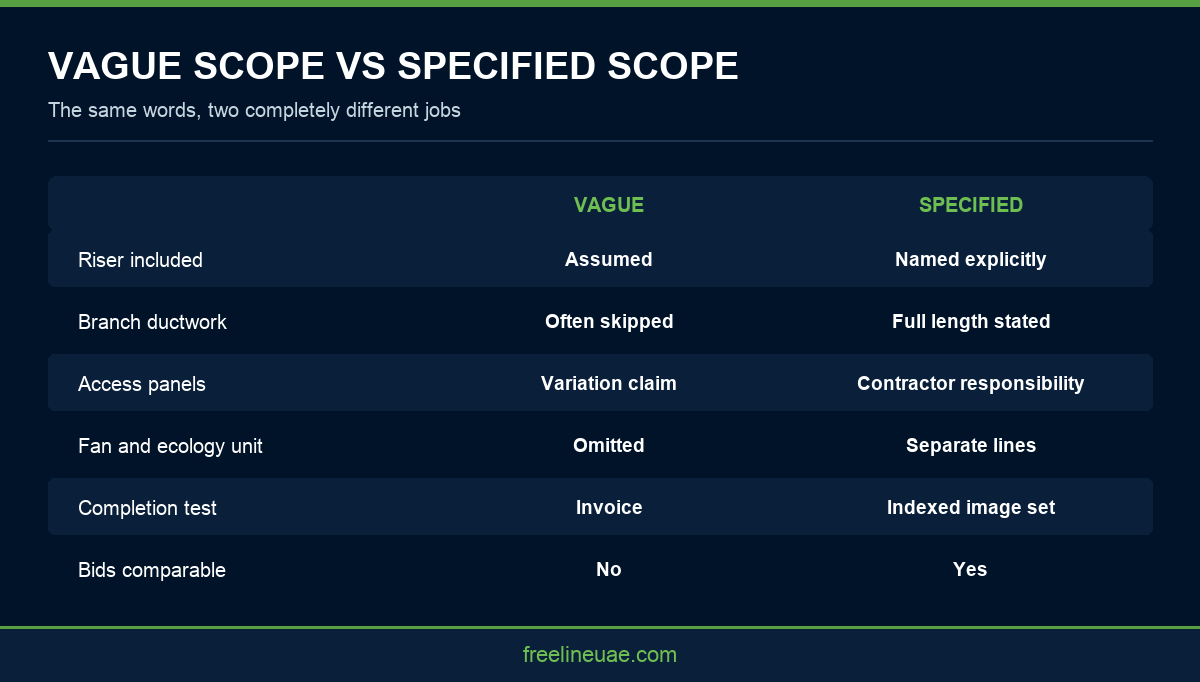
Naming the ductwork is not the same as specifying how much of it will be cleaned. The scope should state that ductwork is to be cleaned along its full length, including branches and the riser, rather than only at sections accessible through existing openings.
This single clause changes the price and it should. A contractor who intends to reach the whole system needs more time, more access provision and more crew, and a scope that permits partial coverage is inviting a bid from someone who intends to do less.
Where a system genuinely cannot be reached in full, the scope should require the contractor to identify and document those sections rather than to quietly skip them. A recorded blind section is a manageable risk, whereas an undocumented one is not.
Coverage should be defined against a route drawing where one exists. If it does not, requiring the contractor to produce one as part of the first clean turns an unknown system into a documented asset for every subsequent visit.
Fire risk should be stated as the purpose in the preamble. A scope written around hygiene invites hygiene level delivery, whereas one that identifies fire safety as the objective sets the expectation that deposits are removed rather than surfaces wiped.
Finally, state that the discharge point and surrounding roof area are included. Grease deposits around a flue terminal generate neighbour complaints and enforcement attention, and they sit outside most default interpretations of duct cleaning.
Clause Three: Access Provision and Making Good
Access is the clause that most often turns a competitive price into an expensive variation. The scope should state that the contractor is responsible for providing access sufficient to clean the full system, including creating new panels where existing provision is inadequate.
It should also state that panels are to be of a proprietary type appropriate to the duct, correctly sealed, and that all making good of ceilings, casings and finishes is included. Otherwise the building receives a cleaned duct and a damaged ceiling.
Requiring panel positions to be recorded turns a one off cost into a permanent benefit. A marked route drawing prevents the next contractor cutting fresh openings alongside existing ones, which is a common and avoidable waste in buildings that change providers.
Working at height and confined space provisions belong in the same clause. Riser access frequently involves both, and requiring documented procedure at tender stage avoids discovering a capability gap once the works window has already started.
Where the riser passes through other tenancies or common areas, the scope should require the contractor to identify the access arrangements needed and to raise them before the works window rather than during it.
Fire dampers within the route deserve a clause of their own. The scope should require them to be identified, inspected while access is open, and reported on, because a seized or missing damper is a compartmentation failure that nobody else is likely to find.
Clause Four: Evidence and Acceptance
The scope should state precisely what evidence constitutes completion, because in the absence of that clause the deliverable becomes an invoice. Before and after photographs taken inside the ductwork at every access point, each labelled with its location, is the minimum.
Add a requirement that images are indexed against the route drawing, and that any access point without both a before and an after image will be treated as not cleaned. That single sentence removes most of the ambiguity from the acceptance process.
Deposit measurement should be required where loading is heavy. Recording thickness at fixed points before and after produces an objective figure, and across successive contracts it produces the trend that justifies changing the frequency in either direction.
Airflow readings before and after are worth specifying on larger systems. Where the figure has fallen well below design, the cause usually lies with the fan or a loaded pollution control unit rather than with the ductwork, and the reading identifies that.
Specify who signs the acceptance. Naming the person or role responsible for reviewing evidence and accepting completion prevents reports being filed unread, which is how partial coverage survives for years in otherwise well run buildings.
Finally, require handback in a food safe condition, with surfaces cleaned down, protection removed and the system run and checked. Kitchens have been handed back covered in the residue of their own extract system more often than the trade likes to admit.
Clause Five: Variations, Timing and Records
A variation route should be stated before the work rather than negotiated during it. Collapsed duct sections, corroded riser plate, seized dampers and previously unknown connections are normal findings, and the scope should set out how they are priced and authorised.
Timing needs specifying in operational terms. State the available windows, their duration, how many can be used per month and what time the kitchen must be handed back, so that contractors price the actual constraint rather than an assumed one.
Retention should be stated as well as format. Extract records are examined after incidents and during insurance reviews, sometimes years later, so requiring them in a durable format held by the client rather than by the contractor matters.
Records should be required in a defined format and issued within a stated period. A report delivered six weeks later, after the kitchen has been trading through the interval, is considerably less useful than one issued within days of the work.
Require that the contractor’s records name the technicians and the date, because an insurer or investigator examining an incident will ask who attended and when, and a report that answers those questions is worth more than one that does not.
Where the same premises also require grease trap servicing and drainage attention, aligning those scopes into the same out of hours window reduces disruption and keeps the compliance file coherent.
Conclusion
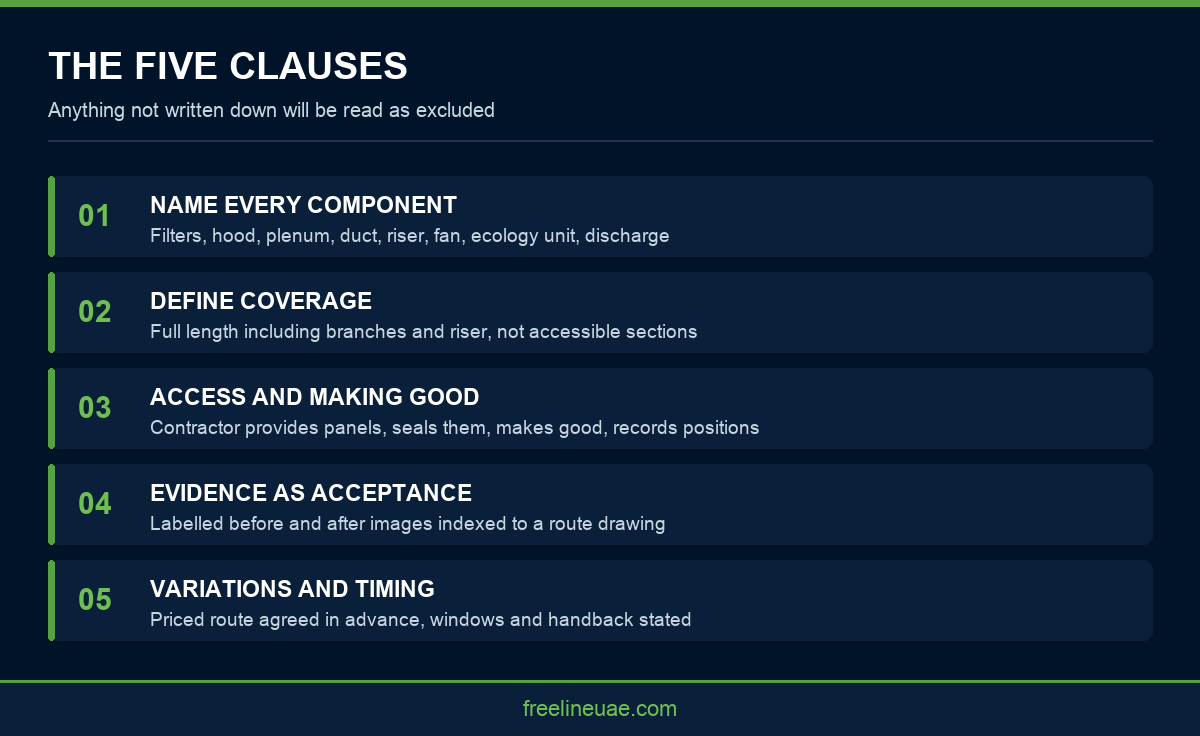
A scope of work for commercial kitchen duct cleaning in Dubai should name every component, define coverage along the full length including the riser, place access provision and making good with the contractor, specify evidence as the acceptance criterion, and set out the variation route in advance. Written that way, competing quotations become genuinely comparable. Contact Freeline to have an existing scope reviewed, or a new one prepared for your site before the next tender goes out.
