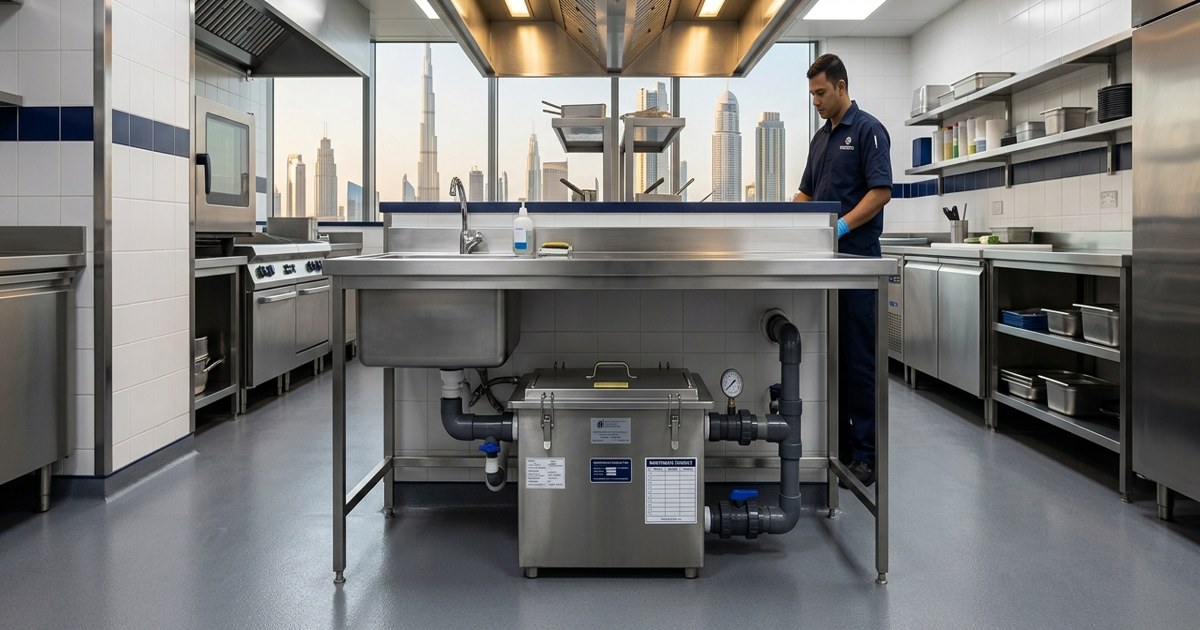
Measuring Grease Build Up in Kitchen Extract Systems
Most decisions about kitchen duct cleaning in Dubai are made on opinion. The contractor says the system needs cleaning, the operator suspects it might not, and neither has a number to argue with. Deposit measurement replaces that conversation with evidence. It is simple, quick, and it turns extract cleaning from a recurring appointment into a managed interval based on what is genuinely accumulating inside the ductwork, and it gives both parties a figure they can point at instead of an adjective. For the scope Freeline works to, see how Freeline degreases a canopy and its ductwork.
Key Takeaways
- Deposit thickness is the only objective measure of how loaded an extract system actually is, and it takes minutes to record at a fixed point.
- Measured before and after, it proves the clean worked. Measured across visits, it sets the interval on evidence rather than on habit.
- Deposits are never uniform, so measurement points must be fixed and recorded, otherwise successive readings cannot be compared.
Why Thickness Is the Right Measure
Grease inside an extract duct is fuel arranged along a channel that runs from a heat source through the building. The quantity of that fuel, rather than the time since the last visit, is what determines the risk at any given moment, and quantity is measurable.
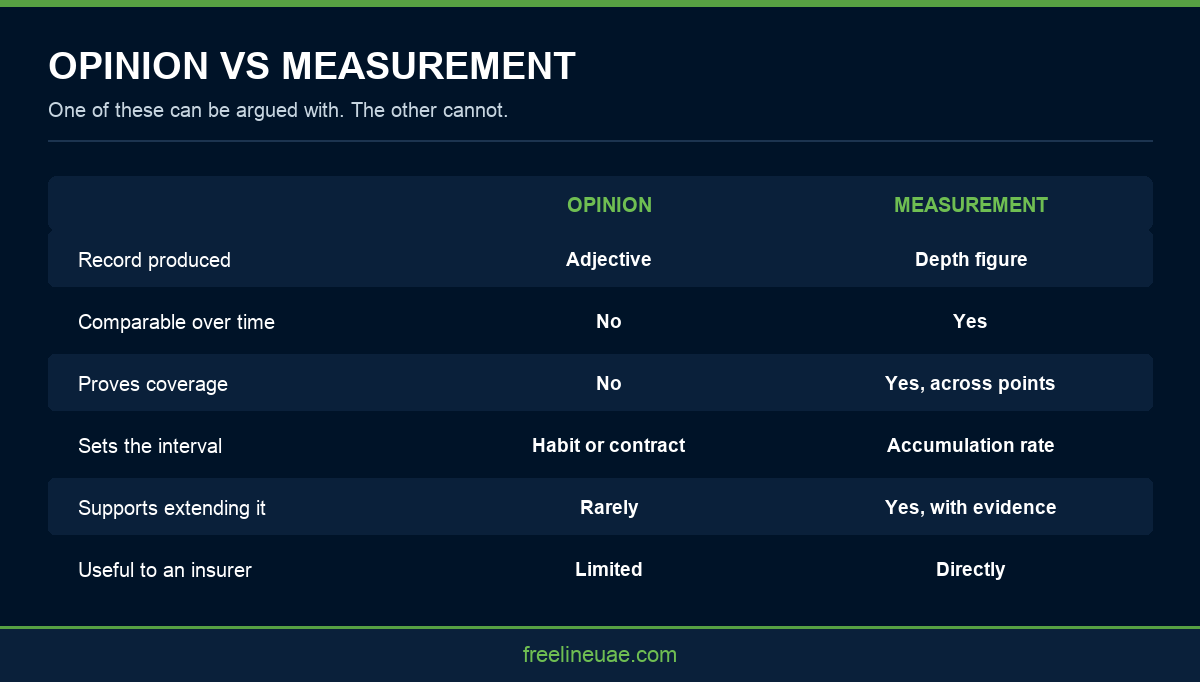
Thickness is the practical proxy for quantity. A depth reading taken at a defined point on the duct wall gives a figure that can be recorded, compared and trended, which is more than any visual assessment can offer no matter how experienced the inspector.
The alternative in common use is a photograph and an adjective. Heavy, moderate and light are useful shorthand between technicians and useless as a record, because the same duct will attract different descriptions from different contractors on different days.
Measurement also settles disputes in the operator’s favour more often than contractors expect. Where a system is genuinely lightly loaded, a recorded figure supports extending the interval, which saves money that an opinion based schedule would have spent.
It matters because deposited grease is combustible and sits in a duct that passes through the building structure. Fire safety in commercial kitchens rests on removing that fuel, so knowing how much of it is present is not an academic question.
The wider principle is familiar from every other maintenance discipline. Conditions that can be measured get managed, and conditions assessed by impression get either over serviced or neglected, usually both at different points in the same building.
How and Where Measurement Is Taken
Readings are taken at access points along the duct route, at the same locations on every visit. Consistency matters more than the absolute number of points, because the value of the data comes from comparison over time rather than from any single reading.
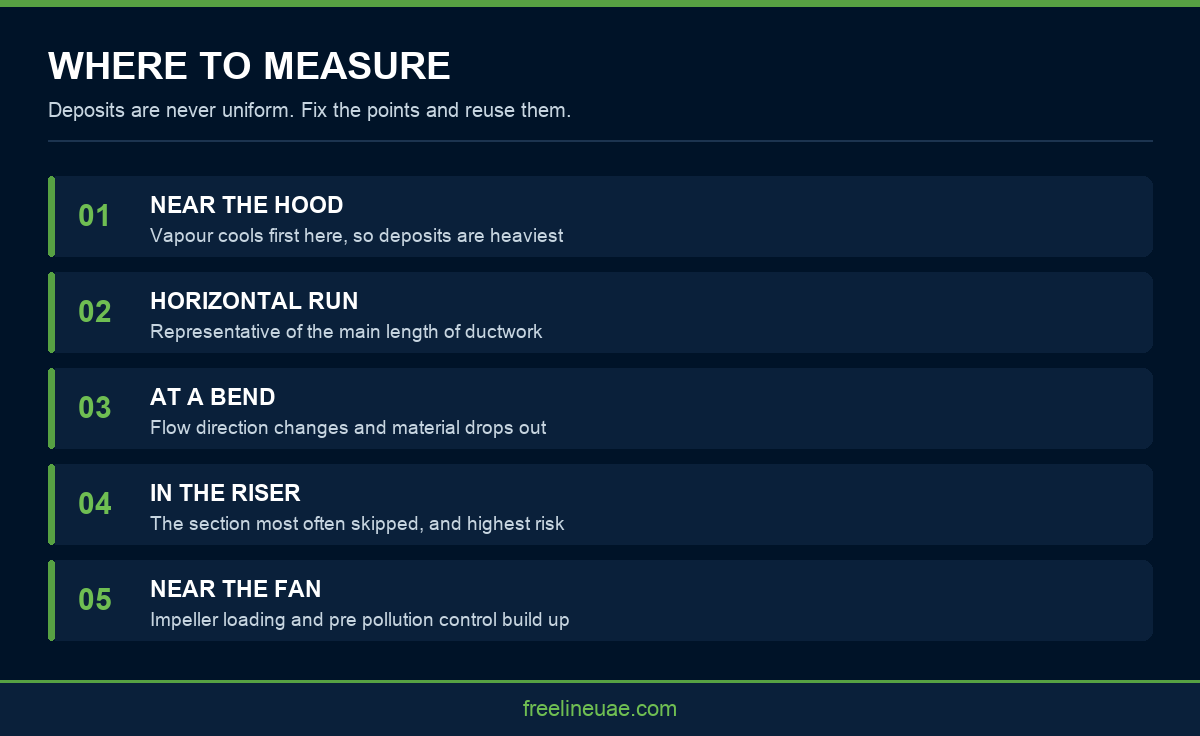
Deposits are never evenly distributed, which is why point selection matters. Accumulation is heaviest close to the hood where vapour first cools, at bends where flow direction changes, at the base of the riser and immediately upstream of any pollution control unit.
A representative set therefore includes a point near the hood, one on the horizontal run, one at a bend, one in the riser and one near the fan. Five points give a usable profile of the system without turning the inspection into an exercise in itself.
The reading itself is straightforward. A depth gauge or comb is pressed to the duct surface through the access panel and the deposit depth recorded, along with the location reference, the date and a photograph of the same point.
Photograph the point as well as recording the figure. An image taken at the same location each visit lets a reviewer sanity check the number, and it catches the occasional transcription error before it distorts the trend.
Recording the location reference against a duct route drawing is what makes the whole exercise durable. Without it, a future contractor cannot find the same points, and the sequence of readings that took years to build becomes uninterpretable.
Reading the Numbers Sensibly
A single reading tells you the current state and very little else. Its value appears the second time the same point is measured, because the difference between the two gives an accumulation rate rather than a snapshot.
Accumulation rate is the figure that should drive the schedule. A system gaining deposit quickly needs a shorter interval regardless of what its contract says, and a system accumulating slowly can safely be extended, which is where the cost savings sit.
The distribution across points is as informative as the absolute figures. Where deposit is heavy near the hood and light further along, the system is behaving normally. Where it is heavy at the base of the riser, extraction may be inadequate or the fan may be underperforming.
Sudden changes are worth investigating rather than simply acting on. A step increase between visits usually reflects a change in the kitchen, whether a new appliance, an extended menu, longer trading hours or a filter regime that has quietly lapsed.
Seasonal patterns emerge once a few years of data exist. Outlets serving tourist volumes or school terms show predictable peaks, and an interval that flexes with those peaks is both safer and cheaper than one fixed across the year.
None of this requires laboratory analysis or specialist instrumentation. It requires the same points to be measured each time and the figures to be written down somewhere both parties can see them, which is a discipline rather than a technology.
Using Measurement to Prove the Clean
The strongest use of the technique is as an acceptance test. Recording deposit at the defined points before work starts and again after completion produces a pair of figures that demonstrate what the visit actually achieved.
This closes the gap that photographs alone leave open. An after image shows a clean surface at one location, whereas a before and after figure at five identified points across the system demonstrates coverage as well as cleanliness.
It also removes the ambiguity from partial work. Where a contractor has cleaned the accessible horizontal runs and left the riser, the riser reading will barely move, and that difference is visible in the report without anyone needing to climb into the duct.
Specifying measurement in the scope of work changes contractor behaviour before the job begins. A provider who knows the riser will be measured after the visit prices to clean the riser, which is the entire point of an objective acceptance test.
It also protects a competent contractor. Where an operator suspects poor work, a measured improvement across every point is the clearest possible defence, and providers who measure tend to welcome the scrutiny rather than resist it.
Kept over several years, the record becomes genuinely valuable. It supports the interval to an insurer, demonstrates diligence to an inspector, and gives the operator a factual basis for challenging a contractor whose results have started drifting.
Fitting Measurement Into Normal Maintenance
The practical barrier is access rather than cost. Measurement requires openings at the points being measured, so a system with too few access panels cannot be assessed properly until that provision is corrected during a first clean.
That makes the first visit the right moment to establish the programme. Panels are created, positions recorded on a route drawing, baseline readings taken at each point, and every subsequent visit repeats the same short exercise.
Combining it with airflow readings gives a fuller picture. Where deposit is low but extract volume has fallen, the ventilation issue lies with the fan or the pollution control unit rather than with the ductwork, and measuring both distinguishes the two immediately.
The time involved is small. Five readings with photographs adds a few minutes to a visit that already involves opening the same panels, so the marginal cost is close to nothing once the access exists.
Where the same premises also carries grease trap servicing, the same principle applies to sludge depth in the trap, and the two records sit naturally in one compliance file covering the kitchen as a whole.
Freeline records deposit measurements as part of its extract cleaning across Dubai, Sharjah and Abu Dhabi, alongside interior imagery and route drawings, within its wider services.
Conclusion
Measurement turns kitchen duct cleaning in Dubai from a service you buy on trust into one you can verify. Fix the measurement points, record them against a route drawing, take readings before and after every visit, and let the accumulation rate set the interval. The technique costs almost nothing once access exists and it settles most disputes before they start. Contact Freeline to establish a measured baseline for your extract system and a route drawing to record it against.
