Grease Trap Cleaning in Dubai: A Complete Operator Guide
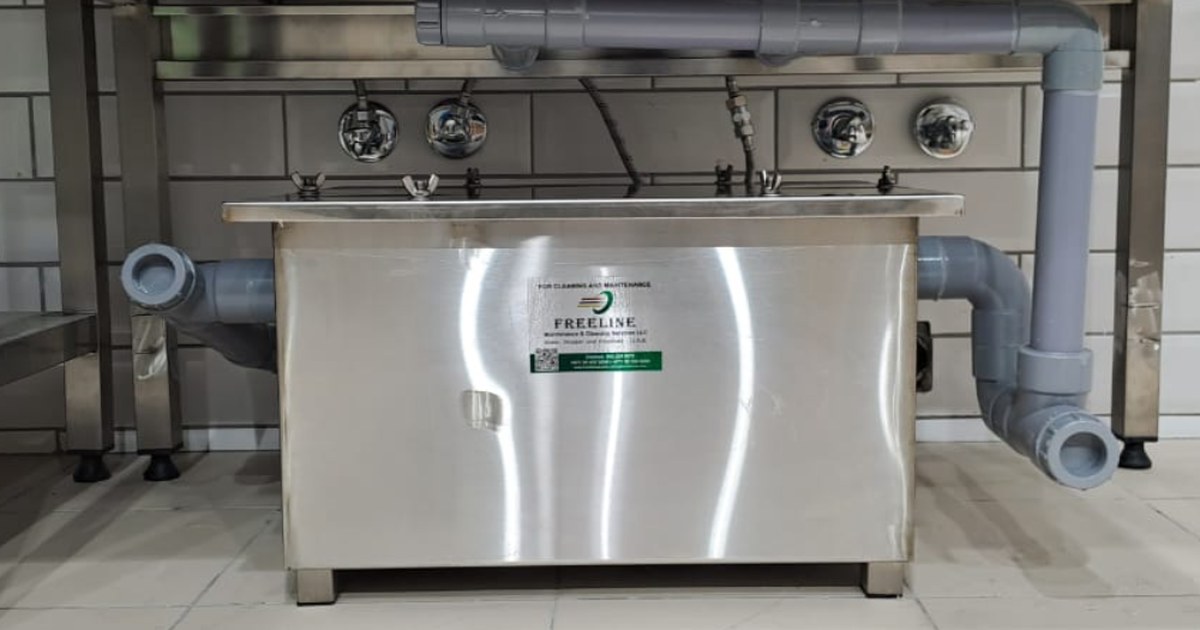
Grease trap cleaning services in Dubai exist because fats, oils and grease do not stay liquid once they leave a commercial kitchen. They cool, they solidify, and they coat the inside of the drainage network serving the whole building. This guide covers how a trap actually works, why sizing determines everything that follows, how often servicing is genuinely needed, what a proper service visit includes, and what a compliant record should contain when an inspector asks for it. For the scope Freeline works to, see how Freeline empties and services an interceptor.
Key Takeaways
- A grease trap is a settlement device, not a filter. It works by retention time, which is why an undersized trap cannot be fixed by cleaning it more often.
- Servicing frequency follows the trap’s capacity against the kitchen’s actual output. Waiting until the trap smells means it stopped working weeks earlier.
- The waste transfer documentation is as important as the cleaning. Where the collected FOG went, and who took it, is what an inspection will ask about.
How a Grease Trap Actually Works
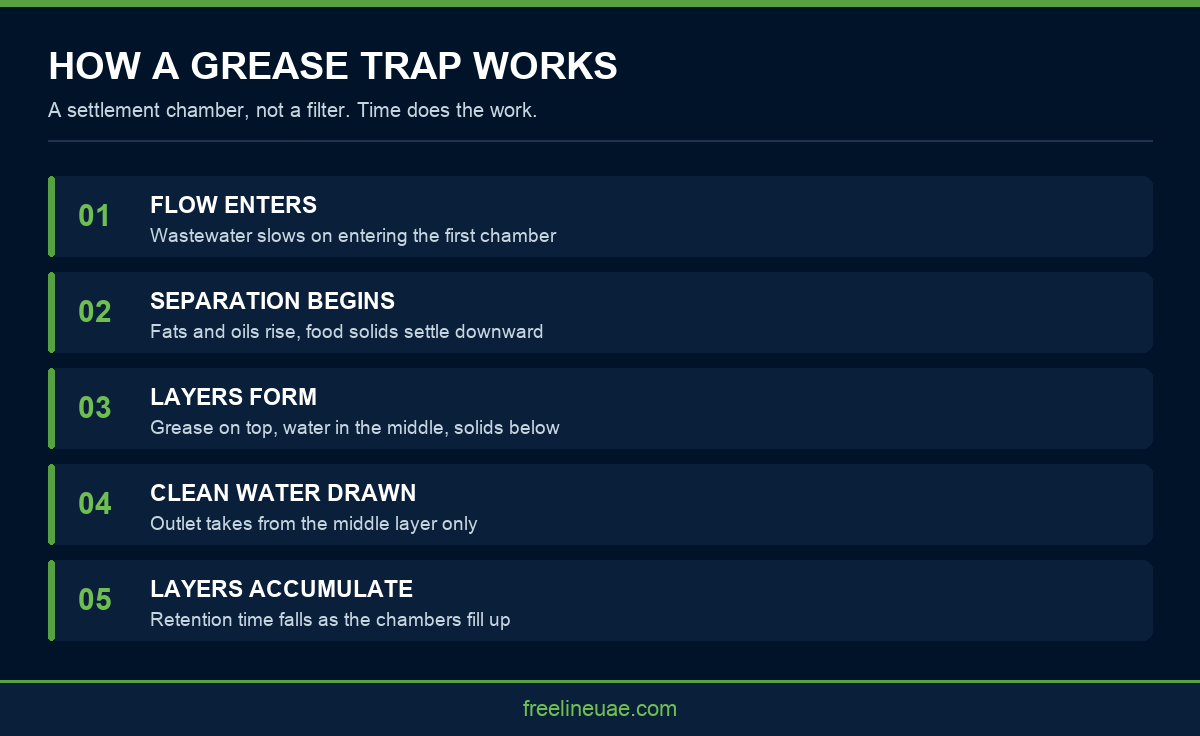
A grease trap is a chamber that slows wastewater down so that separation can occur. Fats, oils and grease are less dense than water and rise, food solids are denser and settle, and relatively clean water is drawn from the middle layer and passes on to the drain.
Grease trap cleaning services in Dubai are therefore buying back retention time rather than simply removing waste, which is the clearest way to understand what the service is actually for.
Everything about that description depends on time. Separation is not instant, so the chamber must hold the flow long enough for the layers to form. A trap that passes water through too quickly does not separate anything, regardless of how well maintained it is.
Nothing about the process is chemical either. A trap does not treat or digest anything, it simply holds material until somebody removes it, which is why the retained volume only ever grows between service visits.
This is why the device is a settlement chamber rather than a filter. Nothing is being strained out, and there is no element to replace. The trap simply provides a quiet volume in which physics can do the work, and its performance is set by how much quiet volume it offers.
The consequence for operators is important and frequently missed. If a trap is too small for the kitchen discharging into it, no cleaning schedule will make it effective, because the water is leaving before it has had time to separate.
Building drainage is where the cost eventually appears. Grease deposited along a sanitary sewer run narrows the bore progressively until flow fails, and clearing a mature deposit from a live drainage stack is far more disruptive and expensive than servicing the trap that should have caught it.
Grease that escapes the trap does not disappear. It cools further along the drain, adheres to the pipe wall and gradually reduces the bore, which is how a kitchen that never blocks internally still produces a building drainage failure two floors below.
Kitchen practice determines how much reaches the trap in the first place. Dry wiping, scraping to solid waste and separate collection of used oil reduce loading at source far more than any downstream intervention, and they cost nothing but discipline.
Temperature adds a UAE specific complication. Warm wastewater keeps grease mobile for longer, so it travels further before solidifying, and a trap running hot separates less effectively than the same trap handling cooler flow.
Understanding the mechanism is what makes the rest of this guide usable. Sizing, frequency, dosing and compliance all follow from the single fact that a grease trap buys time, and its value ends when the retained layer has filled the space that time depended on.
Why Sizing Determines Everything Else
Trap capacity should be calculated from the fixtures discharging into it, the flow those fixtures produce and the retention time required for separation. It is an engineering calculation rather than a matter of choosing whatever fits the available space.
In practice, space frequently wins. Traps are specified late, installed where there is room, and sized by what could be fitted through the door, which produces an undersized unit that then underperforms for the entire life of the premises.
Change of use is a common cause of a trap that was once adequate. A unit fitted out as a cafe and later converted to a grill kitchen inherits a trap sized for the original menu, and nothing in the fit out process usually revisits that decision.
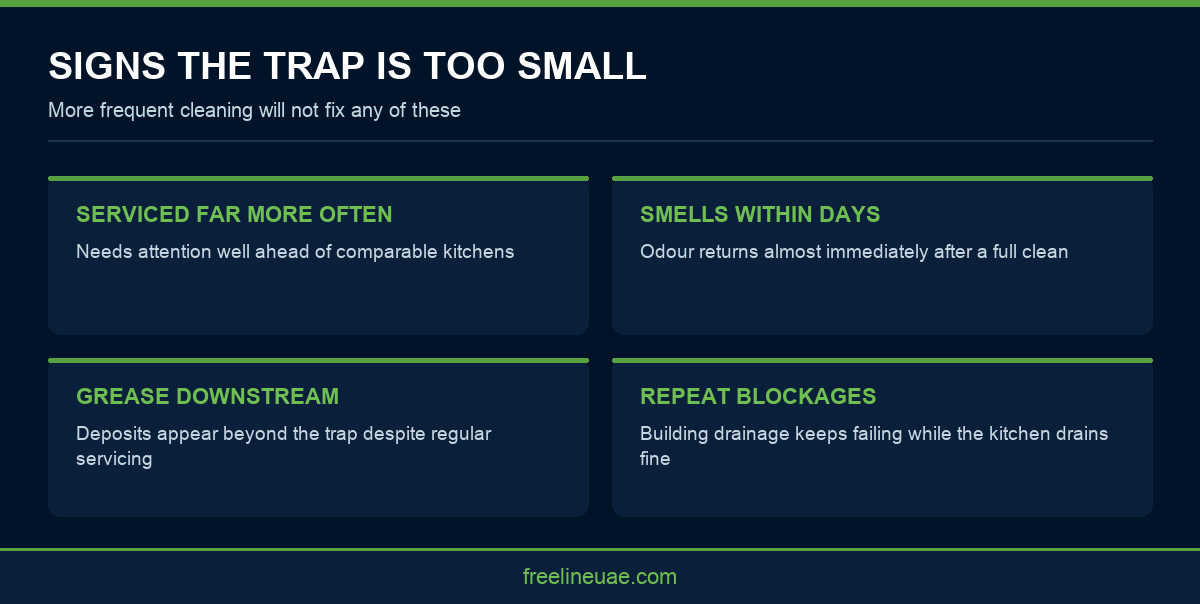
The symptoms of undersizing are distinctive. The trap needs servicing far more often than comparable kitchens, it smells within days of a clean, grease appears downstream despite regular maintenance, and blockages continue in the building drainage.
Operators usually respond by increasing cleaning frequency, which is a rational reaction that does not solve the problem. More frequent emptying of a trap that never had adequate retention time simply removes what little it caught, more often and at greater cost.
Retrofitting is easier than most operators assume. Where floor space genuinely does not exist, an external chamber or a unit sited outside the kitchen envelope is often achievable, and the cost compares favourably with years of excessive servicing and periodic drainage clearance.
The alternative responses are to replace the trap with a correctly sized unit, to add a second trap in series, or to reduce the load reaching it through better kitchen practice and dosing. All three are more effective than shortening the interval indefinitely.
Multiple kitchens sharing a single trap deserve separate mention. Food courts and hotel back of house areas frequently combine several outlets into one unit, and unless the sizing accounted for the combined peak flow the trap will be undersized from the day it opened.
Sizing also determines whether a passive trap is appropriate at all. Very high output kitchens sometimes justify an automatic grease recovery unit that skims continuously rather than retaining, and that decision belongs at design stage rather than after two years of complaints.
How Often a Grease Trap Needs Servicing
Dubai Municipality regulates FOG discharge from commercial premises and enforces requirements through inspection. Operators should confirm the servicing interval applicable to their specific premises and trap type directly with the authority or through their approved service provider, since requirements vary by installation.
Interval and capacity should be reviewed together at least annually. A trap that has needed servicing at a steadily shortening interval across a year is reporting a change in the kitchen, and that trend is worth acting on before it becomes a drainage failure.
Waiting for symptoms is the approach that fails inspections. Odour, slow drainage and visible grease at the outlet all indicate that the trap stopped separating effectively some time earlier, so by the time the kitchen notices, untreated FOG has been entering the drainage network for weeks.
Seasonal variation is worth allowing for. Kitchens serving tourist volumes, event venues and school catering all have periods of much higher output, and an interval set during a quiet month will be inadequate when trading returns to peak.
A measured interval is cheaper than a reactive one. Regular servicing at a defensible frequency costs less than emergency drainage clearance, and it produces the documentation that an inspection or an insurer will want to see.
The working rule
The widely used engineering guidance is that a trap should be serviced before the accumulated grease and solids occupy roughly a quarter of its total capacity, because retention time falls sharply beyond that point and separation efficiency collapses with it.
That rule is useful because it is measurable. A trap can be opened, the layers measured and the interval set from what is actually accumulating, rather than from a figure inherited from whoever serviced it previously.
What the interval depends on
Kitchen output is the main driver. A high volume frying and grilling operation fills a trap far faster than a bakery or a reheat kitchen, and two identical traps in adjacent units can require completely different schedules.
Trap capacity relative to that output is the other half. A generously sized trap on a moderate kitchen may run comfortably for a month or more, while an undersized trap on a busy kitchen can need attention weekly, which is itself the clearest evidence that it should be replaced.
What a Proper Service Visit Involves
The trap is opened, the accumulated grease layer and settled solids are removed in full, and the internal surfaces, baffles and crossover pipework are cleaned. Partial pumping that removes the liquid while leaving the hardened layers is the most common shortcut in this trade.
Sludge depth should be recorded rather than estimated. Measuring the solids and grease layers at each visit converts servicing from a fixed appointment into a managed interval, and it produces the evidence that justifies changing the frequency in either direction.
Baffles deserve particular attention because they create the flow path that makes separation work. A displaced, corroded or missing baffle turns a two chamber trap into a single chamber with a short circuit through it, and the unit stops working while appearing intact.
Inlet and outlet condition should be checked at every visit. Partial blockage at the outlet raises the water level and reduces the air space the trap needs, while a damaged inlet can allow flow to bypass the first chamber entirely.
Downstream inspection is worth including while access is open. Running a camera into the outlet drain after a full service shows whether grease has already built up beyond the trap, which is the difference between a contained problem and a building wide one.
The trap is then refilled with clean water before being returned to service. An empty trap does not separate, and returning a dry unit to a kitchen about to start service means the first hour of discharge passes straight through untreated.
Cover and frame condition is a safety item as much as a maintenance one. Grease trap covers sit in trafficked areas, they corrode, and a failed cover in a kitchen or service corridor is an immediate hazard rather than a future maintenance task.
Condition reporting should accompany the service. Corrosion, failed seals, damaged covers, cracked chambers and evidence of a chronically overloaded unit are all found during a proper clean, and none of them appear on an invoice that records only a pump out.
Finally, the collected waste must be removed by a licensed carrier and taken to an approved disposal point. This is the part of the job an operator never sees and the part an inspection is most likely to ask about.
Full removal versus partial pumping
The distinction that matters commercially is between emptying a trap and pumping it down. Full service removes the floating grease layer, the settled solids and the liquid in between, leaving the chamber clean. Partial pumping takes the liquid, which restores the water level and leaves both hardened layers in place.
The result looks identical from the kitchen. The lid goes back, the drain runs, and the invoice is the same shape, so the difference only becomes visible when the trap requires attention again far sooner than it should have.
Access, odour and timing
Grease trap servicing is unpleasant work in an occupied building, so timing and containment matter. Most visits happen outside service hours, with the route from the trap to the vehicle protected, because spillage on a kitchen or lobby floor becomes an immediate hygiene problem.
Trap location dictates much of this. Units in a basement plant room, under a kitchen floor or in an external chamber each present different access, hose routing and odour control requirements, and a provider should have raised all of that before quoting.
Dosing Systems and Reducing the Load
Biological dosing systems introduce measured quantities of bacteria and enzymes into the drainage line on a timed basis, so that a proportion of the FOG is broken down rather than accumulating in the trap and the pipework beyond it.
The realistic benefit is a reduction in loading rather than the elimination of servicing. A well configured dosing system typically extends the interval between pump outs and reduces downstream deposits, which is where much of its value actually sits.
Dose rate should be set against measured loading rather than sold as a standard package. A kitchen producing heavy fryer output needs a different regime from a cafe, and a single default rate will either waste product or achieve nothing measurable.
Product selection matters more than most suppliers admit. Biological products act on the FOG over time, whereas emulsifying chemicals appear to clear a line quickly by dispersing grease into the flow, which simply relocates the problem further down the drainage system.
That distinction is worth insisting on. An emulsifier passes the grease through the trap in suspension, so the trap looks cleaner, the kitchen drains better, and the building drainage receives everything the trap was installed to retain.
Used cooking oil should never reach the trap at all. It belongs in a separate collection arrangement, and where a kitchen is pouring waste oil to drain no trap and no dosing regime will keep up with the loading it creates.
Dosing works best alongside kitchen practice rather than instead of it. Dry wiping pans before washing, scraping plates to solid waste and never pouring used oil to drain remove FOG at source far more effectively than any product added downstream.
Where dosing is adopted, the equipment needs its own maintenance. Pumps fail, product runs out and timers drift, and a dosing unit that has been empty for two months is a line item on a maintenance contract rather than an active control.
Freeline supplies dosing systems and biochemical products through its biological dosing systems range, which allows the dosing regime to be matched to the trap and the kitchen rather than bought generically.
Compliance Records and Waste Transfer
The service visit is only half of what an inspection examines. The other half is what happened to the collected waste, which means the transfer documentation showing that a licensed carrier removed it and delivered it to an approved facility.
Landlords and mall operators increasingly ask for the same file. Where a unit sits within a managed development, the operator is often contractually required to evidence trap servicing to the landlord as well as to the authority, and one file serves both.
Operators are frequently surprised by this. The kitchen contracted for a clean trap, so the paperwork feels like the contractor’s concern, but responsibility for waste produced on the premises does not transfer simply because somebody drove it away.
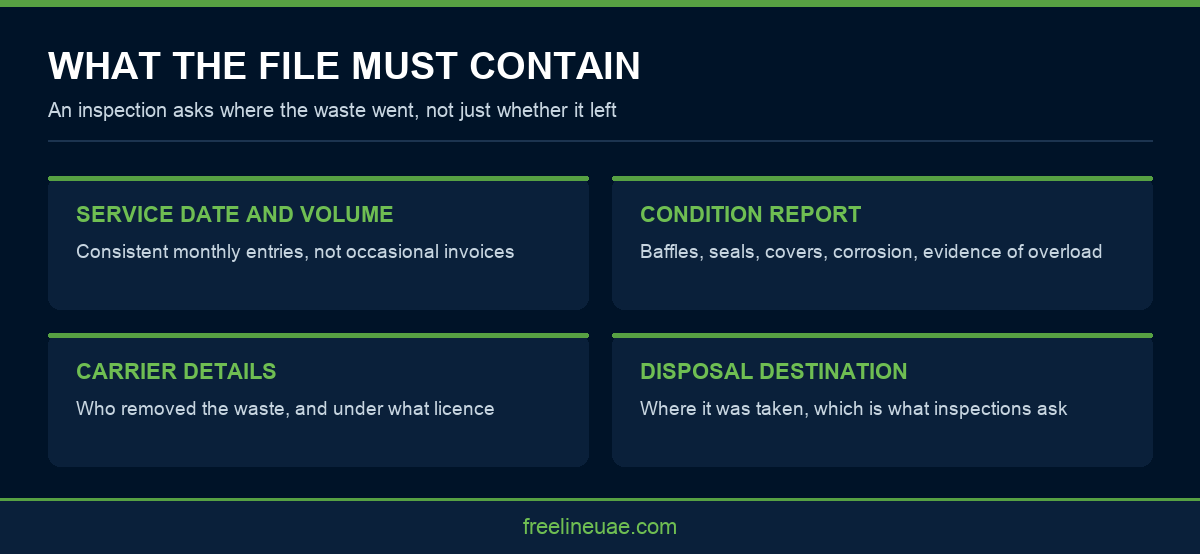
A defensible file contains the service date, the volume removed, the condition report, the carrier details and the disposal destination. Where dosing is in use, the product, the dose rate and the servicing of the dosing equipment belong in the same file.
Records also support the commercial conversation. Where a file shows a trap consistently filling faster than its capacity should allow, that evidence is what justifies replacement to a landlord or a finance team who would otherwise see only a recurring service cost.
Consistency matters as much as completeness. A file with twelve months of identical records demonstrates a maintained system, whereas a folder containing three invoices and a gap suggests either that the trap was neglected or that records were not kept, and an inspector cannot distinguish between the two.
Keep the grease trap file with the kitchen extract records rather than with general accounts. Both concern the same premises, both are examined during the same inspections, and both are needed after any drainage or fire incident.
Choosing a Grease Trap Supplier and Service Provider
Ask whether the provider also handles plumbing and drainage works, because the findings of a trap survey frequently include pipework problems that a pump out contractor is not equipped to correct.
Start by asking whether the provider can size a trap rather than only empty one. A company that calculates capacity from fixture flow is engaging with the actual problem, while one that quotes purely per visit is selling a recurring activity.
Comparing grease trap cleaning services in Dubai on price alone hides most of what separates providers, because the cheapest visit is usually the one that pumps the liquid and leaves both layers where they were.
Ask what the service includes in specific terms. Full removal of grease and solids rather than liquid only, cleaning of baffles and crossover pipework, an inlet and outlet check, refilling with clean water and a written condition report should all be named.
Ask how the collected waste management chain is documented month to month rather than only on request. A provider issuing transfer records automatically with each service is far easier to rely on than one who produces them when an inspection is already underway.
Ask who carries the waste and where it goes, and ask to see the transfer documentation format before appointing anyone. A provider who cannot describe this quickly is unlikely to produce it reliably every month afterwards.
Consider supply and service together where a trap needs replacing. Freeline supplies and installs traps through its interceptor supply and fitting range, which means sizing, installation and the subsequent servicing are handled by one party rather than three.
Finally, look at scope across the premises. Grease traps, kitchen extract and drainage are the same operational problem viewed from three angles, and a provider covering drain line clearing as well keeps the whole chain under one set of records.
Freeline has served UAE commercial kitchens since 2012 across Dubai, Sharjah and Abu Dhabi, covering trap supply, installation, servicing and dosing alongside its wider services.
Conclusion
Grease trap cleaning services in Dubai only work when the trap is correctly sized, serviced before it fills beyond the point where separation stops, cleaned in full rather than pumped down, and documented through to disposal. If your trap needs attention more often than comparable kitchens, or nobody can produce the waste transfer records for the last twelve months, contact Freeline for a survey covering trap sizing, the servicing regime and the condition of the drainage beyond it.
