Kitchen Duct Cleaning in Sharjah: A Restaurant Guide
Kitchen duct cleaning in Sharjah carries a complication that Dubai’s newer developments often avoid. A large share of Sharjah’s food and beverage outlets occupy older mixed use buildings, where extract risers were installed decades ago, serve several floors and are frequently shared between units. That arrangement changes the fire risk, the access problem and the question of who is actually responsible for the cleaning, and this guide covers all three in turn, along with what a first clean of an older system usually involves. For the scope Freeline works to, see how Freeline degreases a canopy and its ductwork.
Key Takeaways
- Shared and older risers are the defining issue in Sharjah. A single neglected unit loads a duct that runs past every other tenancy in the building.
- Responsibility for the riser is often unclear in older leases, and that ambiguity is why these sections go uncleaned for years.
- Access panels are usually missing in older installations, so a first clean normally includes creating them and recording their positions.
Why Older Sharjah Buildings Are Different
Extract systems installed decades ago were built to different expectations. Access panels were rarely provided along duct runs, joints were made to be permanent rather than openable, and the assumption that the interior would need periodic mechanical cleaning was simply not part of the design.
Duct routes in these buildings are also less direct. Systems have been extended, rerouted around later alterations and occasionally connected to serve units the original design never anticipated, which produces bends, dead sections and lengths that appear on no drawing anybody still holds.
Fire dampers are the other legacy issue. Where they exist in older risers they are frequently painted over, seized or missing entirely, and a damper that cannot close removes the compartmentation the building relied on when it was designed.
Material condition adds another layer. Older galvanised ductwork corrodes where grease and moisture sit together over long periods, and a section that has thinned can be damaged by the scraping a heavy deposit requires, so condition assessment has to precede aggressive cleaning.
The riser is where all of this concentrates. It is vertical, long, hard to reach, frequently has no openings at all, and in older buildings it often passes through occupied floors that have changed use several times since it was installed.
None of this makes the work impossible. It makes an internal survey essential before any quotation, because pricing a system nobody has looked inside is guesswork in a building of this age and generally produces a scope that stops at the hood.
Shared Risers and the Responsibility Gap
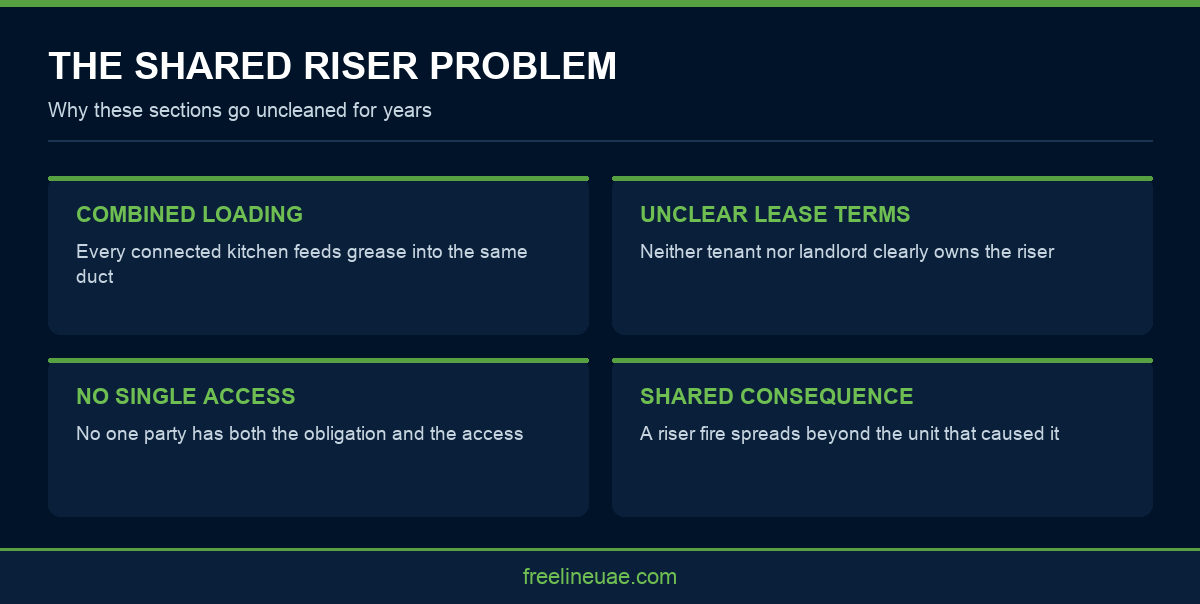
Many older Sharjah premises share an extract riser between multiple food outlets, or between a kitchen and other tenancies in the same stack. Grease from every connected unit accumulates in the same shared duct, and the fire load builds regardless of how well any individual kitchen maintains its own hood.
This creates a responsibility gap that leases frequently fail to close. The tenant maintains equipment within the demise, the landlord maintains common services, and the riser sits awkwardly between those definitions because it serves specific tenancies while running through common structure.
The practical result is that shared risers go uncleaned for years. Each operator reasonably believes the section beyond their ceiling belongs to someone else, and no single party has both the obligation and the access to arrange the work.
Insurance follows the same logic. A fire safety review after an incident will look at the whole extract route rather than at one tenancy, and records covering only the hood are unlikely to satisfy that examination.
The consequence falls on everyone connected to it. A fire originating in a shared riser spreads through the building rather than being contained within one tenancy, and an operator with excellent records for their own hood still occupies a building carrying that load.
The workable answer is a building level arrangement rather than unit level contracts. Where the landlord or association procures riser cleaning across the stack and recovers the cost, the work actually happens, the evidence sits in one file, and each operator retains responsibility only for their own hood and local ductwork.
How Often Cleaning Is Needed
Cooking type drives the interval far more than building age. Heavy grease operations including charcoal grilling, shawarma production and high volume frying can require attention every one to three months, while lower output kitchens run considerably longer.
Shared systems complicate the calculation because the duct sees combined output. A moderate kitchen connected to a riser that also serves two heavy grill operations is contributing to a duct that loads at the combined rate, not at its own.
Operating hours matter as much as menu. Outlets trading from early morning to late night run their extract for far more hours than a single service restaurant, and deposit accumulates against running time rather than against the calendar.
The reliable approach is deposit measurement rather than a fixed schedule. Where thickness is recorded at fixed points during each visit, the interval can be set from what is actually accumulating and adjusted as trading patterns change.
Menu changes should trigger a review rather than waiting for the next visit. An outlet that adds a grill or extends its frying volume has changed its loading rate, and an interval set before that change is no longer appropriate.
Certain findings override any schedule. Visible grease at an access point, deposits appearing at the discharge, a fan running noisily or any evidence of previous fire damage all warrant immediate inspection rather than waiting for the next planned visit.
Access, Evidence and What to Insist On
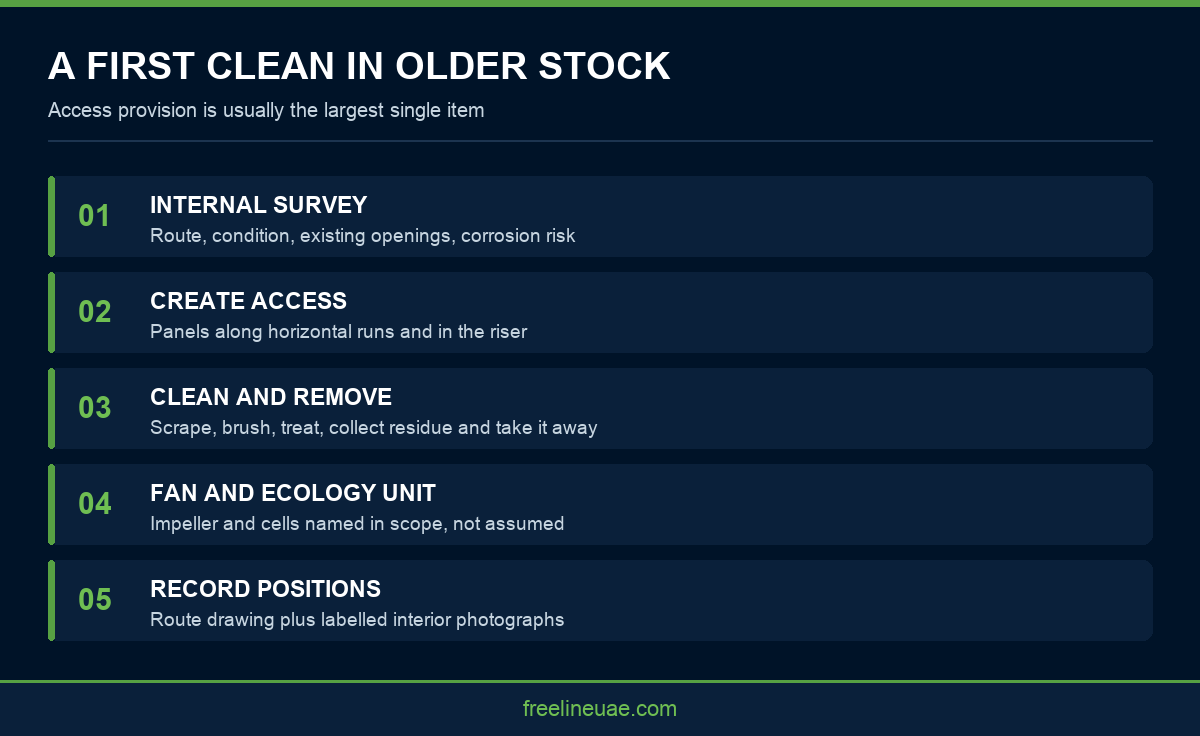
Access provision is normally the largest single item in a first clean of an older system. Panels have to be created at intervals along the horizontal runs and, critically, in the riser, and making good afterwards is part of the same job rather than an extra.
Recording panel positions turns a one off cost into a lasting asset. A simple duct route drawing marked with access points saves every future contractor from cutting new openings, and it immediately reveals any section that still has no access at all.
Evidence must come from inside the duct. Before and after photographs at each access point, labelled with location, are the only way an operator can confirm that the riser was reached rather than that the canopy was polished.
Airflow readings are worth taking at the same time. Recording extract volume before and after gives a number, and where it has fallen well below design the cause is usually the fan or a loaded electrostatic precipitator rather than the ductwork itself.
Deposit measurement adds an objective figure where loading is heavy, and across several visits it produces the trend that justifies the interval to a landlord, an insurer or an inspector who was not present for any of the work.
Finally, insist that the fan and any ecology unit are named in the scope. These are the components most often omitted in older buildings and the ones whose neglect produces roof deposits and complaints from neighbouring occupiers.
Choosing a Contractor in Sharjah
Ask how the riser will be cleaned before asking anything about price. The answer separates contractors immediately, because a considered approach to vertical access in an older building requires planning, equipment and a stated method for creating openings safely.
Ask what happens when the survey finds problems. Corroded duct sections, seized fire dampers, collapsed lengths and connections nobody knew existed are all normal discoveries in older stock, and a provider should describe how variations will be handled before work starts.
Ask about crew competency for confined and vertical work. Riser cleaning in older buildings involves height, restricted spaces and sometimes occupied floors, and a contractor without documented procedure will either avoid the riser or take risks inside your building.
Ask for an anonymised example report from a comparable building. A contractor experienced in older shared systems will produce location labelled interior images and a route drawing, rather than a folder of photographs of clean stainless steel.
Ask how the work fits around trading. Most kitchen extract cleaning happens overnight, the kitchen needs protecting beforehand and cleaning down afterwards, and in a shared building the access arrangements involve parties beyond your own tenancy.
Freeline has served UAE commercial kitchens since 2012 with a branch in Al Nahda serving Sharjah, covering hoods, ducts, risers, fans and interceptor servicing within its wider services.
Conclusion
Kitchen duct cleaning in Sharjah is mostly a question of reaching the parts of older systems that were never designed to be opened, and of resolving who is responsible for a shared riser. Insist on an internal survey, access panels with their positions recorded, interior photographs labelled by location, and a scope naming the fan and ecology unit. If nobody in your building can tell you when the riser was last cleaned, contact Freeline for an internal survey and a scoped proposal.
