HDPE Pipe Suppliers and Contractors in the UAE
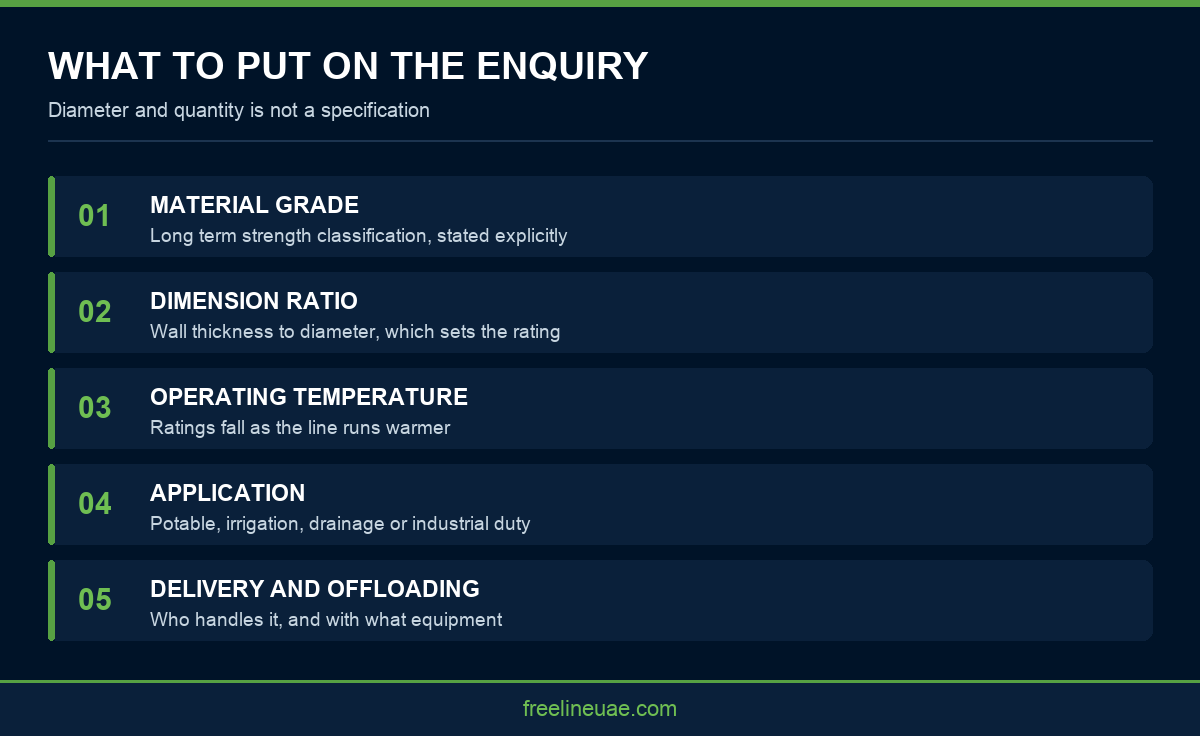
Enquiries to HDPE pipe suppliers in Dubai usually start with a diameter and a quantity, which is not enough information to price anything meaningfully. Grade, dimension ratio, operating temperature and application all change what should be supplied, and a quotation issued without them is comparing pipes that are not equivalent. This guide covers what to specify on the enquiry, what to ask an installing contractor, what documentation should arrive alongside the pipe, and how to read two quotations that appear to describe the same order. For the scope Freeline works to, see how Freeline fuses and lays polyethylene lines.
Key Takeaways
- A pipe quoted by diameter alone is unspecified. Grade and dimension ratio together determine the pressure rating, and both belong on the enquiry.
- Storage in direct sun degrades pipe before installation, so how a supplier stores stock is a legitimate question rather than an impertinent one.
- Fusion competency is what separates contractors. Recorded jointing parameters are the only evidence of build quality once a system is buried.
What Actually Needs Specifying
Material grade comes first. HDPE for pressure applications is classified by its long term strength, and the common designations describe materially different products despite looking similar on delivery, so the grade should appear on the enquiry rather than being assumed.
Dimension ratio is the second half of the specification and it is the one most often omitted. It relates wall thickness to outside diameter, and together with the grade it determines the pressure the pipe can carry at a reference temperature.
Quoting a diameter without the ratio therefore specifies almost nothing. Two pipes of identical outside diameter can have very different wall thicknesses and pressure capabilities, and the cheaper quotation is frequently the thinner pipe rather than the better price.
Operating temperature should be stated explicitly on the enquiry. Ratings are quoted at a reference temperature and fall as the line runs warmer, which matters in this climate for shallow buried runs and matters considerably for anything on the surface.
The underlying material is high density polyethylene in every case, but the grade determines how much stress it tolerates over decades, which is why two pipes that look identical on a delivery lorry can carry very different pressures safely.
Application belongs on the enquiry too. Potable water, irrigation, drainage and industrial duty carry different requirements for certification and sometimes for colour coding, and a supplier who does not ask is not engaging with the specification.
Certification and Traceability
Material certificates should accompany delivery rather than being requested afterwards. They confirm the grade and dimension ratio actually supplied, which is the only way to verify that what arrived matches what was ordered.
Potable applications carry an additional requirement. Pipe intended to convey drinking water should be certified as suitable for that use, and a supplier unable to produce evidence of it should not be supplying for that application.
Batch traceability matters more than most buyers realise. Where a fault later emerges, being able to identify the production batch distinguishes a material problem from an installation one, and without it that question cannot be settled.
Marking on the pipe itself is the practical check. Grade, dimension ratio, standard and production information are normally printed along the length, and comparing that marking against the delivery note takes moments and occasionally prevents an expensive mistake.
Colour coding is worth confirming at order stage. Different applications conventionally use different stripe colours in this region, and receiving correctly rated pipe in the wrong colour creates an argument on site that nobody wants during installation.
Keep the certificates with the project records. They form part of the handover package alongside fusion records and test certificates, and reconstructing them years later once a system is buried is effectively impossible.
How Stock Is Stored Before It Reaches You
Ultraviolet exposure is the single most avoidable cause of premature failure in this material, and it happens before installation rather than after it. Pipe stacked uncovered in UAE conditions degrades at the surface while looking entirely serviceable.
That makes supplier storage a legitimate line of enquiry. A yard that keeps stock covered and rotates it is protecting the product, and one that leaves pipe in open sun for months is selling material that has already begun its service life.
Stock age is worth asking about alongside storage. Pipe held for extended periods, even under cover, is not equivalent to recently manufactured material, and a supplier who cannot say how long a batch has been held is not tracking it.
The same applies to your own site. Material delivered in good condition and then stacked uncovered for the duration of a fit out arrives at installation in exactly the state the supplier’s yard was being criticised for.
Handling damage during offloading is the other storage related risk. Dragging pipe across rough ground scores the outer surface, and deep scoring reduces the effective wall thickness at exactly the point where the pipe is expected to hold pressure.
Covered storage costs almost nothing and eliminates the problem entirely. It remains among the most common causes of avoidable failure precisely because the damage is invisible and nobody connects it to a fault appearing several years later.
Choosing an Installing Contractor
Fusion competency is the question that matters most. Jointing is a controlled process with defined parameters, and the difference between a sound joint and a latent failure comes down to whether those parameters were observed and recorded on the day.
Ask whether fusion records are produced as standard rather than on request. A contractor logging heat, pressure and cooling time for each joint is demonstrating process control, and on a buried system those records are effectively the only evidence of build quality.
Ask how testing will be carried out. HDPE expands under pressure, so a test procedure without a stabilisation period will read that expansion as leakage, and a contractor unfamiliar with the material frequently condemns sound work.
Ask about leak location capability. Buried faults surface some distance from their source, and a contractor with location equipment of their own responds faster and excavates considerably less than one who subcontracts it after a problem arises.
Ask about programme and crew availability as well. Fusion work is sequential and weather dependent to a degree, and a contractor committing to a date without describing crew allocation is describing an intention rather than a plan.
Ask what documentation is handed over at completion. Fusion records, test certificates, as built drawings and material certificates should arrive together, because a buried system without records is significantly more expensive to own for the rest of its life.
Comparing Quotations Fairly
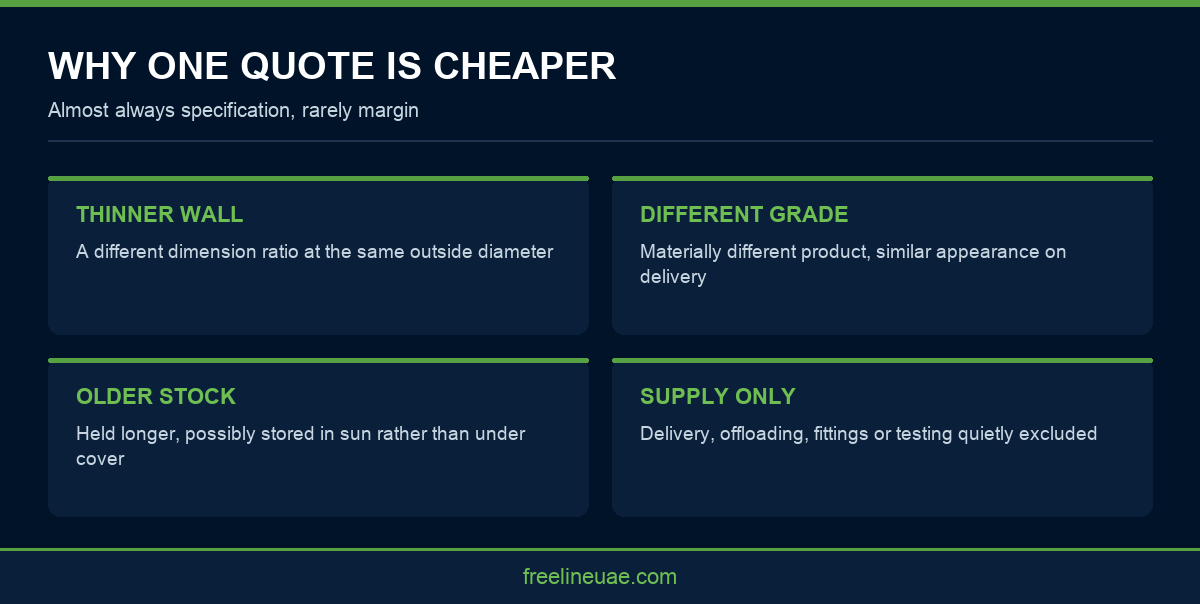
Price differences between suppliers usually reflect specification rather than margin. A quotation that is materially cheaper is frequently a thinner wall, a different grade, older stock, or a supply only price where the others included installation.
Reading for what is excluded is more useful than reading for what is offered. Delivery, offloading, fittings, transitions to other materials, testing and disinfection are all items that appear in some quotations and are silently absent from others.
Offloading deserves a specific mention because larger diameters are heavy and awkward. A delivery that leaves pipe on a service road because nobody arranged handling equipment becomes an immediate site problem that somebody has to pay to solve.
Fittings frequently carry a longer lead time than pipe. Where a project needs specific couplers, flange adaptors or transition fittings, establishing availability early avoids a programme delay caused by a component worth a fraction of the order value.
Where supply and installation come from the same party, responsibility is clearer if something later fails. Splitting them is often cheaper on paper and produces an argument about whether the material or the workmanship was at fault.
Freeline supplies and installs HDPE systems across Dubai, Sharjah and Abu Dhabi, covering fusion jointing, testing and the associated plumbing scopes within its wider services.
Conclusion
Sourcing from HDPE pipe suppliers in Dubai works when the enquiry states grade, dimension ratio, operating temperature and application, when certificates and traceability arrive with the delivery, and when the installing contractor records fusion parameters. A pipe quoted on diameter alone is not a specification, and the cheapest quotation is usually the thinner wall. Contact Freeline for a specification review, or for a combined supply and install proposal covering the whole system from material through to handover documentation.
