Preventing Blocked Drains in UAE Commercial Kitchens
Blocked drains in UAE commercial buildings almost always begin in a kitchen, and they almost never appear there. The kitchen drains perfectly while depositing material that fails a stack two floors below, which is why the occupier who experiences the backup is frequently not the one who caused it. This guide covers the mechanism, the source control that prevents it at no equipment cost, and why the grease trap is best understood as a drainage measure rather than a kitchen one. For the scope Freeline works to, see how Freeline clears a blocked line.
Key Takeaways
- Fats leave a kitchen warm and liquid, then cool and deposit along the run. The blockage forms where the material solidified, not where it originated.
- Source control beats downstream clearance. Dry wiping, scraping to solid waste and separate oil collection cost nothing and remove load before it enters the drain.
- A correctly sized and serviced grease trap protects the building drainage, which is the return that justifies it far more than kitchen hygiene does.
Why the Blockage Appears Somewhere Else
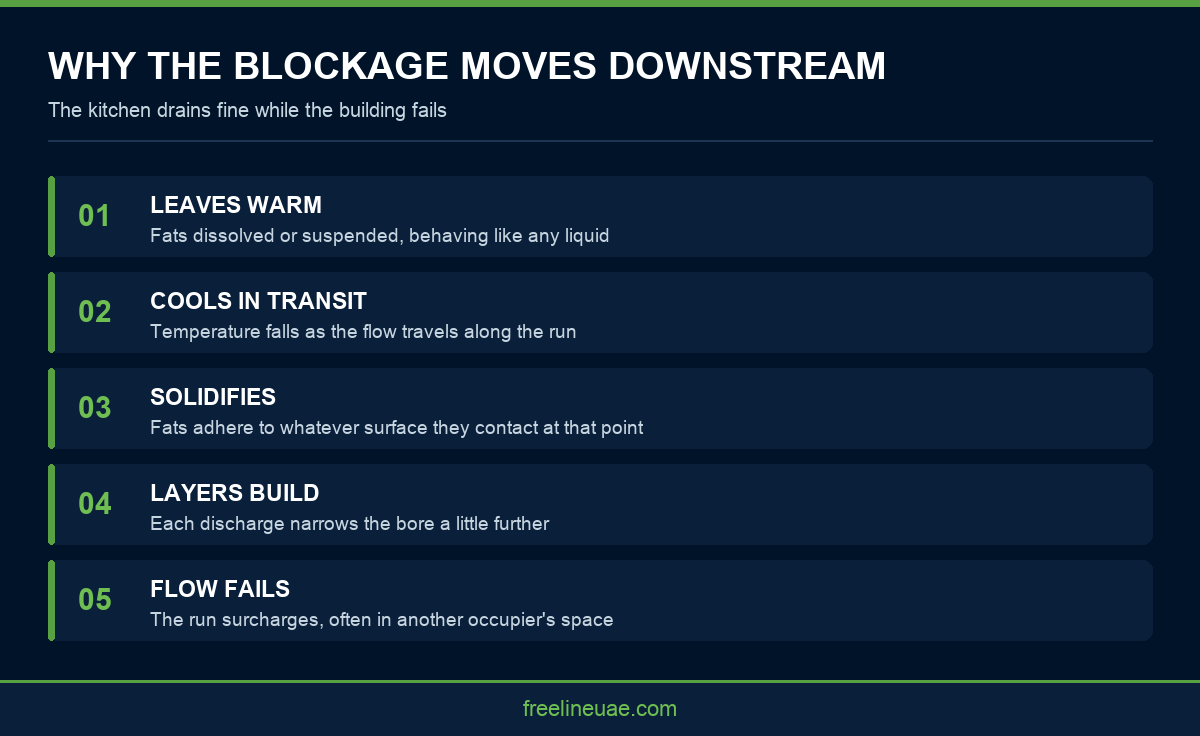
Fats, oils and grease leave a commercial kitchen dissolved or suspended in warm water. At that temperature they behave like any other liquid and pass through the kitchen drainage without any difficulty, which is why the kitchen itself rarely reports a problem.
Cooling changes their behaviour completely. As the water travels and loses heat, the fats reach a temperature at which they solidify, and they adhere to whatever surface they are in contact with at that moment, which is the inside of the pipe.
Each discharge adds a further layer. The deposit builds inward from the pipe wall over weeks and months, progressively narrowing the bore until the remaining channel can no longer carry peak flow and the run fails.
Where that happens depends on the temperature profile of the drainage rather than on the layout. A long horizontal run, a section passing through a cooler part of the building, or a change of gradient where flow slows will all encourage deposition at that point.
This is why building drainage failures are so often misattributed. The tenant who experiences the surcharge is downstream of the cause, and in mixed use buildings the parties involved frequently have no operational relationship with each other at all.
The same mechanism affects the wider sanitary sewer network beyond the building boundary, which is why authorities regulate what commercial kitchens may discharge rather than leaving it to individual operators to decide.
It also explains why clearing the blockage never solves anything for long. The clearance removes the deposit at one location while the source continues discharging exactly as before, so the same run reforms the same obstruction on the same schedule.
Source Control Costs Nothing and Works Best
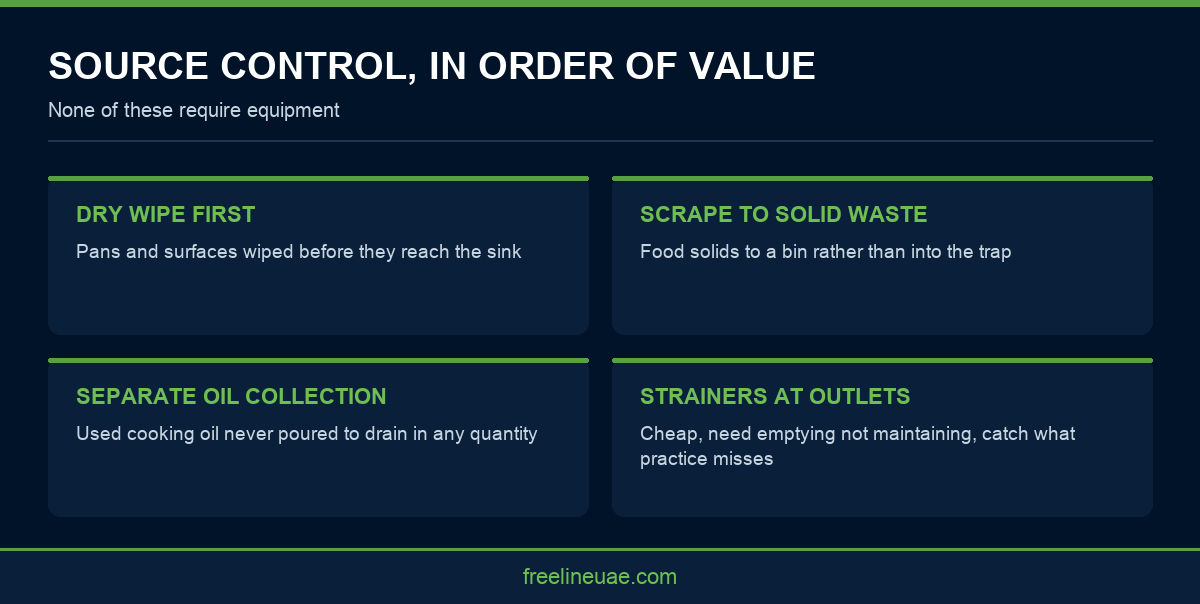
The cheapest intervention available is removing fats before they enter the drain at all, and it requires discipline rather than equipment. Dry wiping pans, trays and surfaces before they reach the sink takes seconds and removes the majority of residual grease.
Scraping plates and pans to solid waste is the same principle applied at a different point. Food solids that reach the drain either settle in the trap or travel onward, and both outcomes are worse than the material going into a bin.
Used cooking oil should never reach the drainage in any quantity. It belongs in a separate collection arrangement, and a kitchen pouring waste oil to drain will overwhelm any trap and any dosing regime regardless of how well either is specified.
Kitchen practice also affects what the grease trap has to cope with. A trap sized correctly for a disciplined kitchen will struggle in one where oil and solids routinely reach the drain, which is how a compliant installation ends up looking undersized.
Strainers and basket traps at sinks and floor gullies catch what practice misses. They are cheap, they need emptying rather than maintaining, and they prevent the solids that cause most immediate blockages from entering the system.
Water temperature is the detail nobody mentions. Very hot water carries fats further before they solidify, which moves the deposition point deeper into the building drainage where it is considerably harder and more expensive to reach.
Blocked drains in UAE kitchens are therefore a management problem as much as a technical one, because every effective control depends on a routine being followed rather than on equipment being installed.
None of this is technically demanding, which is precisely why it fails. Source control depends on kitchen routine surviving staff changes and busy services, so it works where it is written into procedure and quietly stops where it is not.
The Grease Trap Is a Drainage Measure
Operators generally think of a grease trap as a hygiene requirement, and it is genuinely more useful to think of it as protection for the drainage beyond it. Its entire purpose is to stop fats reaching pipework where they will cause an expensive failure.
That reframing changes how sizing is viewed. An undersized trap is not merely a compliance shortfall, it is a system that allows fats through to the building drainage every day, and the cost of that appears somewhere else on the maintenance budget.
It also changes how servicing is prioritised. A trap serviced late has stopped separating well before anybody notices odour, and during that period the drainage downstream is receiving material the trap was installed specifically to retain.
The link is straightforward to test. Where a building jets the same kitchen run repeatedly, the productive question is not how often it should be cleaned but what is reaching it, and the answer usually involves the grease trap upstream.
Laundries and staff canteens contribute to the same problem and are routinely overlooked. Both discharge warm water carrying fats, lint or detergent residues, and neither is usually considered when a building reviews what is loading its drainage.
Dosing supports this rather than replacing it. Biological dosing reduces the load reaching the trap and the drainage beyond, and its benefit is measured in longer intervals rather than in the elimination of either servicing or jetting.
When Cleaning Is Still Required
Prevention reduces frequency rather than removing the need entirely. Some material will always pass through, deposits will accumulate slowly even in a well managed system, and periodic cleaning of the kitchen drainage remains part of a sensible programme.
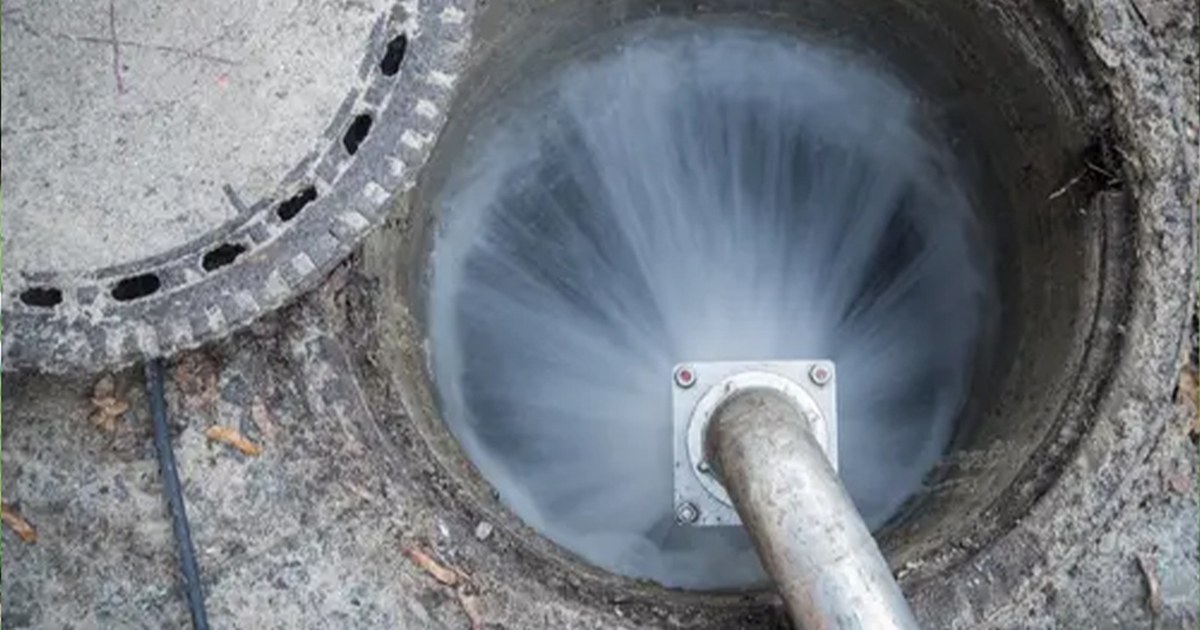
Jetting is the appropriate method for that work. It scours the full bore and flushes the released material back to an access point, whereas rodding opens a channel through the deposit and leaves the narrowed pipe substantially as it was.
The interval should follow what each visit actually finds. A run consistently found clear can be scheduled less often, and one heavily loaded at every visit is reporting either an inadequate interval or a source problem that jetting will never fix.
Repeat blockages at a fixed point mean something different. That pattern usually indicates a structural defect such as a displaced joint, a bellied section holding standing water or insufficient fall, and a camera survey is the cheaper next step.
Interceptors and floor gullies deserve their own attention. They accumulate solids that never reach the trap, and a blocked gully backs a kitchen up just as effectively as any failure further downstream does.
Records make the difference between a programme and a habit. Recording which runs were jetted, what condition they were in and what defects were observed is what allows the interval to be set on evidence and adjusted as circumstances change.
Building a Regime That Holds
The elements are simple enough individually. Source control in the kitchen, a correctly sized trap, servicing before it fills beyond the point where separation stops, dosing where it earns its place, and planned jetting of the runs that accumulate.
What makes it hold is ownership. Each element belongs to somebody specific, and regimes fail where kitchen practice is assumed to happen, trap servicing is arranged by whoever remembers, and jetting is called when something has already gone wrong.
Keeping the records together helps considerably. Trap servicing, dosing, jetting and any drainage survey all describe the same system, and a file holding all four allows a recurring problem to be diagnosed from documents rather than from a fresh investigation.
Preventing blocked drains in UAE premises is ultimately cheaper than clearing them, and the records are what demonstrate that to whoever approves the budget each year.
Reviewing the whole chain annually is usually enough. The question is whether the drainage is stable, deteriorating or improving, and whether the money is being spent at the source or on repeatedly clearing its consequences further downstream.
Freeline covers the whole chain across Dubai, Sharjah and Abu Dhabi, from grease trap supply and servicing through to jetting, drainage surveys and plumbing within its wider services.
Conclusion
Blocked drains in UAE commercial buildings are usually a kitchen problem expressed somewhere else in the building. Control fats at source, size and service the grease trap as a drainage measure rather than a hygiene box, jet the runs that accumulate on a schedule set from evidence, and survey anything that blocks repeatedly. If the same run keeps failing, contact Freeline for a survey covering the grease trap and the drainage beyond it as one connected system.
