Auto Dosing Grease Trap Systems: How They Work
An auto dosing grease trap system introduces measured quantities of biological product into the drainage line on a timer, so that a proportion of the fats and oils are broken down rather than accumulating. Used correctly it extends the interval between pump outs and reduces deposits downstream. Sold badly it becomes a monthly charge for a pump that stopped working eight months ago. This article covers the difference, how the rate should be set, and why these systems fail so quietly when nobody checks them. For the scope Freeline works to, see the dosing systems Freeline installs.
Key Takeaways
- Dosing reduces loading. It does not eliminate servicing, and any supplier suggesting otherwise is describing a product that does not exist.
- Biological products digest fats over time. Emulsifiers only disperse them, which moves the problem into the building drainage rather than solving it.
- The dose rate must be set against measured loading, and the equipment itself needs maintaining or the whole arrangement quietly stops working.
What an Auto Dosing System Actually Does
A dosing unit consists of a product reservoir, a metering pump and a timer, plumbed into the drainage line upstream of the grease trap or into the trap itself. At set intervals it injects a measured volume of biological product into the flow.
The product contains bacteria and enzymes selected to break down fats, oils and grease into simpler compounds. That process takes time, which is why dosing is normally scheduled for periods when the kitchen is closed and the drainage is quiet.
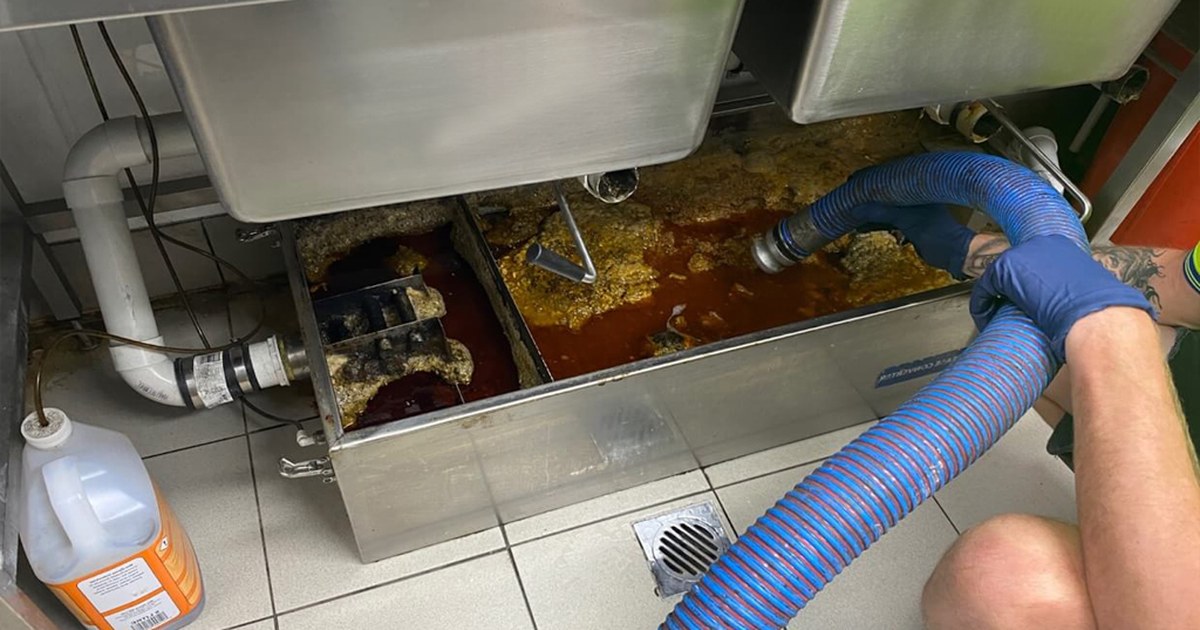
The practical effect is a reduction in how much intact grease reaches and accumulates in the trap. Less accumulation means the retained layer grows more slowly, and the interval before the trap needs emptying extends accordingly.
There is a second benefit further along the system. Grease that escapes any trap deposits in the drainage beyond it, and a dosing regime acting on the flow reduces the material available to form those downstream deposits.
The underlying chemistry is ordinary biology rather than anything exotic. The bacteria used are the same sort that break down organic matter in any sewage treatment process, applied at the point where the fats enter the system rather than at the end of it.
What it does not do is remove the need for servicing. Solids still settle, some grease still accumulates, and the trap still requires periodic emptying, inspection and a condition check. Dosing changes the frequency rather than the requirement.
Biological Products Versus Emulsifiers
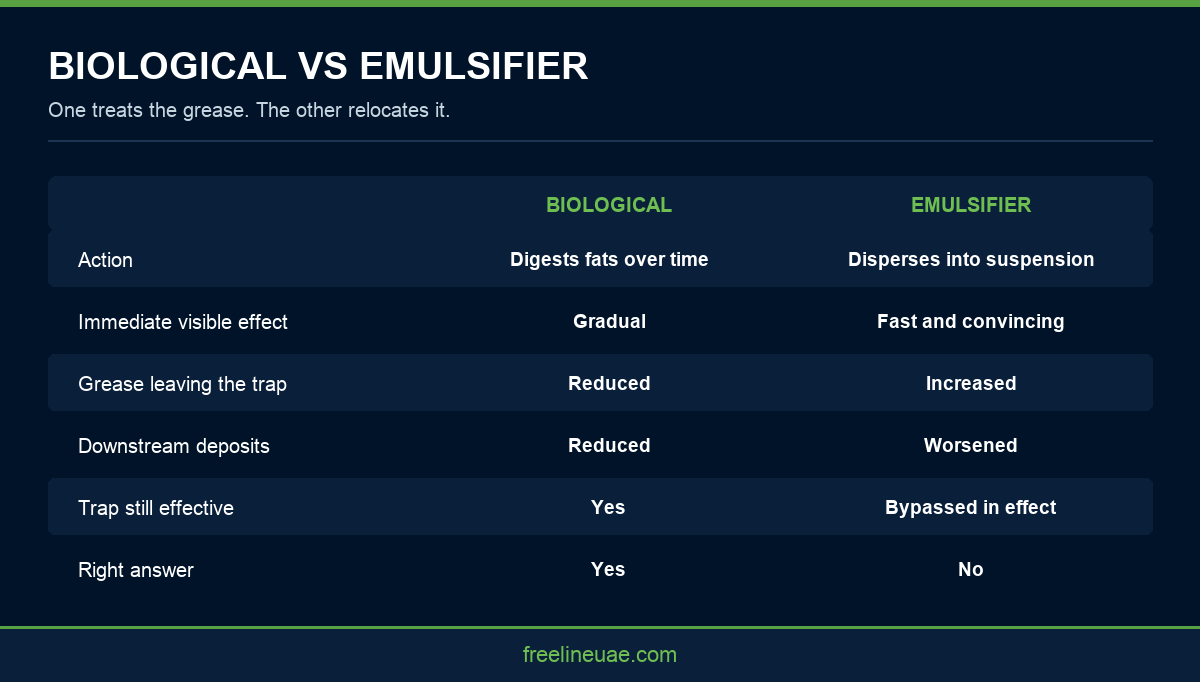
This is the distinction that matters most and the one most often blurred in sales conversations. Biological products digest fats over time, converting them into simpler compounds that pass through the system without reforming as deposits further along.
Emulsifiers work differently and produce a misleading result. They disperse grease into the water as fine droplets, so the flow carries it away in suspension, the trap appears cleaner and the kitchen drains noticeably better almost immediately.
The grease has not gone anywhere. It passes through the trap in suspension, precisely defeating the purpose of the device, and then cools and redeposits further along the drainage where it is considerably harder and more expensive to remove.
The immediate improvement is what makes emulsifiers persuasive. An operator with a slow drain sees the problem disappear within hours, which feels like a solution and is actually a transfer of the problem to a part of the system they cannot see.
Regulators take the same view for the same reason. Discharging emulsified fat, oil and grease into the public drainage is precisely what trap requirements exist to prevent, so a product that achieves it efficiently is not a compliance strategy.
The test is simple enough to apply. Ask whether the product digests fats or disperses them, and ask what happens to the grease afterwards. A supplier who cannot answer that clearly is selling a symptom fix rather than a treatment.
Setting the Dose Rate Properly
Dose rate should follow measured loading rather than a standard package. A kitchen running high volume fryers produces a very different demand from a cafe, and a single default rate will either waste product or achieve nothing observable.
The starting point is the trap servicing history. Where records show how quickly the retained layer has been accumulating, the dosing regime can be set to target a specific reduction and then adjusted once its effect on that rate becomes visible.
Timing matters as much as quantity. Product injected during service simply washes through with the flow, so dosing is normally scheduled overnight or during closure, when the drainage is quiet and the biological process has time to act.
The effect should be measured rather than assumed. If sludge and grease depth in the trap are recorded at each service, the accumulation rate before and after dosing began gives an objective answer about whether the arrangement is working.
Product storage matters in UAE conditions. Biological products contain live cultures with a finite shelf life, and a drum left in a hot yard through summer may deliver considerably less activity than its label suggests when it finally reaches the pump.
Adjustment should be expected. A dose rate set at installation reflects the kitchen as it was then, and menu changes, extended hours or a change of operator all alter the loading and should trigger a review of the rate.
Why Dosing Systems Quietly Fail
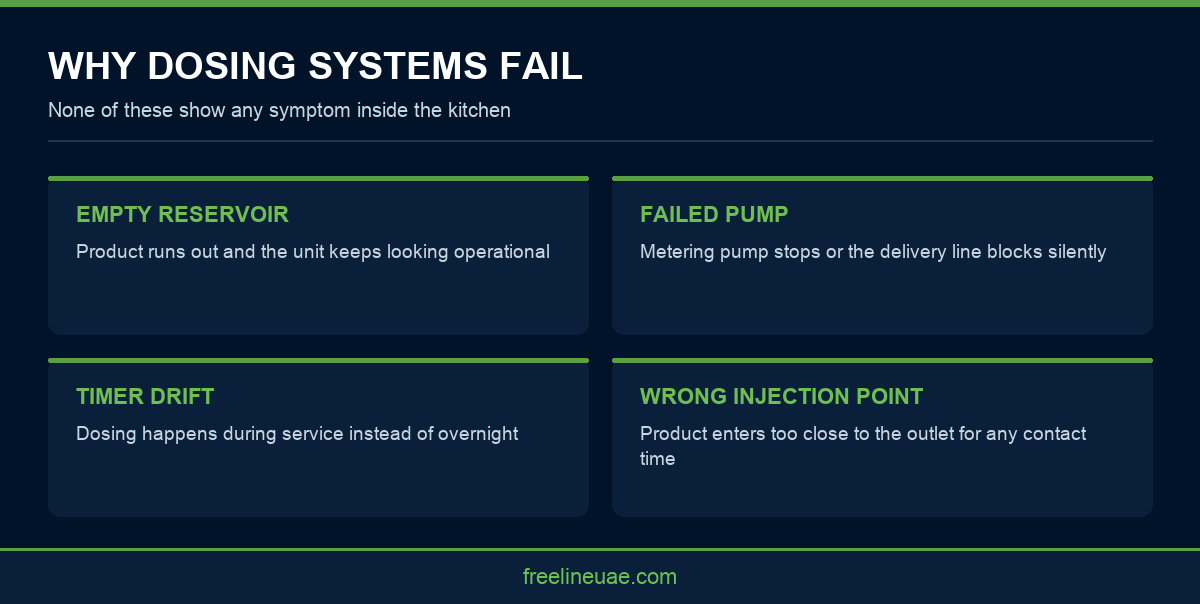
The most common failure is the simplest. The product reservoir empties, nobody notices, and the system continues to appear installed and operational while dosing nothing at all for months at a time.
Pump failure is the second, and it is equally invisible. A metering pump that has stopped, or a delivery line that has blocked, produces no symptom in the kitchen, so the fault persists until somebody physically checks the equipment.
Timer drift and power interruption account for a further share. A unit that has lost its schedule may dose at the wrong time, during service rather than overnight, which wastes the product without producing the intended effect.
Injection point problems are less obvious but equally consequential. A dosing line discharging into the wrong part of the system, or too close to the trap outlet, gives the product no contact time and therefore no opportunity to work.
A simple usage check catches most of it. Recording how much product has been consumed between visits shows immediately whether the unit is dosing at the intended rate, without anybody needing to dismantle the equipment to find out.
All of these are found by inspection and none by observation from the kitchen. A dosing arrangement needs a scheduled check of reservoir level, pump operation, line condition and timer settings, and that check belongs in the maintenance regime rather than being assumed.
Where Dosing Fits in a Wider Regime
Dosing works alongside kitchen practice rather than instead of it. Dry wiping pans before washing, scraping plates to solid waste and collecting used cooking oil separately remove fats at source, and no downstream product competes with removing the load before it enters the drain.
It also works alongside correct sizing rather than compensating for it. Where a trap is undersized, dosing may reduce the symptoms slightly, but the underlying problem is retention time and it will persist until the capacity itself changes.
Cost should be assessed across the whole regime rather than per litre. A dosing arrangement that genuinely extends the servicing interval and reduces downstream jetting usually pays for itself, and one that does neither is simply an additional line item.
The realistic proposition is a longer interval and cleaner downstream drainage, not the removal of servicing. Where a supplier presents dosing as a replacement for pump outs, the arrangement will fail an inspection that asks for waste transfer records.
Records should cover the dosing as well as the trap. Product used, dose rate, timing, and the servicing of the dosing equipment itself all belong in the same file as the grease trap servicing history and the waste transfer documentation.
Freeline supplies dosing systems and biochemical products through its dosing range, and sets the regime against the trap and the kitchen rather than selling a standard package, alongside its wider services.
Conclusion
An auto dosing grease trap system is a genuine improvement when the product digests rather than disperses, the rate is set against measured loading, the equipment is checked on a schedule and the trap is still serviced properly. It is a monthly charge for nothing when any of those four are missing. If you have a dosing unit and nobody has checked the reservoir this quarter, contact Freeline for an assessment of both the equipment and the regime behind it.
