Cloud Kitchen Ventilation Compliance in Dubai Explained
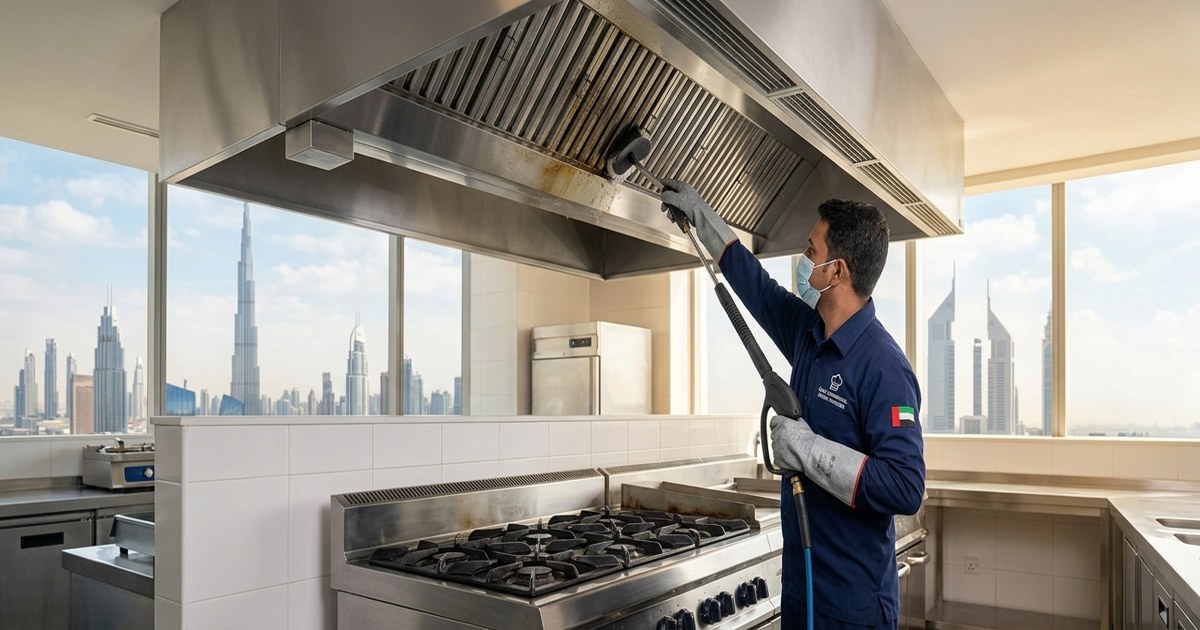
Cloud kitchen exhaust cleaning presents a problem that traditional restaurants rarely face. A dozen independent brands cook in adjoining bays, often sharing extract infrastructure, with short leases and no single party owning the system that connects them all. The cooking output is restaurant scale while the governance is closer to a serviced office, and that mismatch is where compliance quietly fails. This article covers how shared systems load, where responsibility should sit and what a workable regime looks like in practice. For the scope Freeline works to, see how Freeline degreases a canopy and its ductwork.
Key Takeaways
- Shared extract infrastructure means one heavy grill operator loads the duct that serves every other bay in the facility.
- Short licence terms discourage operators from funding cleaning of shared sections, so the work only happens if the facility operator arranges it centrally.
- Deposit accumulates against combined output, so intervals calculated from a single bay’s menu will always be too long.
Why Cloud Kitchens Are a Different Problem
A conventional restaurant owns its extract system from hood to discharge, maintains it, and carries both the risk and the records. Responsibility is untidy in older buildings but the principle is clear enough, and one operator has an obvious interest in the whole route.
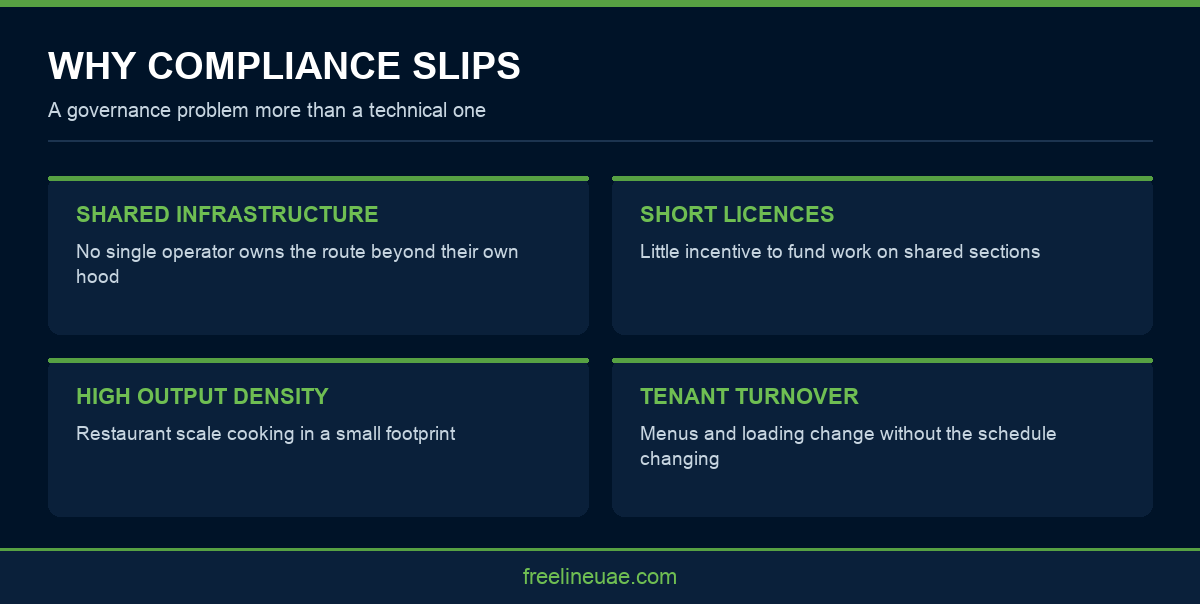
A cloud kitchen facility inverts that. Multiple brands occupy small production bays under short agreements, and the extract system is usually facility infrastructure rather than tenant equipment, so no individual operator has either the access or the incentive to maintain beyond their own hood.
Output density makes this consequential. These facilities concentrate a great deal of cooking into a small footprint, frequently with high grease methods such as frying and grilling, so the systems load faster than the floor area would suggest to anyone estimating from experience elsewhere.
Turnover of operators adds a further complication. Brands enter and leave, menus change without notice, and a bay that produced light output last quarter may now run a fryer through eighteen hours a day, which changes the loading rate of the shared duct immediately.
Fire safety considerations do not soften because the occupancy model changed. A loaded shared riser behaves exactly as it would in a conventional building, carrying fire away from the kitchen and through the structure, regardless of how the tenancies are arranged beneath it.
The net effect is a system carrying restaurant scale fire load with none of the ownership that normally drives restaurant scale maintenance. That gap is the actual subject of this article, and it is a governance problem more than a technical one.
Shared Extracts and Combined Loading
Where several bays discharge into a common duct or riser, the deposit in that shared section reflects the sum of everything connected to it. A diligent operator with a light menu still occupies a facility whose shared duct is loaded by the heaviest user.
This makes individual scheduling unreliable. An interval calculated from one bay’s output will be too long for the shared section, because that section is accumulating at the combined rate of every kitchen feeding into it.
It also makes individual diligence insufficient. An operator can clean their own hood and local ductwork meticulously and still be exposed to a fire originating in a shared riser they have no access to and no contractual responsibility for.
The workable model is central procurement. The facility operator arranges cleaning of all shared infrastructure on a single schedule, recovers the cost through service charges, and each brand retains responsibility only for equipment inside its own bay.
Insurance sits behind the same argument. A claim following an incident will examine maintenance of the whole extract route, and a facility able to produce one coherent file covering shared infrastructure is in a considerably stronger position than a collection of partial tenant records.
That model also solves the records problem. One file covering the whole facility is more useful to an inspector, an insurer and an incoming operator than a dozen partial files held by brands who may no longer be trading at the site.
Setting a Realistic Interval
Cooking method drives deposit rate, and cloud kitchens skew toward the methods that produce the most. Frying, grilling and high volume production are common because the delivery model favours them, so intervals should start shorter than a mixed menu restaurant would need.
Operating hours compound it. Delivery kitchens frequently trade far longer than a conventional service pattern, sometimes close to continuously, and deposit accumulates against running time rather than against the calendar an annual contract was written on.
Because the tenant mix changes, the interval needs reviewing rather than fixing. A facility that sets a schedule at opening and never revisits it will be wrong within a year, usually in the direction of under servicing as heavier operators move in.
Deposit measurement is the honest way to manage this. Recording thickness at fixed points in the shared duct at each visit gives an accumulation rate that reflects whoever is actually trading, rather than an assumption based on the original tenant list.
Filter discipline inside each bay changes the shared loading more than operators realise. Where filters are washed properly and often, less grease passes into the shared duct, and a facility that enforces a filter regime slows accumulation across the whole system.
Certain findings should trigger immediate attention regardless of schedule. Grease visible at an access point, deposits appearing at the discharge, a fan running noisily or any complaint from neighbouring occupiers all indicate the system has moved beyond its interval.
Splitting Responsibility Clearly
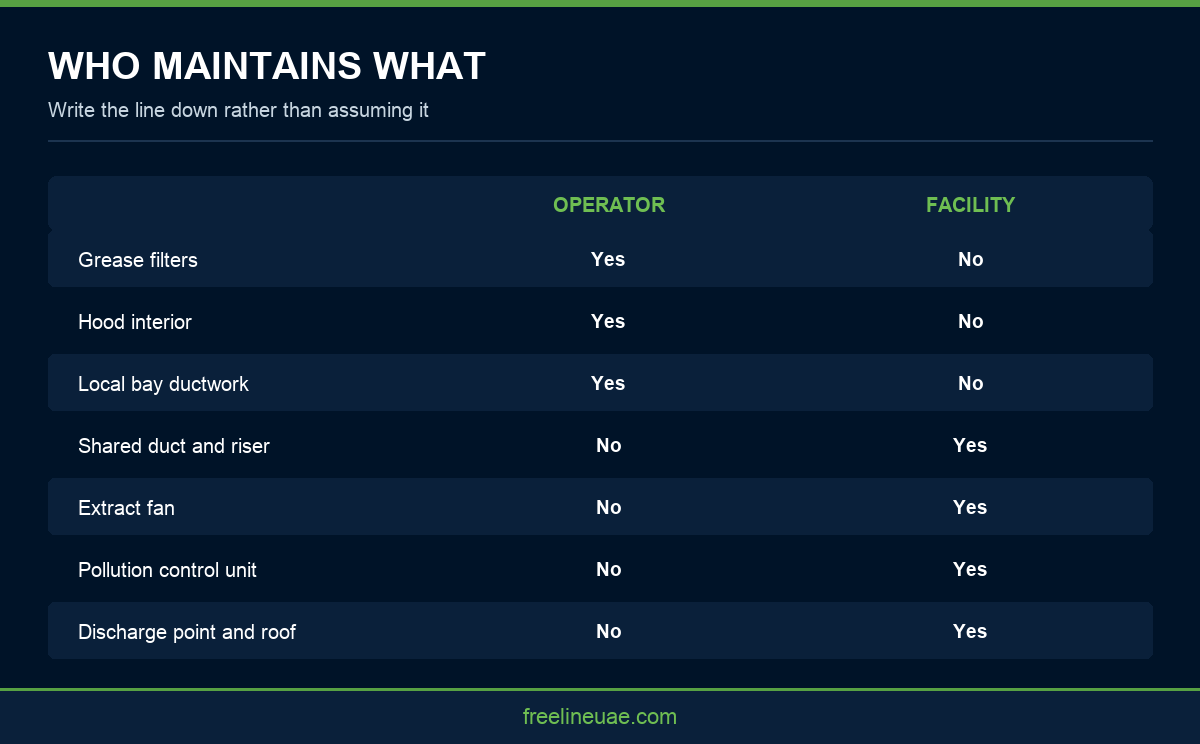
The licence or agreement should state plainly which components the operator maintains and which the facility maintains. In practice the sensible line falls at the point where the bay’s local ductwork joins shared infrastructure, though it needs writing down rather than assuming.
Operator responsibilities typically cover filters, the hood interior and local ductwork within the bay. These are accessible, they relate directly to that kitchen’s output, and they can reasonably be inspected at handover between successive occupants.
Facility responsibilities cover the shared duct, the riser, the extract fan, any pollution control unit and the discharge point. These require access across the building, they serve multiple parties, and no individual operator can arrange work on them.
Make up air belongs in the facility column too. Dense production bays extract a great deal of air, and where the supply cannot replace it the ventilation goes into deficit, hoods stop capturing properly and grease escapes into the space rather than the duct.
Handover between operators is the moment most often missed. When a brand leaves, the condition of the bay’s local ductwork should be recorded, so that an incoming operator inherits a known position rather than the accumulated output of a predecessor they never met.
Where the facility also provides drainage and grease trap servicing, the same split applies and the same file should hold both. Cloud kitchen facilities generate concentrated FOG loading for exactly the reasons they generate concentrated grease deposits.
What Facility Operators Should Insist On
Insist on access provision across the shared route as a first priority. Many facilities are fitted out quickly and cheaply, and extract ductwork installed without access panels cannot be maintained afterwards without cutting them in later at greater cost.
Insist on evidence indexed to a route drawing. In a facility with several bays and a complex shared route, untitled photographs are meaningless, whereas images tied to identified access points demonstrate which sections were actually reached.
Insist on the fan and any pollution control unit being named in scope. These are the components whose neglect produces roof deposits and neighbour complaints, and in a dense facility with nearby occupancies those complaints arrive quickly.
Insist on scheduling that reflects trading rather than office hours. Delivery kitchens often peak late into the night, so the quiet window for cleaning may be mid morning rather than overnight, and a contractor unfamiliar with the model will assume otherwise.
Insist on a documented review point. Because the tenant mix changes, the schedule should be reassessed at a stated interval against measured deposit, rather than rolling forward unchanged from whatever was agreed when the facility first opened.
Freeline works with UAE commercial kitchen facilities across Dubai, Sharjah and Abu Dhabi, covering shared extract systems, fans, pollution control units and drain line clearing within its wider services.
Conclusion
Cloud kitchen exhaust cleaning fails on governance rather than on technique. Shared extract systems accumulate at the combined rate of everyone connected to them, short licences discourage operators from funding shared work, and tenant turnover keeps changing the loading. Central procurement by the facility, a clear split of responsibility, access provision throughout and measured intervals are what make it work. Contact Freeline to survey a shared extract system and establish a measured interval for the facility as a whole.
