Choosing the Best Water Tank Cleaning Company in Dubai
Finding the best water tank cleaning company in Dubai is harder than it should be, because the finished work is invisible. Every provider leaves behind a tank that looks clean and a certificate that says so. The difference between a thorough job and a rinse only becomes apparent in a laboratory result, or six months later when the same complaints return. These are the checks that separate them before you sign anything, covering approval, method, verification and how to read a quotation properly. For the scope Freeline works to, see how Freeline sanitises a stored water system.
Key Takeaways
- Approval status and an accredited laboratory relationship are the two qualifications that are not negotiable. Everything else is preference.
- A method statement issued before the work, naming concentration, contact time and sample points, is the clearest evidence of a real procedure.
- Compare quotations line by line rather than on the total. The cheapest tender usually differs on laboratory testing or on pipework scope.
Start With Approval and Licensing
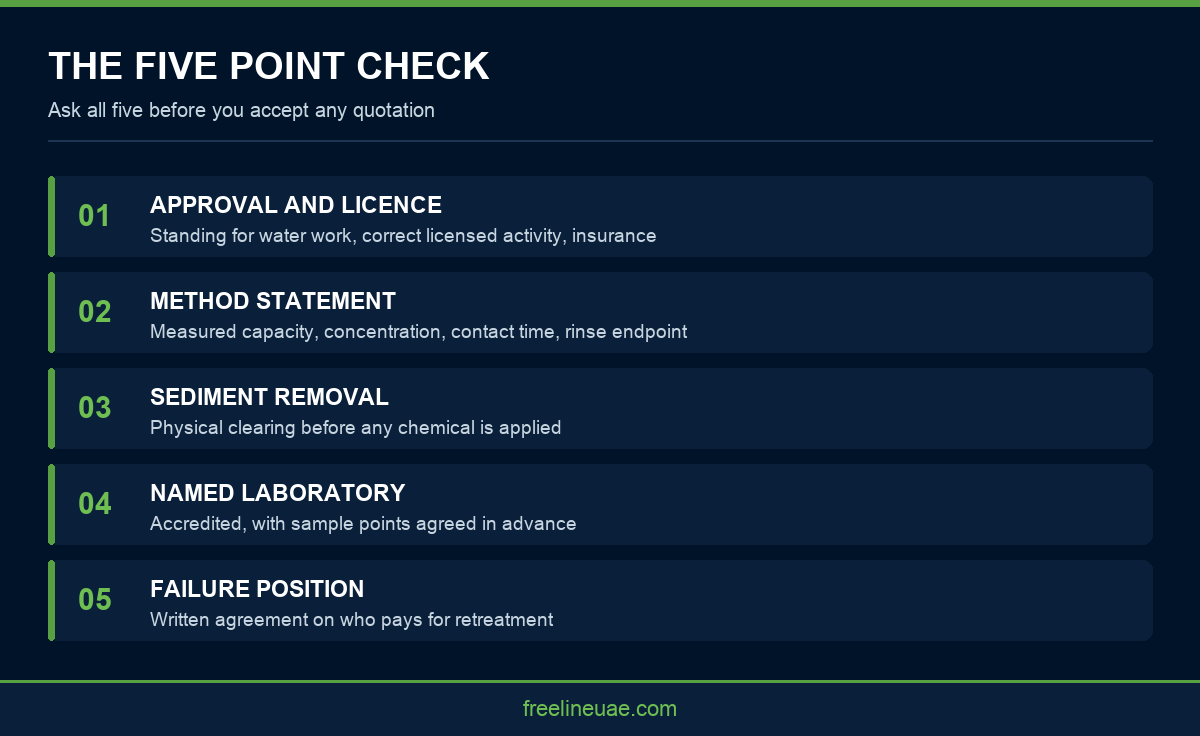
Water related work in Dubai is overseen by Dubai Municipality, and any company operating on potable water systems should be able to evidence its standing immediately. A provider who needs several days to locate documentation is telling you how frequently that documentation is requested.
Trade licence scope deserves the same scrutiny as approval. A general cleaning licence does not automatically extend to potable water tank cleaning and disinfection, and a mismatch between the licensed activity and the work performed causes difficulty later if a consultant, insurer or purchaser reviews the file.
Insurance is the item owners consistently forget. Work inside a live building water system carries risks of contamination, chemical handling incidents and interrupted supply. Confirming that cover exists and specifically extends to this activity takes one email and prevents an expensive conversation after something goes wrong.
Experience specific to water systems is worth separating from experience in maintenance generally. Tank work sits at the intersection of cleaning, chemistry and documentation, and competence in one of those three does not imply competence across all of them, which is why the questions below focus on method rather than on years in business.
Confined space competency belongs in the same conversation. Entering a water tank is confined space work with genuine hazards, and a contractor without documented procedure for it is exposing your building alongside their own crew. Asking to see that procedure reveals a great deal about how a company operates day to day.
Ask for the Method Before the Price
A serious provider issues a method statement before the work rather than an invoice afterwards. It should state tank capacity, the target disinfectant concentration, the intended contact period, the rinse endpoint, the sample locations and the criterion that constitutes a pass.
The capacity figure is the most revealing entry on that document. It requires somebody to have visited and measured, and it determines the chemical quantity. A method statement without it means the dose was estimated rather than calculated, and estimates in this context are almost always underdoses.
Concentration should be stated as a figure rather than described as appropriate or sufficient. A provider comfortable with the chemistry will give a number and explain how it relates to tank volume and to the water quality condition found on arrival, since demand varies considerably between buildings.
Ask specifically what happens to sediment. Sludge on a tank floor consumes disinfectant and shelters organisms beneath it, so physical removal must precede any chemical application. A provider who describes dosing without describing sediment removal has skipped the stage that determines whether the rest works.
The rinse endpoint is the other detail worth pressing. It should be defined by measurement, meaning the tank is refilled once residual has returned to normal supply levels, rather than by elapsed time or by smell. Vague answers here usually indicate the step is rushed in practice.
Check How the Result Gets Proved
Verification is the point at which the market separates most clearly. Ask which laboratory will analyse the samples, whether it is accredited, how many sample sets will be taken and at which outlets. An established relationship produces specific answers without hesitation.
Sample locations should be named in advance rather than chosen on the day. Selecting them after treatment allows the party who performed the work to pick the outlets most likely to pass, which quietly defeats the purpose of independent verification and is impossible to detect afterwards.
Ask what the analysis covers as well as who performs it. Standard bacteriological testing looks for indicator organisms such as coliform bacteria, and a provider should be able to explain what a result means rather than simply forwarding a laboratory sheet to the client.
Two consecutive sample sets taken at an interval are considerably stronger than a single set. One clear result can reflect a favourable outlet or residual disinfectant still present in the bottle, whereas consistent results across identified points describe the system rather than one fortunate moment.
Ask directly what happens if a result fails. A company that does this work regularly will answer without pausing and will already hold a position on who bears the cost of redosing and retesting. A provider treating the question as hypothetical has probably not been tested by one.
Compare Quotations on Scope, Not Total
Pricing varies with tank count and capacity, access difficulty, whether work runs out of hours and whether laboratory analysis is included. Those four variables explain nearly every price gap in a tender, and not one of them is visible in the total at the bottom of the page.
Read the exclusions rather than the inclusions. A quotation covering storage in detail but silent on distribution pipework has addressed half the system at full price, and the untreated half will recontaminate the treated half within days of the building returning to normal use.
Check whether repeat treatment is priced. On older systems a first pass failure is common enough that its commercial treatment should be written down in advance. A quotation that stays silent has not removed that risk from the project, it has simply left it sitting with the building owner.
Consider what else the provider carries. Where tank work sits alongside plumbing and broader building upkeep, one party holds the history for the whole system, which makes a future marginal result interpretable rather than the start of a fresh investigation.
Warning Signs Worth Acting On
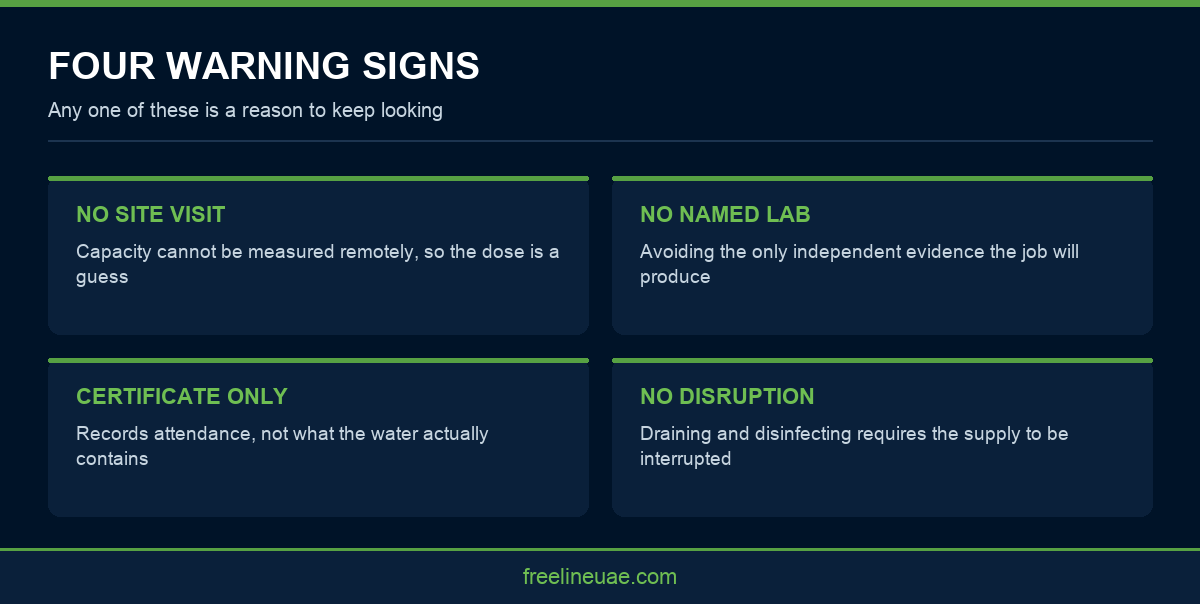
A quotation produced without a site visit is the clearest signal. Tank capacity cannot be established remotely, so a price generated from a phone call is a price for attendance rather than for a defined and calculable piece of work.
Reluctance to name a laboratory is the second. Independent analysis is the only part of the process that is not self reported by the contractor, so a provider steering away from it is steering away from the only objective evidence the job will produce.
A certificate presented as the deliverable is the third. A contractor certificate records that a visit took place. Laboratory analysis records what the water actually contains. Any provider treating those two documents as equivalent is selling paperwork rather than an outcome.
Pressure to sign quickly is a further signal. Tank cleaning is rarely a genuine emergency outside a failed water test, so manufactured urgency usually protects a price from comparison rather than protecting the building from any real risk.
Finally, be cautious of anyone promising no disruption. Cleaning requires the tank to be drained and the supply interrupted for a period, and a provider guaranteeing uninterrupted water has either not understood the request or is planning to compress the stages that make the work effective.
Conclusion
The best water tank cleaning company in Dubai is the one that welcomes these questions, because answering them is how a competent provider distinguishes itself from a cheaper one. Ask for evidence of approval, a method statement with a measured tank capacity, a named accredited laboratory, a scope covering pipework as well as storage, and a written position on retesting. Freeline has delivered water system services across Dubai, Sharjah and Abu Dhabi since 2012. Contact the team for a survey.
