Water Tank Cleaning Services in Sharjah: A Practical Guide
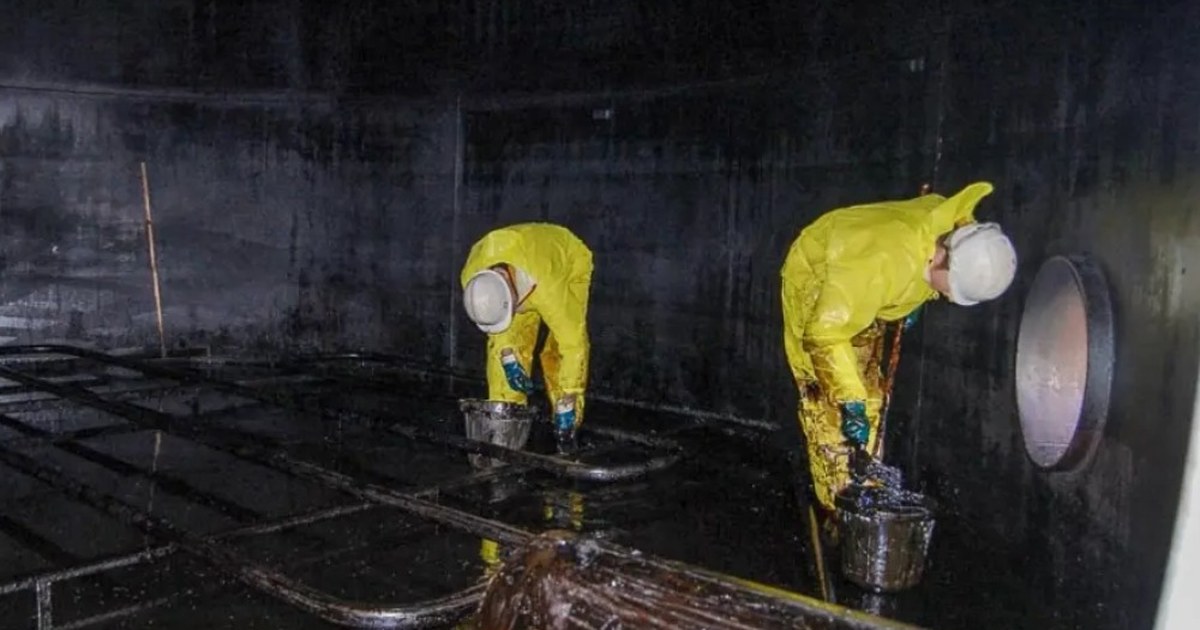
Water tank cleaning services in Sharjah face the same underlying problem as anywhere else in the UAE, namely stored water sitting warm for days before anybody uses it. What differs is the building stock. Sharjah carries a high proportion of older residential blocks, villa compounds and shared accommodation, and those buildings tend to have longer service histories, more alterations and less complete documentation. This guide covers what that means in practice, from setting a cleaning interval to verifying the result and choosing a contractor for an older property. For the scope Freeline works to, see how Freeline sanitises a stored water system.
Key Takeaways
- The method is identical across the emirates. What changes in Sharjah is building age, alteration history and how much system documentation actually exists.
- Older buildings carry more sediment, rougher tank surfaces and more undocumented pipework, so surveys matter more and first pass failures are more common.
- Shared accommodation and villa compounds combine high occupancy with limited oversight, which makes a recorded cleaning cycle more valuable than an informal one.
Why Sharjah Buildings Need Their Own Assessment
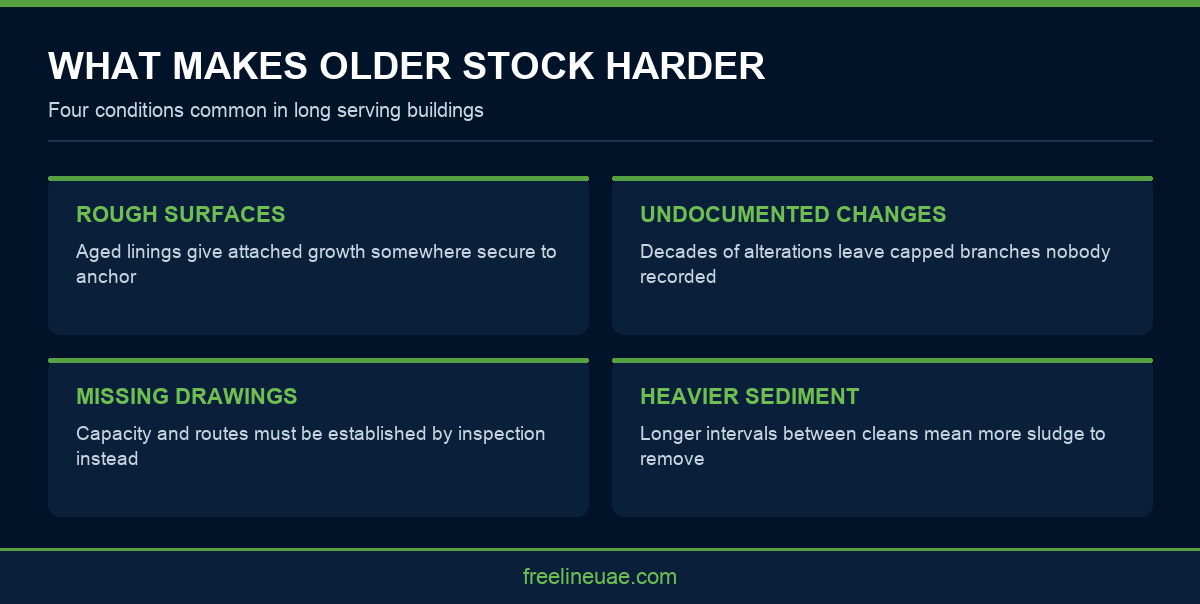
A large share of Sharjah’s residential stock has been in service for decades, and tanks age in ways that affect cleaning directly. Internal surfaces roughen, linings fail in patches, and hairline cracking develops around fittings and seams, all of which give attached growth somewhere secure to anchor itself.
A rough surface is measurably harder to return to a clean condition than a smooth one. Two tanks on identical cleaning schedules can produce very different laboratory results simply because one has a sound lining and the other does not, which is why condition reporting matters as much as the clean itself.
Alteration history compounds this. Older buildings have been reconfigured repeatedly, with units subdivided, outlets added and pipework rerouted, and each change risks leaving a capped branch behind. Those dead legs hold water that never moves and reseed the system after every treatment.
Water chemistry adds another variable in older systems. Ageing pipework contributes corrosion products that discolour water and consume disinfectant, and those deposits are frequently mistaken for a tank problem when the actual source is the distribution plumbing feeding the outlets.
Documentation is often the missing piece. Where drawings are outdated or absent, the survey has to establish tank capacity, isolation points, pipe routes and dead legs by inspection rather than from records, and any quotation issued without that inspection is a price for attendance rather than for defined work.
How Often Tanks Should Be Cleaned
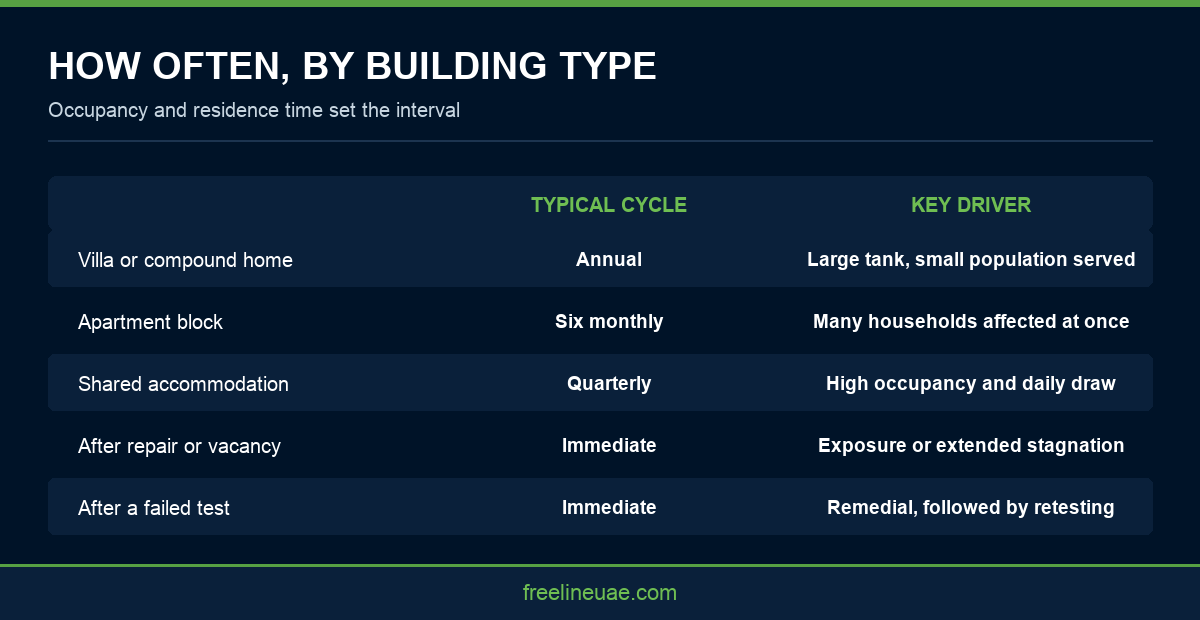
There is no single interval that suits every building, and any contractor offering one has not asked enough questions. The sensible approach starts from building type, adjusts for occupancy and history, then lets laboratory results move the interval up or down over time.
Villas and low occupancy homes commonly work on an annual cycle, because the tank is large relative to daily draw but the population served is small. Apartment blocks usually justify a six monthly cycle, since the consequences of a problem are distributed across many households at once.
Shared and staff accommodation sits at the demanding end. High occupancy, high daily draw and a population with limited ability to raise concerns combine to make a shorter cycle and rigorous documentation genuinely worthwhile rather than merely advisable.
Laboratory results are what make an interval defensible rather than habitual. A building passing comfortably year after year has evidence for extending its cycle, while a building drifting toward marginal results has evidence for shortening it well before an outright failure occurs.
Certain events override the calendar completely. A tank should be cleaned after any internal repair, after a period of vacancy, after suspected ingress and immediately following a failed water test, regardless of when the last scheduled clean took place.
What the Work Should Actually Involve
The sequence is fixed and each stage depends on the one before it. The tank is isolated and drained, sediment is physically removed, internal surfaces are cleaned and disinfected at a stated concentration held for a defined contact period, the tank is rinsed until residual returns to normal supply levels, then refilled and sampled.
Sediment removal before dosing is the stage most often compressed and the one that determines whether the rest works. Sludge on a tank floor absorbs disinfectant rapidly and shelters organisms beneath it, so a tank dosed over an untouched floor produces a collapsed residual and a failed result.
The rinse endpoint should be defined by measurement rather than by elapsed time or by smell. Refilling early leaves concentrated water in a system that residents are about to use, and it also invalidates any sample taken shortly afterwards by loading the bottle with leftover chemical.
Multiple tank arrangements impose their own sequence. Where a ground level tank feeds a roof tank, the ground tank must be treated first, otherwise the cleaned roof tank is refilled from an untreated source and the work is undone almost immediately.
Condition reporting should accompany every clean. Cracks, failed seals, missing insect screens, corroded hatches and daylight entering the tank all cause recontamination, and a clean that identifies none of them will simply be repeated next year with the same outcome.
Verification and What the Paperwork Should Show
The deliverable is evidence rather than attendance. Bacteriological analysis should show absence of coliform bacteria, issued by an accredited laboratory, with every sample identified by the location it came from rather than listed as a set of anonymous passes.
Sample location determines what a result actually means. A sample drawn at the tank describes the tank, while samples drawn at outlets describe what residents receive, and in a building with contaminated pipework the difference between those two is the entire story.
Two consecutive sample sets taken at an interval are stronger than one. A single clear result can reflect a favourable outlet or residual disinfectant still acting inside the bottle, whereas consistent results across identified points on separate days describe the system rather than a moment.
Interpreting a marginal result needs judgement rather than reflex. A single borderline reading at one outlet is neither an automatic system failure nor simply noise, and the correct response is a targeted resample at that point alongside a comparison point elsewhere in the building.
Records should be kept indefinitely. Water quality questions surface during sales, tenancy disputes, refinancing and insurance reviews, often years afterwards, and a dated series of results held with the condition reports is far more persuasive than anybody’s recollection of work done properly at the time.
Choosing a Contractor for a Sharjah Building
Approval and licensing come first. A company working on potable water systems should evidence its standing without delay, and the licensed activity should actually cover water tank cleaning and disinfection rather than general cleaning, since a mismatch causes difficulty when the file is later reviewed.
Method comes second. Ask for measured tank capacity, the target concentration, the contact period, the rinse endpoint and the named sample points. A capacity figure requires a site visit, so its presence or absence tells you whether the dose was calculated or estimated.
Scope honesty comes third and matters more in older buildings. Storage and distribution form one connected system, so a quotation covering tanks while silent on pipework has addressed half the problem, and in a building with dead legs the untreated half will assert itself quickly.
Where tank work sits alongside broader building upkeep, the records accumulate into a usable history rather than a series of unrelated receipts, which matters most in exactly the older buildings this guide is concerned with.
Continuity is worth more than a marginal saving. A provider returning to the same building holds its history, recognises whether a result reflects deterioration or noise, and can point out that the same hatch seal has now failed twice. Rotating contractors annually on price destroys that information every year.
Conclusion
Water tank cleaning services in Sharjah work best when the age of the building is treated as a variable rather than an afterthought. Insist on a survey that establishes capacity and finds the dead legs, sediment removal before dosing, a measured rinse endpoint, accredited laboratory results with named sample points, and a condition report that identifies what will recontaminate the tank. Freeline serves Sharjah alongside Dubai and Abu Dhabi. Contact the team to arrange a survey.
