FOG Management for UAE Restaurant Groups Explained
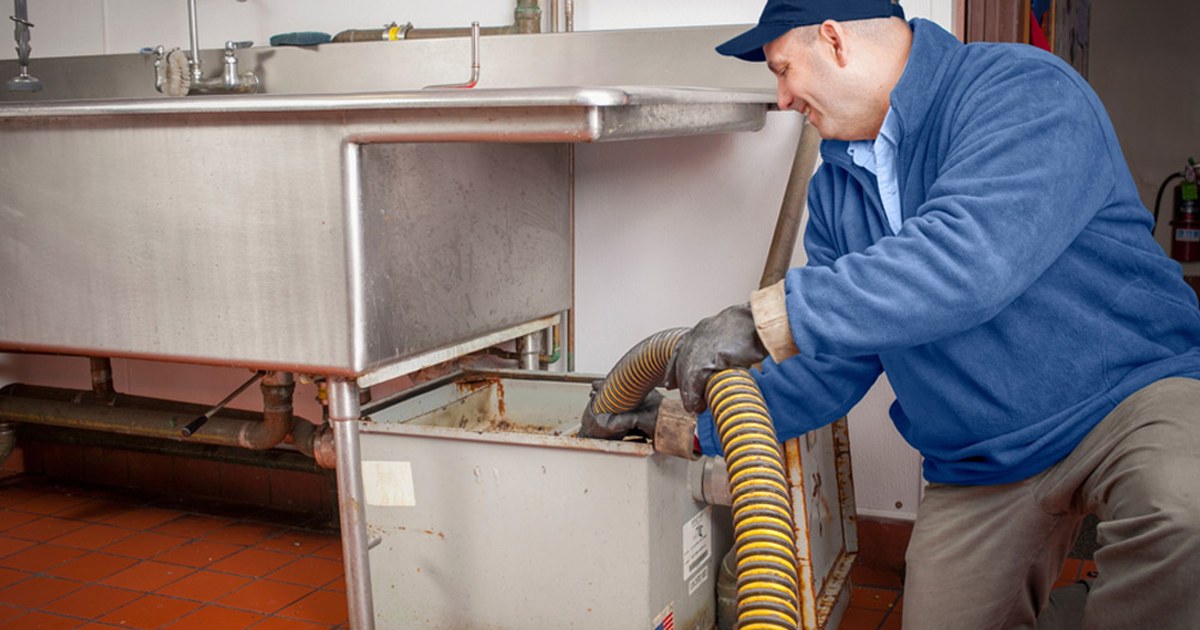
FOG management in the UAE becomes a different discipline once a restaurant group passes a handful of sites. One site is an operational task. Twenty sites is an information problem, where the difficulty is not knowing how to service a trap but knowing which of your twenty traps is quietly failing, and finding out before the drainage does. This article covers how groups standardise the specification, measure what matters and report by exception, so that the portfolio becomes legible from head office. For the scope Freeline works to, see how Freeline empties and services an interceptor.
Key Takeaways
- At group scale the binding constraint is comparability. Records in twenty different formats cannot be read as a portfolio, however diligent each individual site is.
- Standardising specification and reporting is what turns servicing from a recurring cost into management information about which sites are deteriorating.
- Exception reporting is the mechanism that scales. Nobody reads twenty routine reports, but everybody reads a list of the three sites that moved.
Why Group Scale Changes the Problem
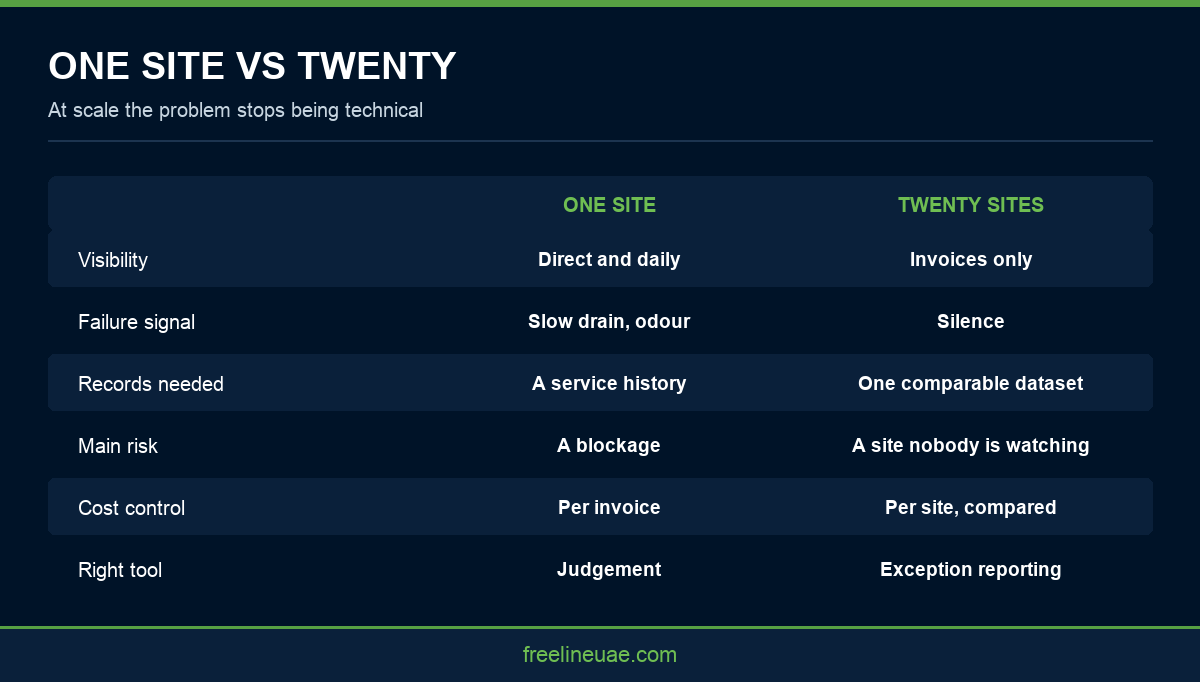
A single operator knows their kitchen. They notice when the drain runs slowly, they remember the last service, and they can form a reasonable judgement about whether the trap is coping with what the kitchen produces.
None of that survives multiplication. A group operations manager responsible for twenty sites has no direct visibility of any individual trap, and the information reaching them arrives as invoices rather than as condition data.
The failure mode at scale is therefore silence. A site whose trap has been undersized since fit out generates no alert, because its servicing frequency looks like a supplier arrangement rather than a symptom, and nobody is comparing it against the other nineteen.
Effective FOG management in the UAE therefore starts with making the portfolio legible rather than with changing anything technical about how a trap is serviced.
Cost behaves the same way. A group can be spending substantially more per site at three locations without anyone noticing, because the invoices are approved locally and never sit side by side in a form that makes the difference visible.
The consequences also travel further than one kitchen. Fats escaping a trap deposit along the sanitary sewer run serving the whole building, so a single neglected site inside a shared development can create a problem that other occupiers experience first.
The remedy is not more servicing. It is standardisation of what is specified, what is recorded and how it is reported, so that twenty sites produce one comparable dataset rather than twenty unrelated files.
Standardising the Specification
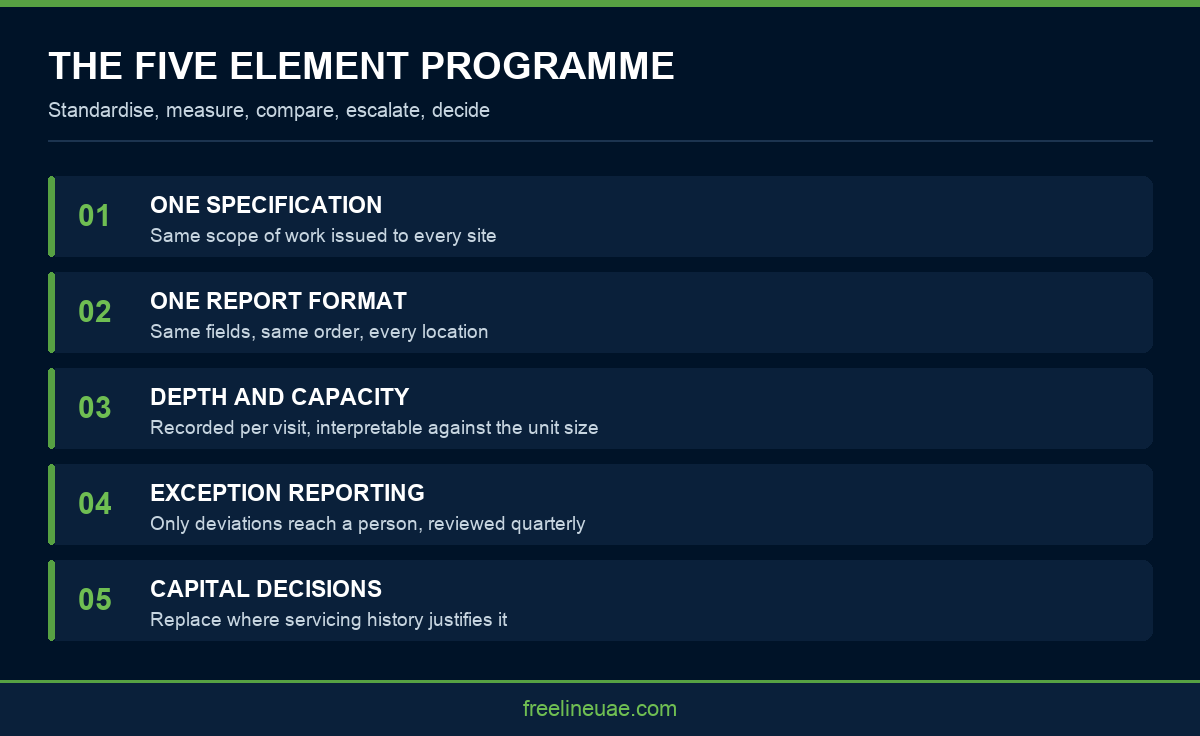
A group should issue one specification covering what a service visit includes, rather than allowing each site to inherit whatever its local supplier offers. Without that, the same line item means different work at different locations.
The specification should require full removal of the grease layer and settled solids rather than partial pumping, cleaning of baffles and crossover pipework, an inlet and outlet check, refilling with clean water and a written condition report.
It should also require sludge and grease depth to be recorded at each visit. That single requirement converts every service from an event into a data point, and across a portfolio it is what makes comparison between sites possible at all.
Waste transfer documentation should be specified in a defined format and required with every service rather than on request. At group scale, chasing paperwork retrospectively across twenty sites is a job nobody has time to do properly.
Group specifications should also name who arranges access and when. Multi site programmes fail on scheduling more often than on scope, particularly where sites trade at different hours and local managers control the keys.
Where sites use dosing, the specification should cover the product type, the dose rate basis and the servicing of the dosing equipment itself, because an unmaintained dosing unit is a cost with no effect and it is invisible from head office.
Making Records Comparable
Comparability is the property that makes a portfolio manageable, and it is destroyed by small inconsistencies. Different measurement points, different units, different report formats and different service descriptions all prevent one site being read against another.
The practical fix is a single reporting template applied everywhere. Site, date, volume removed, depth measurements at defined points, condition findings, waste carrier and disposal destination, in the same fields in the same order for every location.
Depth measurement deserves emphasis because it is the field that carries the most information. A trap accumulating faster than its capacity should allow is reporting either an undersized unit or a change in the kitchen, and both are worth knowing early.
Capacity should be recorded once per site alongside the fixture count. Without it, a depth reading cannot be interpreted, since the same accumulation means very different things in a small trap and a large one.
The same principle applies to the waste management chain. Recording the carrier and destination in a fixed field across every site turns compliance from a folder of loose documents into a portfolio view that can be checked in minutes.
Held consistently, this dataset answers questions that no individual site can. Which locations are deteriorating, which are over serviced, which suppliers are performing and where capital spend on replacement would remove a recurring cost.
Exception Reporting and Escalation
Nobody at group level reads twenty routine service reports every month, and any system that depends on them doing so has already failed. What works is exception reporting, where the routine remains in the file and only deviations reach a person.
Sensible exceptions are straightforward to define. Accumulation rate outside an expected band, a servicing interval that has shortened across consecutive visits, a missed service, missing waste transfer documentation, or any condition finding above a stated threshold.
Each exception should carry an owner and a response. A site whose accumulation rate has doubled needs investigation rather than simply more frequent servicing, since the cause is usually a menu change, a failed dosing unit or a trap that was always too small.
Escalation should distinguish operational faults from capital ones. A blocked line is an operational response, while a chronically undersized trap is a capital decision, and treating the second as the first produces years of unnecessary servicing spend.
New openings should enter the programme at fit out rather than after trading begins. A trap sized correctly at design costs nothing extra, whereas one discovered to be undersized two years later carries both replacement cost and disruption.
Reviewing the exception list quarterly is usually sufficient. It surfaces the sites that need attention, provides the evidence to justify replacement where it is warranted, and takes a fraction of the time that reading every report would consume.
Controlling Cost Across the Portfolio
Cost per site becomes visible only once records are comparable, and it is frequently the first thing a group discovers when standardisation is introduced. Wide variation between similar sites usually reflects trap capacity rather than supplier rates.
Benchmarking between comparable sites is what makes the case. Two outlets with similar menus and covers should show similar accumulation rates, and a persistent gap between them is either a capacity difference or a service quality difference worth investigating.
Consolidating suppliers is the obvious lever and it is worth doing for the reporting consistency as much as for the commercial terms. A single provider producing identical records across twenty sites is more valuable than a marginal saving from local arrangements.
Good FOG management in the UAE ultimately shows up as fewer surprises rather than as a lower unit rate, because the sites that would have failed are identified while the fix is still a maintenance decision.
Capital replacement should be assessed against servicing history rather than age. A trap requiring servicing at twice the frequency of comparable sites will usually pay for its own replacement within a predictable period, and the records are what demonstrate that.
Dosing should be evaluated on measured effect at portfolio level. Where accumulation rates fall at dosed sites relative to comparable undosed ones, the arrangement is working, and where they do not, the spend is worth reconsidering.
Freeline services grease traps across Dubai, Sharjah and Abu Dhabi and can operate to a single specification and reporting format across a group, including supply and installation where replacement is justified, alongside its wider services.
Conclusion
FOG management at group scale is an information discipline rather than a technical one. Standardise the specification, require depth measurement and waste transfer records in a single format, report by exception rather than by volume, and use the resulting data to decide where replacement removes a recurring cost. If your group receives service invoices but cannot say which site is deteriorating fastest, contact Freeline to discuss a portfolio arrangement built around one specification and one reporting format.
