Sewage Tank Cleaning in Sharjah for Villas and Compounds
Sewage tank cleaning in Sharjah is a routine service that goes badly wrong when it is treated as one. Properties outside mains drainage depend entirely on their tank being emptied before it fills, the work involves genuine confined space hazards, and the collected waste has to be tracked to an approved disposal point. This guide covers how the interval should be set, why confined space procedure matters, what the records need to contain, and what separates a competent contractor from a tanker with a hose. For the scope Freeline works to, see how Freeline empties and cleans a foul tank.
Key Takeaways
- Emptying interval follows tank capacity against actual occupancy. Measuring sludge depth at each visit turns an appointment into a managed schedule.
- Tank entry is confined space work with real hazards. A contractor without documented procedure is a risk to your property as well as their own crew.
- Waste transfer documentation matters as much as the emptying, because responsibility for waste produced on a property does not end when a tanker drives away.
Septic Tanks and Holding Tanks Are Not the Same
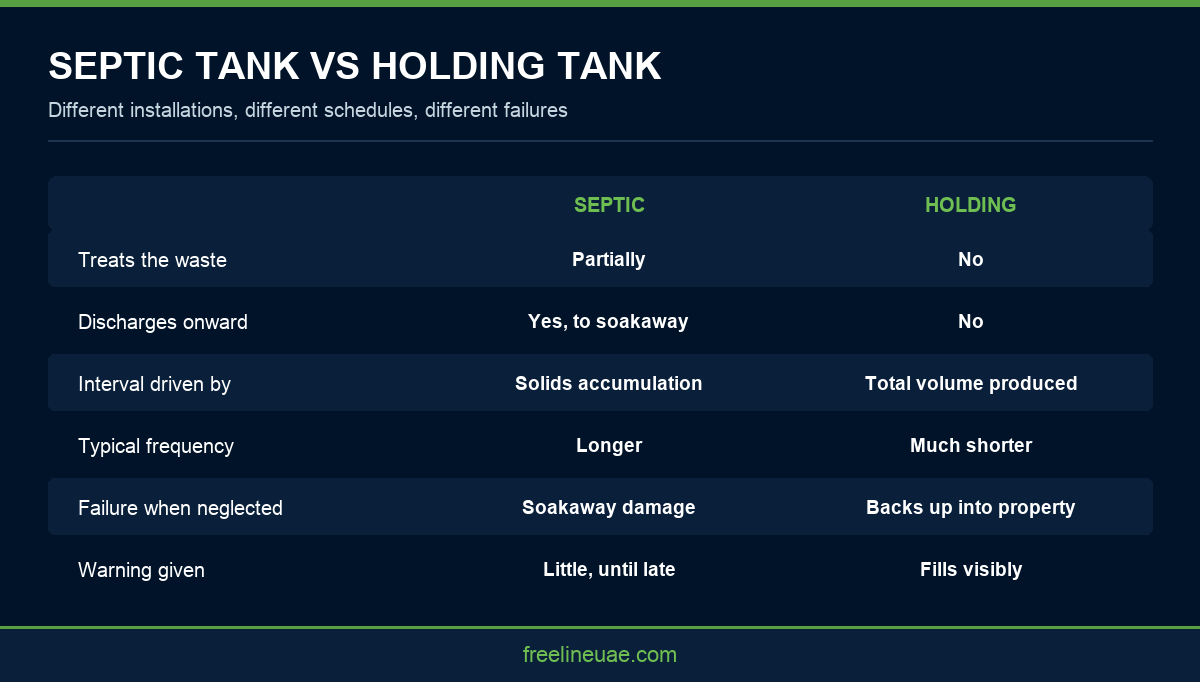
The two terms are used interchangeably and describe different installations. A septic tank provides settlement and partial biological treatment, discharging clarified effluent to a soakaway or further treatment, and it retains the solids that accumulate.
A holding tank does none of that. It simply stores everything the property produces until a tanker removes it, which means its emptying interval is dictated by total volume produced rather than by the rate at which solids accumulate.
That distinction changes the schedule completely. A holding tank on a fully occupied villa may need emptying every few weeks, while a correctly sized septic tank on the same property might run for a year or more before desludging is required.
It also changes what neglect does. An overfull holding tank backs up into the property, whereas a neglected septic tank continues to appear functional while passing solids forward into the soakaway, which is far more expensive to remediate later.
Where a soakaway is involved, its condition matters as much as the tank. A sewage treatment arrangement relies on the ground accepting discharge, and a soakaway that has become blinded by carried over solids will surcharge regardless of how recently the tank was emptied.
Establishing which type you have is therefore the first step, and it is not always obvious from the surface. Older compounds in particular have been extended and modified, and the arrangement in the ground frequently differs from whatever the drawings show.
Setting the Emptying Interval
Capacity against occupancy is the working basis. A tank sized for a family of four behaves entirely differently once the property houses twelve, and occupancy in villa compounds and staff accommodation frequently changes without anybody revisiting the schedule.
Sludge depth measured at each visit is the reliable refinement. Recording it converts emptying from a fixed appointment into a managed interval, and a tank filling faster than its capacity should allow is reporting something worth investigating.
Water ingress is the most common cause of unexpectedly rapid filling. Where surface water or groundwater enters through a failed cover, a cracked chamber or a defective connection, the tank fills with water rather than waste and the interval collapses for reasons nobody diagnoses.
Seasonal occupancy patterns matter in Sharjah specifically. Properties used intermittently, compounds with variable staff numbers and villas occupied by extended families through certain periods all produce loading that varies substantially across a year.
Recording occupancy alongside the volume removed is worth the small effort. Two figures together explain a changing interval, whereas volume alone leaves everybody guessing whether the property has changed or the tank has developed a fault.
Waiting for symptoms is the approach that fails. Slow drainage, odour and surface breakout are all late warnings, so a property noticing any of them has usually been carrying an overdue tank for some time already.
Confined Space Safety Is Not Optional
Sewage tanks generate hydrogen sulphide and other hazardous gases, and they can hold oxygen deficient atmospheres. Both conditions are undetectable without instrumentation and both have caused fatalities in this kind of work, frequently to people attempting a rescue.
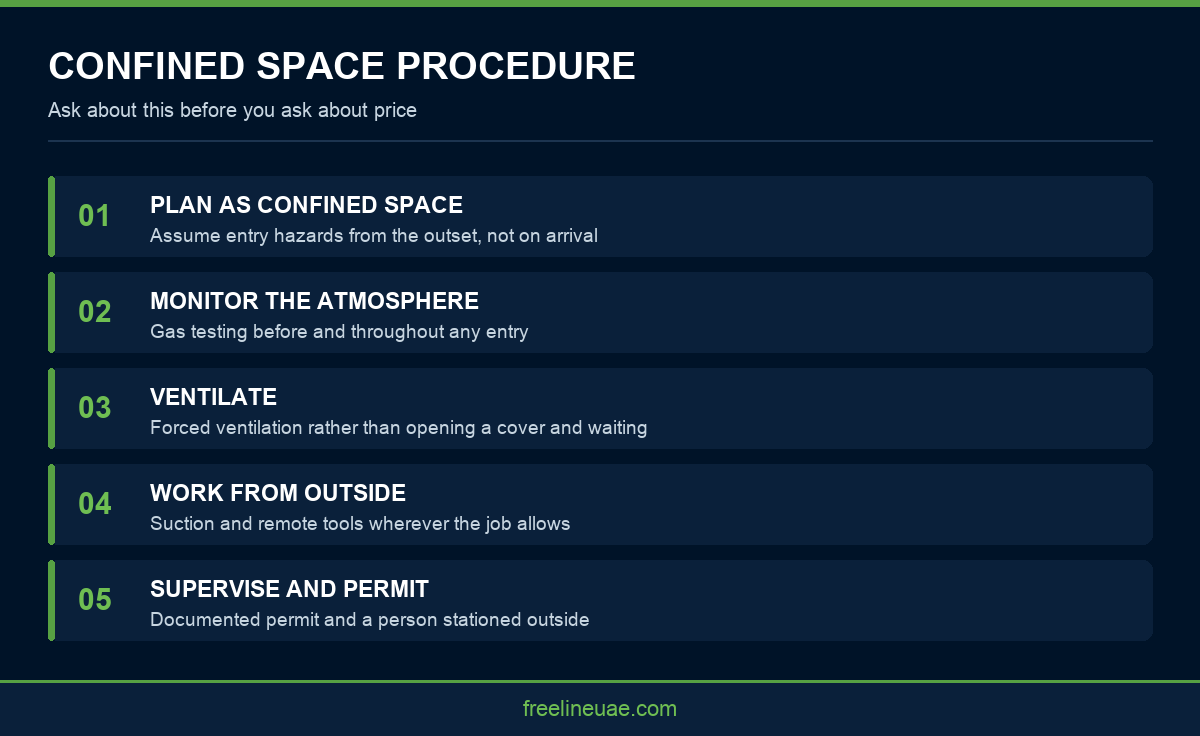
Competent practice means the work is planned as confined space entry from the outset. That involves gas monitoring before and during any entry, forced ventilation, a documented permit, appropriate equipment and a person stationed outside throughout.
The safest approach is to avoid entry altogether wherever possible. Most emptying and cleaning can be completed from outside the tank using suction equipment and remote tools, and entry should be the exception that requires justification rather than the default method.
This is worth asking about directly before appointing anybody. A contractor who describes their confined space procedure without hesitation has one, and a provider who treats the question as excessive is telling you how the work will actually be carried out.
Covers and chambers deserve inspection while access is open. A corroded cover in a trafficked area is an immediate hazard rather than a future maintenance item, and it is cheapest to identify at the moment the tank is already exposed.
The risk extends to the property owner as well as the crew. Work carried out unsafely on your premises is your problem too, and it is a straightforward matter to confirm that procedure and insurance exist before anybody opens a cover.
Waste Transfer and Records
The emptying is only half the service. The collected material must be removed by a licensed carrier and delivered to an approved disposal point, and the documentation showing that is what an inspection or an authority will ask to see.
Property owners are often surprised that this concerns them at all. Responsibility for waste produced on a property does not transfer simply because somebody drove it away, so the transfer record is the owner’s protection rather than the contractor’s paperwork.
A usable record contains the date, the volume removed, the carrier details and the disposal destination. Where a condition report accompanies it, that combination demonstrates a maintained installation rather than a series of unrelated call outs.
Consistency matters as much as completeness. Twelve months of regular records demonstrates a managed asset, whereas three invoices and a gap suggests either neglect or poor record keeping, and nobody reviewing the file can distinguish between them.
Photographs add considerably to a written report. Images of the chamber interior, the covers and any observed defect give the owner something to compare against at the next visit, which is how deterioration becomes visible before it becomes a failure.
Condition findings belong in the same record. Cracked chambers, failed covers, corroded fittings, evidence of ingress and any sign of soakaway distress are all observed during emptying, and none of them appear on an invoice recording only a volume.
Choosing a Contractor in Sharjah
Ask about confined space procedure first, because the answer tells you most of what you need to know about how the company operates generally. Documented method, gas monitoring and a stated preference for working from outside the tank are the indicators.
Ask who carries the waste and where it goes, and ask to see the transfer documentation format before appointing anyone. A provider unable to describe this quickly is unlikely to produce it reliably at every visit afterwards.
Ask whether tanker access has been assessed. Hose runs have a working limit, and a tank positioned beyond it requires intermediate pumping or a longer and messier operation, which is better established before the first visit than during it.
Ask how emergencies are handled outside the schedule. Properties on holding tanks are entirely dependent on the tanker arriving, so response arrangements for an unexpected fill matter more here than for a mains connected building.
Ask whether condition reporting is included. A contractor who inspects the chamber, covers and connections while the tank is empty is providing information you cannot otherwise obtain, and that is when defects are cheapest to find.
Freeline provides sewage and septic tank cleaning across Sharjah, Dubai and Abu Dhabi, alongside drain jetting, plumbing and its wider services for the same property.
Conclusion
Sewage tank cleaning in Sharjah is straightforward when the interval follows measured sludge depth rather than habit, the work is planned as confined space entry, and the waste is tracked to an approved disposal point with records the owner keeps. If your tank is filling faster than it used to, or nobody can produce the transfer documentation for the last year, contact Freeline for an assessment of the tank, its access and the schedule it actually needs.
