Pipeline Disinfection in Dubai: A Complete Guide for Buildings
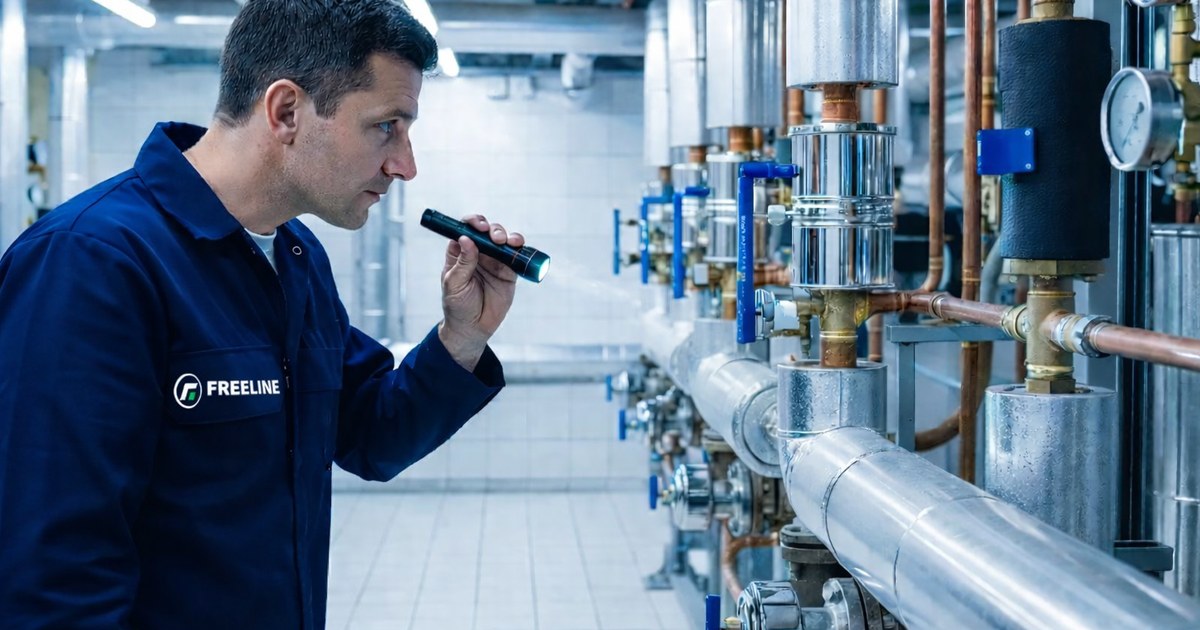
Pipeline disinfection in Dubai is the controlled process that restores water quality inside a building. Every property receives treated water at the boundary, but what happens after that point is the owner's responsibility. Water sits in tanks, moves slowly through long runs of pipe and warms in ambient heat, and that is precisely where quality is lost. This guide explains what the work involves, when it is required, how chlorination is dosed and verified, and what a properly documented handover should contain before anyone signs it off.
Key Takeaways
- Pipeline disinfection removes biofilm and microbial contamination from the pipework inside a building, not from the supply network outside it.
- The process is a sequence of cleaning, dosing, contact time, flushing and laboratory testing. Skipping the testing step makes the whole job unverifiable.
- New buildings, repaired mains, long vacancies and failed water tests are the four situations that most often trigger a requirement for water pipeline disinfection in Dubai.
What Pipeline Disinfection Actually Involves
Pipeline disinfection is the controlled application of a disinfectant to the inside surface of a water distribution system, held for a defined period, then flushed out and verified by laboratory testing. It is not a cleaning product poured into a tank. It is a measured chemical process with a dose, a contact time and a pass criterion.
The confusion in the market is understandable. Many contractors use the words cleaning, flushing, sanitising and disinfection as if they mean the same thing. They do not. Flushing moves water at high velocity to carry loose sediment out of the line. Cleaning removes physical deposits from a surface. Disinfection inactivates the micro organisms living on that surface. A pipe can be visually clean and still carry a mature microbial film.
The distinction matters commercially, not just technically. Building owners routinely pay for a service labelled disinfection and receive a flush, because the invoice looks the same and the water looks clearer afterwards. The difference only becomes visible when a laboratory test is run, or when the same complaint returns three months later. Understanding what separates the two is the single most useful thing an owner can know before commissioning the work.
That film is the real target. Biofilm is a layer of micro organisms that attaches to pipe walls and protects itself inside a matrix it secretes. Once established it is far more resistant to disinfectant than free floating bacteria, which is why a brief rinse with chlorinated water achieves very little. Effective work depends on holding an adequate concentration against that film for long enough to break it down.
There is a second reason the vocabulary matters. Scope written loosely tends to be delivered loosely. A contract that says the contractor will sanitise the water system creates no obligation to reach a concentration, hold it, or prove anything afterwards. A contract that specifies dose, contact time, sampling points and acceptance criteria creates a measurable deliverable.
This is why the two variables that matter most are concentration and time. A low dose held for a long period and a high dose held briefly can achieve comparable results, but only if both are measured. A contractor who cannot tell you the residual concentration at the end of the contact period has not performed a disinfection. They have performed a rinse.
Why Dubai Buildings Need Pipeline Disinfection
This is the gap that pipeline disinfection in Dubai is intended to close, and it is why the work is treated as a building service rather than a supply problem.
The wider public health case is not in dispute. The World Health Organization reports that microbiologically contaminated drinking water transmits diseases including diarrhoea, cholera, dysentery and typhoid, and is estimated to cause around 505,000 diarrhoeal deaths every year. Those figures describe a global picture rather than a UAE one, but the mechanism is identical wherever water stands still in warm pipework.
Occupancy patterns add a further layer. A building at partial occupancy draws less water than it was designed for, so residence time in the tanks and risers increases at exactly the point when budgets are tightest. The result is that water quality problems often appear during quiet periods rather than busy ones, which is the opposite of what most owners expect.
It is worth being precise about where the problem starts. The water arriving at a Dubai property is treated and monitored before it reaches the boundary, and the supply network is not the usual source of building level complaints. Responsibility and risk transfer at the point where water enters private infrastructure. From that point the tank, the riser, the branch lines and the outlets are all owner maintained assets, and their condition is not visible from the outside.
For a building owner the practical consequence is narrower. Water quality complaints, discoloured supply, taste and odour issues and failed tenant tests almost always originate inside the building rather than at the supply point. Disinfecting the pipework, alongside water tank cleaning and disinfection, addresses the part of the system the owner actually controls.
Stored water is the weak point
Dubai buildings almost universally store water on site before distributing it. Storage is necessary, but it introduces a pause. Water that moves continuously carries a disinfectant residual and has little opportunity to develop microbial growth. Water that sits loses that residual, and the pipework downstream of the tank inherits the problem.
The longer the pause, the greater the risk. Tanks sized generously for peak demand often hold several days of supply in a partly occupied building, and low occupancy makes the situation worse rather than better.
Heat accelerates everything
Ambient temperature in the UAE pushes cold water systems into the range where microbial growth accelerates. Pipework in roof voids, service risers and external runs can sit well above the temperature a cold water system is designed to hold.
That matters for organisms such as Legionella, which multiply in warm stagnant water and are controlled by a combination of temperature management and disinfection. The World Health Organization notes that legionellosis is preventable through proper water system management, and building water systems are the setting where that management either happens or does not.
When Pipeline Disinfection Is Required
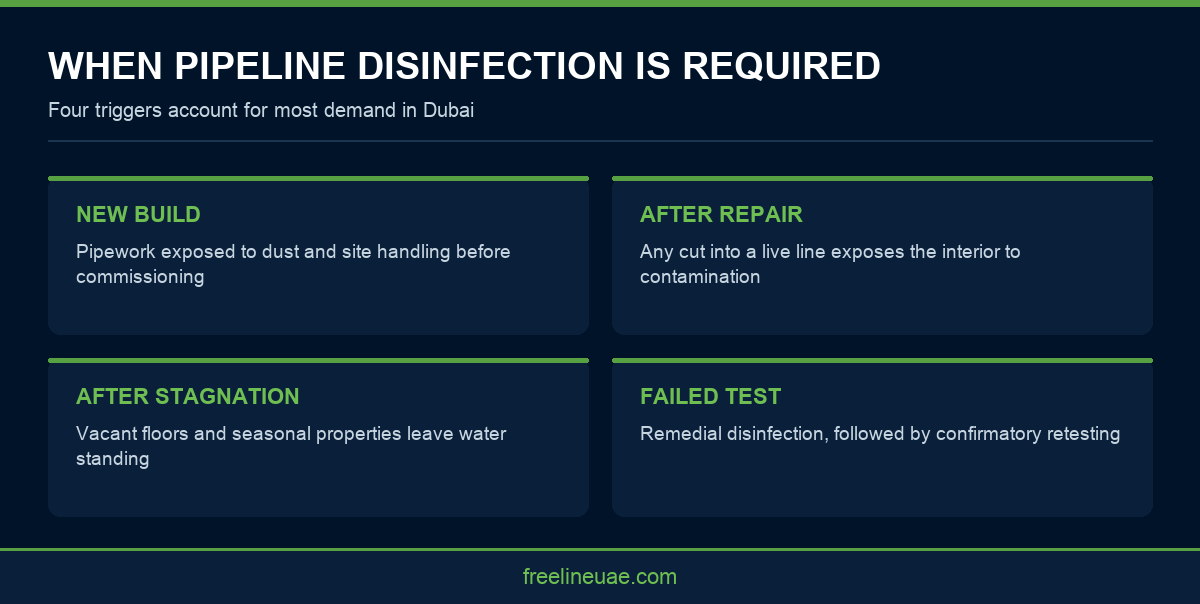
Four situations account for most of the demand. The first is new construction. A newly installed water line has been cut, stored on site, handled by many trades and left open to dust and debris. It must be cleaned and disinfected before it carries potable water, and a satisfactory result is normally part of the handover package.
The second is repair or modification. Any time a pipe is cut into, the interior is exposed to whatever is in the surrounding environment. Disinfection of the affected section restores the barrier. This applies to planned modifications and to emergency repairs, and it is the step most often skipped under time pressure.
The third is stagnation. A building left vacant, a wing taken out of service, a floor between tenants or a seasonal property all leave water standing in pipework for extended periods. Bringing that system back into use without disinfection means the first occupants receive whatever developed during the pause.
Change of use belongs on the list as well. A floor converted from office to residential, a unit turned into a clinic or a kitchen added to a previously dry area all alter both the demand pattern and the risk profile of the water system. The pipework may be sound, but the assumptions it was designed and commissioned under no longer hold, and a disinfection at that point resets the baseline.
The fourth is a failed water quality test. When a laboratory result comes back with coliform present or an unacceptable count, disinfection is the corrective action. In this case the work is not preventive, it is remedial, and it must be followed by repeat testing to confirm the problem has actually been resolved rather than diluted.
Dead legs deserve separate mention. When a building is reconfigured, an outlet removed or a floor replanned, sections of pipework are frequently capped rather than cut back to the main. The water in those sections never moves again. It continues to connect to the live system, and it continues to seed it. Disinfection addresses the immediate contamination, but a dead leg will regenerate the problem, so the survey should identify them and the remedial plan should remove them.
Owners often ask whether pipeline disinfection in Dubai is a one off exercise or a recurring commitment. The honest answer is that it depends on which of these triggers applies to the property.
There is also a routine case. Buildings with complex systems, long dead legs or a history of quality problems benefit from disinfection on a planned interval rather than in response to a failure. Where this is adopted it usually sits within a wider building maintenance programme alongside tank cleaning.
How the Disinfection Process Works Step by Step
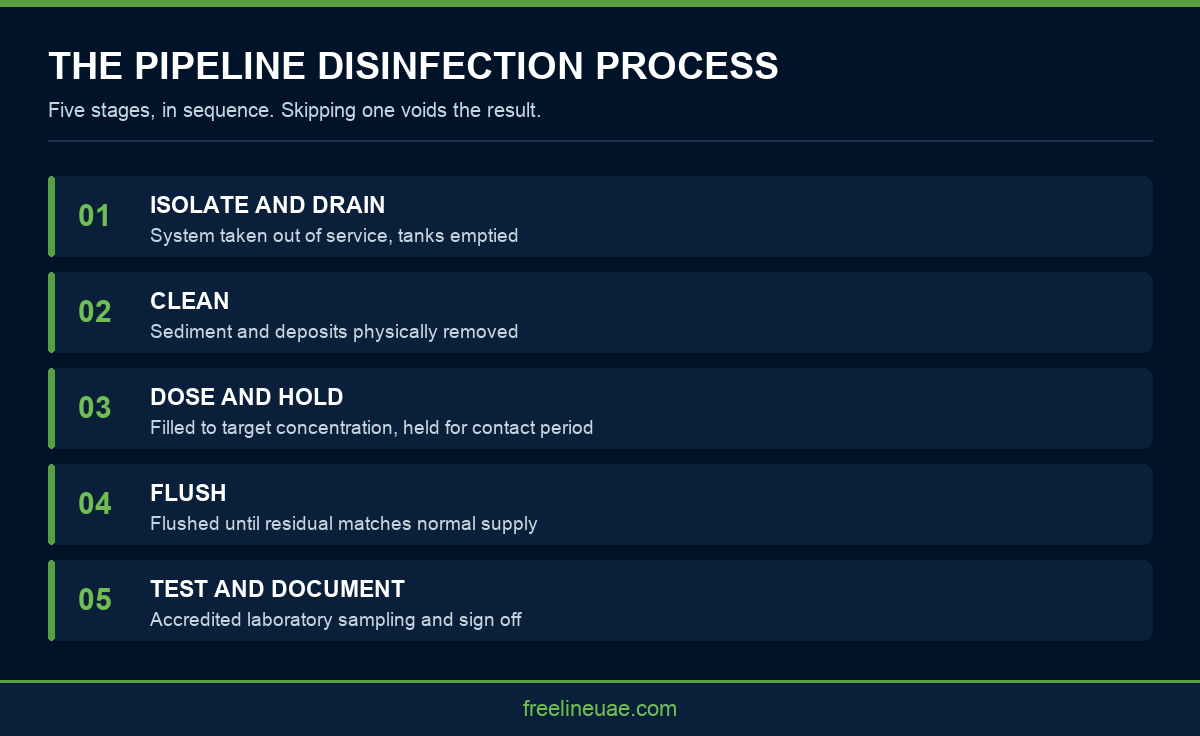
Before any of this begins there should be a survey. The crew needs to know the system volume in order to calculate the chemical quantity, the isolation points in order to plan the outage, the material of the pipework in order to select an appropriate concentration, and the location of the furthest outlets in order to know where residual will be measured. Disinfection quoted without a survey is disinfection quoted without knowing the dose, and the figure is therefore an estimate of price rather than of work.
The sequence matters as much as the chemistry. Dosing before cleaning wastes chemical. Flushing before the contact period ends voids the process. Testing before flushing produces a meaningless result. Where the work touches plumbing services and mechanical isolation, coordination between the disinfection crew and the site team is what keeps the sequence intact.
Isolation, draining and physical cleaning
The system or the affected section is isolated and drained. Where tanks form part of the scope they are emptied, cleaned and the internal surfaces treated. Physical removal of sediment comes first because loose material consumes disinfectant and shields organisms beneath it.
This stage is unglamorous and frequently rushed. A disinfectant dose applied over a layer of sediment will be consumed by that sediment rather than acting on the pipe wall.
Dosing and contact time
The system is then filled with water dosed to a target free chlorine concentration and held. The recognised international reference for potable water mains is the AWWA C651 methodology, which sets out several accepted combinations of concentration and holding period rather than a single figure. Higher concentrations are held for shorter periods, lower concentrations for longer.
Whichever combination is chosen, the controlling requirement is the same. A minimum residual must still be present at the end of the holding period, measured at the far end of the system rather than at the dosing point. If the residual has fallen below the threshold, the demand exceeded the dose and the process must be repeated.
Flushing and return to service
The chlorinated water is then flushed out until the residual in the system matches normal supply levels. This step protects both the occupants and the pipework, since concentrated disinfectant is not intended to remain in a system in use.
Verification during this stage is what separates a controlled flush from an optimistic one. Residual should be measured as the flush proceeds rather than assumed to have cleared after a set number of minutes, because long branches and low use outlets clear far more slowly than the main runs.
Flushing also has an environmental dimension. Highly chlorinated water should be neutralised or discharged appropriately rather than released without thought, and a competent contractor will have a defined method for this.
Chlorination and the Alternatives
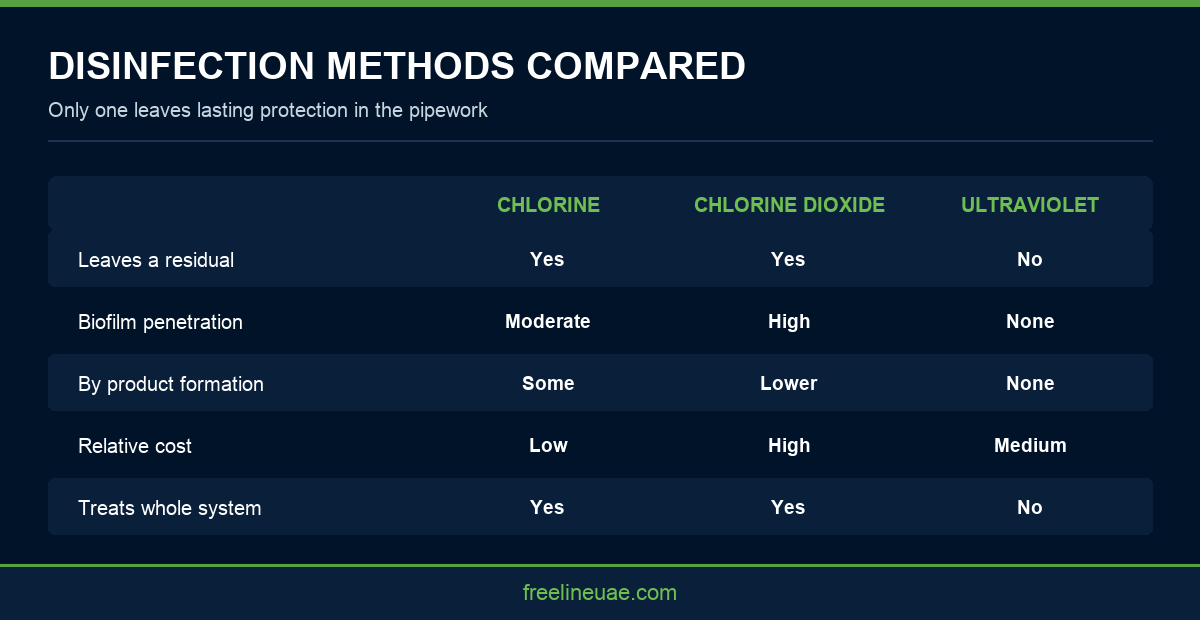
Chlorine remains the default because it is effective, inexpensive, easy to measure and leaves a residual that continues to protect the system after the crew leaves. That residual is the property no alternative fully replicates.
The main objection to chlorination is by product formation. When chlorine reacts with organic matter it can form trihalomethanes and haloacetic acids. This is a genuine consideration, though it should be kept in proportion. As noted in the technical literature on water chlorination, the World Health Organization has stated that the health risks from these by products are extremely small in comparison with the risks associated with inadequate disinfection.
Method selection should follow the system rather than fashion. For the great majority of Dubai buildings, chlorination correctly dosed and properly verified is the appropriate answer, and the alternatives earn their place only where a specific constraint applies. A provider who recommends an expensive alternative before surveying the system is selling a product rather than solving a problem.
Cost is not the only trade off. Every method has an operational profile covering handling, storage, competency and monitoring, and a building that cannot support that profile will not sustain the treatment. The best method for a site is the one it can actually run correctly over time.
Chlorine dioxide
Chlorine dioxide is used where biofilm penetration is the priority or where taste and odour from chlorine are a concern. It works across a wider pH range and forms fewer trihalomethanes. It is more expensive, must be generated on site and requires tighter handling controls, which limits it to systems where those trade offs are justified.
Ultraviolet treatment
Ultraviolet germicidal irradiation inactivates organisms as water passes a lamp. It adds no chemicals and no taste. Its limitation is decisive for pipework disinfection. It treats only the water flowing through the unit and leaves no residual, so it cannot address a biofilm already established downstream. It is a supplementary control rather than a substitute for chlorination.
How Results Are Verified and Documented
A disinfection job is only as good as its evidence. The deliverable is not the visit, it is the record. At minimum a competent contractor should hand over the dosing record showing target and achieved concentration, the contact period start and end times, residual readings taken at the extremities of the system, confirmation of the final flush, and laboratory results from an accredited testing facility.
The laboratory element is where weak providers are exposed. Bacteriological confirmation normally requires samples showing absence of coliform organisms, and good practice is two consecutive sample sets taken at an interval rather than a single result. A single clear sample taken immediately after flushing can reflect residual disinfectant in the sample rather than a genuinely clean system.
Retention of the records matters too. Water quality issues surface months after the work, often during a sale, a refinancing, a tenant dispute or an insurance question. A contractor who issues results and keeps no copy leaves the owner exposed, and an owner who files the report without reading it is in much the same position.
Sampling location matters as much as sampling frequency. Samples drawn at the plant room tell you about the plant room. Samples drawn at the furthest and least used outlets tell you about the system. A report that does not state where samples were taken is difficult to rely on.
It is worth knowing what a weak report looks like. A single page stating that the system was disinfected and is now safe, with no concentrations, no times, no sample locations and no laboratory letterhead, is an assurance rather than a record. It cannot be audited, it cannot be compared against a later result, and it provides no defence if a water quality dispute arises with a tenant or a purchaser.
This documentation has value beyond compliance. It establishes a baseline. When a future complaint arises, a dated record of system condition allows the owner to determine whether something has changed or whether the issue lies elsewhere. Buildings that keep these records make better decisions than buildings that repeat the same investigation every year.
Choosing a Pipeline Disinfection Contractor in Dubai
The first question is regulatory standing. Water related work in Dubai is overseen by Dubai Municipality, and a contractor operating in this space should be able to evidence their approval status without hesitation. A provider who cannot produce documentation quickly is telling you something useful.
The second is method. Ask which standard the disinfection follows, what concentration and contact time will be used, where residual readings will be taken and which laboratory will process the samples. Specific answers indicate a defined procedure. Vague answers indicate improvisation.
The third is scope honesty. Pipework and storage are one system. A quotation covering the tanks but silent on the distribution pipework, or the reverse, leaves half the problem in place. The same applies to associated works such as HDPE pipe installation on new lines, where disinfection should be built into the programme rather than added afterwards.
The third and a half point, easily missed, is what happens if the result fails. A competent contractor states in advance who bears the cost of redosing and retesting when the first laboratory result does not pass. If that is unwritten, it becomes a negotiation at the worst possible moment, with the building out of service and the occupants waiting.
Scope breadth is worth weighing too. A provider that also handles septic tank cleaning and drainage can address supply and waste side issues together, which matters in older properties where the two are often discovered at the same time.
The fourth is capacity to work around occupancy. Disinfection requires the system to be out of service for a period. In an occupied building that means night works, phased isolation, temporary supply arrangements and clear resident notice. A contractor who has not raised these issues has not thought about your building.
Price deserves a note. Disinfection pricing varies with system volume, isolation complexity, out of hours working and whether laboratory testing is included. A quotation materially below the others in a tender usually differs in one of those four areas, and most often it is the testing. Comparing quotations line by line rather than on the total is the only reliable way to see what is actually being offered.
Whichever provider is appointed, pipeline disinfection in Dubai should be bought as a specified process with a stated method and an independent result, not as an unspecified visit.
Freeline has operated in UAE facility maintenance since 2012 across Dubai, Sharjah and Abu Dhabi, and delivers pipeline disinfection alongside tank cleaning and maintenance services as a single coordinated scope.
Conclusion
Water quality inside a building is a maintenance outcome, not a supply outcome. Pipeline disinfection in Dubai addresses the section of the system the owner controls, and it works only when dose, contact time, flushing and laboratory verification are treated as one process rather than four optional steps. If your building is approaching handover, returning from vacancy, recovering from a failed water test or simply overdue for review, the sensible first move is an assessment of the existing system. Contact Freeline to arrange a site survey and a scoped proposal.
