Pipeline Chlorination in Dubai: Dose, Contact Time and Flushing
Most quotations for pipeline chlorination in Dubai describe an outcome rather than a method. They promise a disinfected system without stating the concentration, the holding period, or how the result will be proved afterwards. Those three details are the whole job, and everything else in the document is packaging. This article explains how the dose is actually calculated, why contact time cannot be shortened to suit a programme, what a correct flush looks like, and which mistakes make a chlorination impossible to verify later.
Key Takeaways
- Chlorination is defined by two measured variables, concentration and contact time. Neither is meaningful without the other.
- The pass criterion is the residual remaining at the end of the holding period, measured at the far end of the system rather than at the dosing point.
- Flushing is a controlled stage with its own endpoint, not simply running taps until the smell fades.
What Chlorination Does Inside a Water Line
Chlorine added to water forms compounds that attack the cell structure of micro organisms. In a pipe the target is rarely free floating bacteria in the water itself. It is the layer of growth attached to the pipe wall, which shelters organisms and continuously reseeds the water passing over it.
That layer is why concentration alone does not solve the problem. A strong dose passing quickly through a line contacts the outer surface of the growth and little else. A sustained concentration held against it has time to break the structure down and reach what is underneath.
Chlorine is also consumed as it works. Organic matter, sediment, corrosion products and the growth itself all absorb chlorine, and that absorption is called demand. A system with high demand will strip a dose within hours. This is the single most common reason a chlorination fails, and it is entirely predictable if anyone measures.
Temperature adds a further variable in the UAE. Chlorine acts faster in warm water but also dissipates faster, so a system sitting at high ambient temperature both responds well initially and loses residual more quickly than the same system would in a cooler climate. That shortens the margin for error and makes the end of period reading more important, not less.
The practical consequence is that dosing is not a fixed recipe. The same building, chlorinated before and after a tank clean, will show markedly different demand. Applying a standard figure to every system produces a pass in clean pipework and a silent failure in dirty pipework, which is exactly the situation where the work mattered most.
How the Chlorination Dose Is Calculated
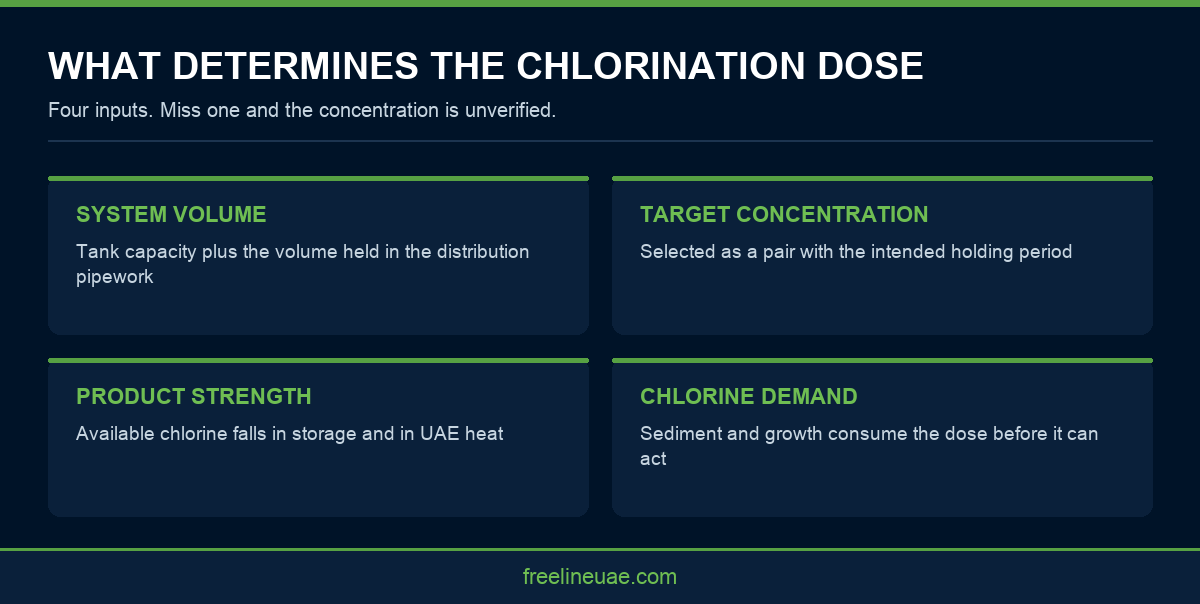
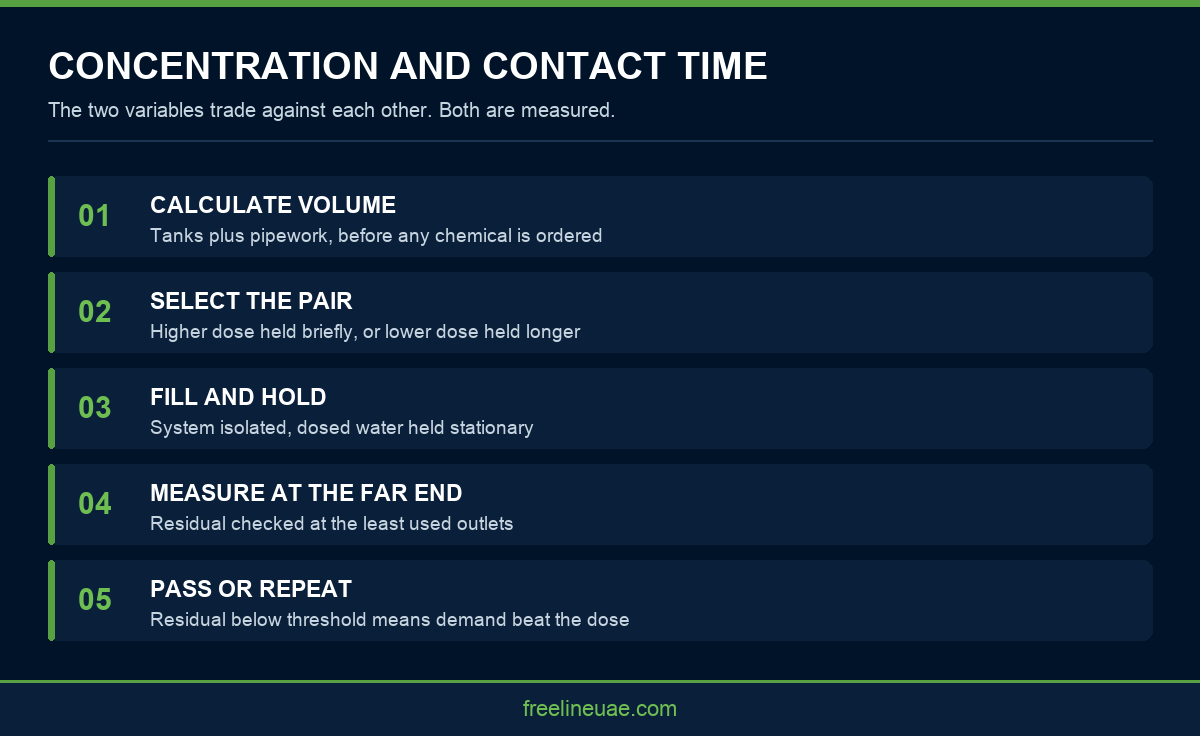
The dose starts with volume. The crew needs the capacity of the tanks plus the volume held in the distribution pipework, calculated from pipe diameter and run length. Without that figure the quantity of chemical is a guess, and a guess in this context is usually an underdose.
The target concentration is then selected. The recognised international reference for potable mains is the AWWA C651 methodology, which sets out accepted pairings of concentration and holding period rather than one universal number. Higher concentrations are held briefly, lower concentrations for longer, and both are valid when applied correctly.
Chemical quantity follows from volume, target concentration and the strength of the product being used. Most contractors in the region work with sodium hypochlorite, whose available chlorine content falls over time in storage and in heat. A drum that has sat in a UAE yard through summer will not deliver its labelled strength, and dosing from the label rather than from a test is a routine source of underdosing.
Finally the dose must account for demand. Where a system is known to be heavily fouled, the practical approach is to clean first, then chlorinate, rather than trying to overcome years of deposit with chemistry alone. Cleaning is cheaper than repeat dosing, and it makes the result predictable.
Contact Time and Why It Cannot Be Rushed
Contact time is the period the dosed water is held stationary in the system. It is the variable most often compressed, because it is the variable that keeps the building out of service. A crew under pressure to restore supply will be tempted to flush early, and nothing about the finished job looks different if they do.
The check that exposes this is the end of period residual. Whatever concentration and duration are chosen, a defined minimum must still be present when the holding period ends. If the residual has collapsed, demand exceeded the dose and the system was not disinfected, regardless of how long the water sat there.
Where that reading is taken matters as much as the number. A sample drawn at the plant room reflects the dosing point, where concentration is naturally highest. The meaningful reading comes from the furthest and least used outlets, because those are the parts of the system the dosed water reached last and weakest.
A useful question to ask any contractor is simple. At which outlets will you measure residual at the end of the contact period, and what reading constitutes a pass. A provider with a defined procedure answers immediately. A provider improvising will answer in generalities.
Flushing and Returning the System to Service
Once the contact period is complete the chlorinated water is displaced. Flushing continues until the free chlorine residual in the system falls back to normal supply levels. That is a measured endpoint, not a matter of judgement or elapsed time.
Long branches, upper floors and rarely used outlets clear far more slowly than main runs. A flush that clears the risers in twenty minutes may leave concentrated water sitting in a capped branch for far longer. Every outlet in scope needs to be run and checked, which is tedious and is therefore frequently abbreviated.
Disposal deserves attention. Highly chlorinated water should be neutralised or discharged through an appropriate route rather than tipped into the nearest drain without thought. This is both an environmental obligation and, in a building with its own drainage assets, a matter of protecting them.
Only after the flush is verified should sampling for laboratory analysis take place. Sampling too early captures residual disinfectant in the bottle rather than the true condition of the system, and produces a clean result that means very little. Sequence protects the integrity of the evidence.
Common Chlorination Mistakes in Dubai Buildings
The first is dosing without knowing the system volume. It guarantees the concentration is unverified from the outset and makes every subsequent measurement difficult to interpret.
The second is treating tanks and pipework as separate jobs. Chlorinating a tank and leaving the distribution lines untouched simply feeds clean water into a contaminated network, and the benefit disappears within days. Tank work and water tank cleaning and disinfection should be scoped together with the pipework.
The third is ignoring dead legs. Capped branches left from past alterations hold water that never moves. They will not be reached properly by a normal fill, and they will reseed the system afterwards, so they need to be identified during survey and dealt with as a plumbing correction rather than a chemistry problem.
The fourth is skipping the laboratory stage. Pipeline chlorination in Dubai without bacteriological confirmation is an activity, not a result. It may well have worked, but nobody can demonstrate that it did, which is worthless the moment a tenant, a purchaser or an insurer asks the question.
The fifth is treating the survey as optional. Volume, isolation points, pipe material, outlet locations and dead legs all come from the survey, and every number in the method statement depends on them.
The sixth is poor record keeping. Concentrations, times, sample points and laboratory certificates should arrive as a package. Where this is handled inside a wider building maintenance programme the records accumulate into a useful history rather than a one off receipt.
Conclusion
Pipeline chlorination in Dubai is straightforward when it is done properly and impossible to audit when it is not. Insist on a stated system volume, a defined concentration and contact time, residual readings from the far end of the network, a verified flush and laboratory confirmation. Any provider unwilling to commit to those five points is quoting for a visit rather than a result. Contact Freeline to arrange a survey and a fully specified chlorination proposal.
