Choosing a Water Pipeline Disinfection Company in Dubai
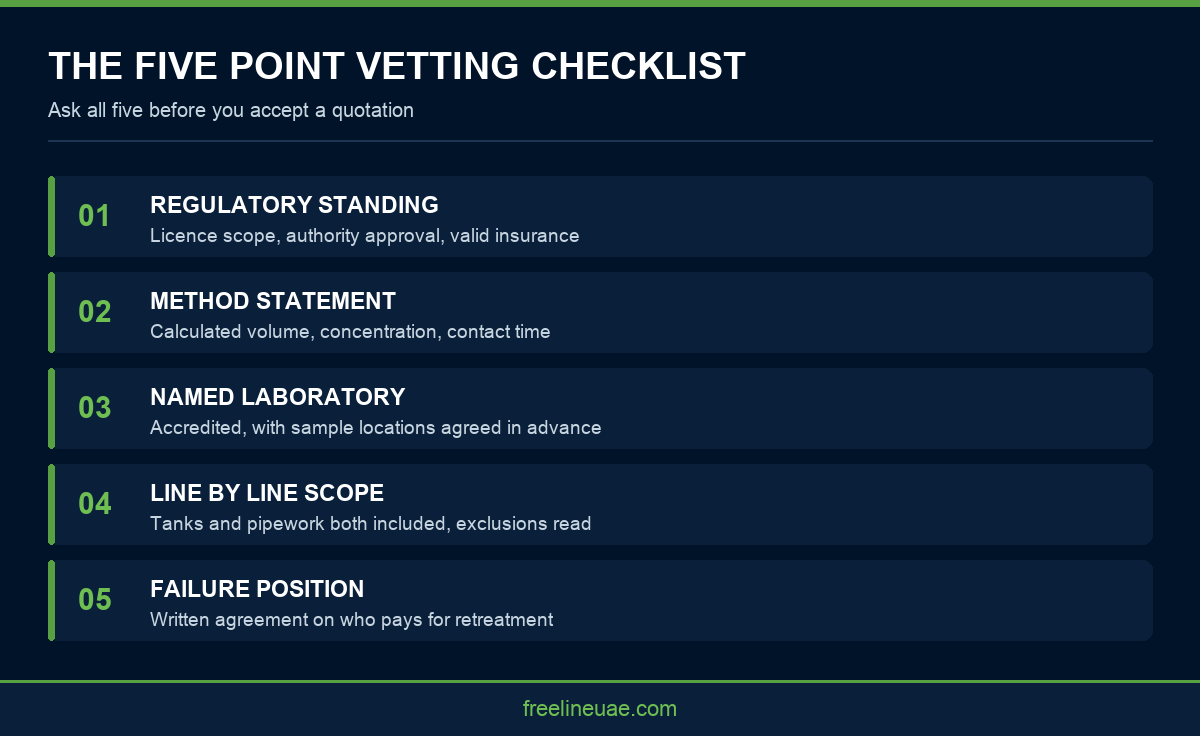
Choosing a water pipeline disinfection company in Dubai is difficult because the finished work is invisible. Every provider produces water that looks identical afterwards, and almost every provider produces a certificate to go with it. The difference between a genuine disinfection and an expensive flush only appears in the detail of how the work is specified, executed and independently proved. These five checks separate the two before you commit to a contract rather than after the invoice arrives.
Key Takeaways
- Regulatory standing and an accredited laboratory relationship are the two non negotiable qualifications. Everything else is a preference.
- A method statement issued before the work, stating volume, concentration and contact time, is the clearest signal of a defined procedure.
- Quotations should be compared line by line. The cheapest price in a tender usually differs in scope, and most often the missing item is laboratory testing.
Start With Regulatory Standing
Water related services in Dubai are overseen by Dubai Municipality, and any company working on potable water systems should be able to evidence its approval status immediately. A provider who needs several days to locate documentation is telling you something about how often it is asked for.
Trade licence scope matters as well as approval. A general cleaning licence does not necessarily cover potable water disinfection, and a mismatch between the licensed activity and the work performed can create difficulty later if a consultant or insurer reviews the file.
Ask how long the company has worked on water systems specifically rather than in maintenance generally. Disinfection sits at the intersection of plumbing, chemistry and documentation, and experience in one of those three does not imply competence across all of them.
Technical grounding is worth probing too. A provider should be comfortable explaining why a residual matters, how water chlorination behaves in a fouled line and why contact time cannot simply be traded for a stronger dose. Fluency here is difficult to fake.
Insurance is the quiet item on this list. Work on a live building water system carries the risk of contamination, chemical handling incidents and supply interruption. Confirming that the cover exists and extends to this activity costs one email and prevents an expensive discussion later.
Ask for the Method Statement
A serious provider issues a method statement before the work rather than an invoice after it. That document should state the calculated system volume, the target concentration, the intended contact period, the isolation arrangements, where residual will be measured and the criterion that constitutes a pass.
The volume figure is the most revealing entry. It requires someone to have surveyed the site, measured tank capacity and calculated the water held in the pipework. A method statement without it means the chemical quantity was estimated, and an estimate at that stage is usually an underdose.
Contact time deserves a direct question, because it determines how long the building loses supply. A provider who cannot state the holding period in advance cannot plan an outage, and a provider who offers a suspiciously short outage is likely trading contact time for convenience.
The isolation plan matters in occupied properties. Which risers come off, in what order, what stays live and how residents are notified are practical questions that reveal whether the company has worked in a live building or only on empty sites. Coordination with plumbing works should be addressed rather than assumed.
Check How Verification Is Handled
Verification is where the market separates. Ask which laboratory will analyse the samples, whether it is accredited, how many sample sets will be taken and at which outlets. Specific answers indicate an established relationship. Vague answers usually mean testing is an optional extra that will appear as a variation later.
Two consecutive sample sets taken at an interval are better practice than a single set. One clear result can reflect residual disinfectant or a favourable outlet, whereas consistent results across identified locations describe the system rather than a moment.
Ask what the analysis actually covers. Bacteriological testing for coliform organisms is the standard confirmation, and a provider should be able to explain what the parameters mean rather than simply forwarding a laboratory sheet. Broader water quality testing is available where a building has a specific concern.
Sample locations should be named in advance. Drawing samples at the plant room produces reassuring results and very little information. The meaningful points are the furthest and least used outlets, because those are where dosed water arrived last and where problems persist.
Ask what happens if a result fails. A company that has done this work often will answer without hesitation and will already have a position on who bears the cost of redosing and retesting. A company that treats the question as hypothetical has probably not been tested by one.
Compare Quotations on Scope, Not Price
Disinfection pricing varies with system volume, isolation complexity, out of hours working and whether laboratory analysis is included. Those four variables explain almost every price gap in a tender, and none of them are visible in a total.
Ask for the quotation to be structured by stage rather than as a single figure, covering survey, cleaning, dosing, flushing and testing. A staged breakdown makes gaps visible immediately.
Read for exclusions rather than inclusions. A quotation covering the storage tanks but silent on distribution pipework addresses half the system, and the untreated half will reseed the treated half within days. Tank work and water tank cleaning and disinfection should appear alongside the pipework scope, not instead of it.
Check whether repeat treatment is priced. On older systems a first pass failure is common enough that the commercial treatment of it should be written down. A quotation that is silent has not removed the risk, it has simply left it with you.
Payment terms tied to results are worth proposing. Where a portion of the fee is linked to a satisfactory laboratory outcome rather than to attendance alone, the incentive to complete the contact period properly is aligned with the building owner rather than against them.
Consider what else the provider can carry. Where disinfection is delivered alongside broader building maintenance, the same party holds the system history, which makes future results interpretable rather than isolated. Splitting the work across providers is cheaper per visit and more expensive per problem.
Red Flags Worth Walking Away From
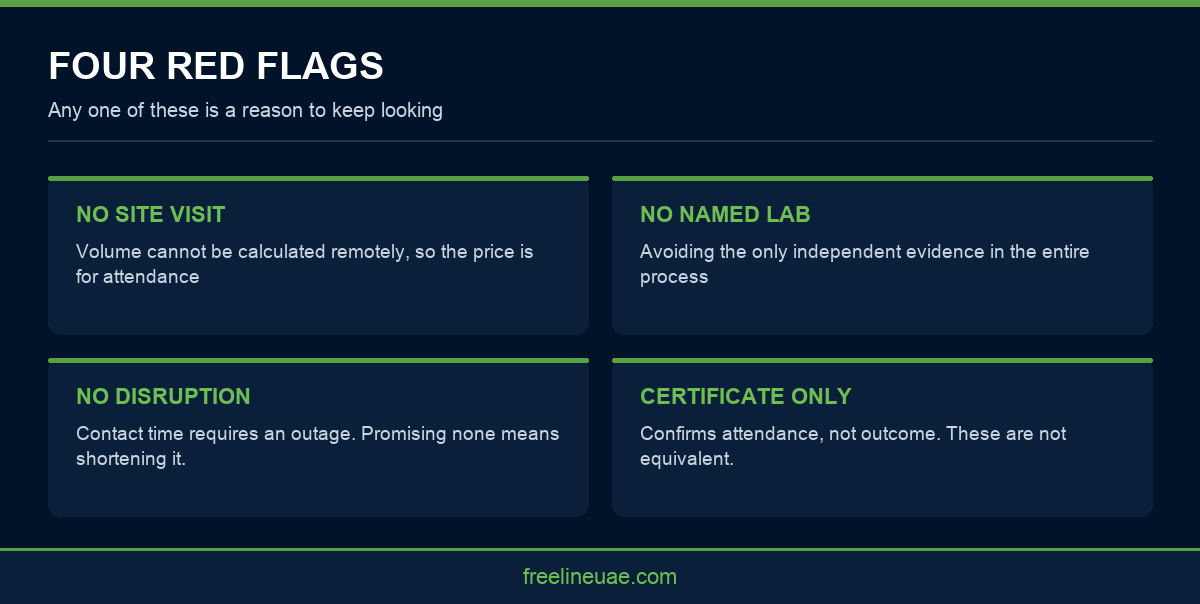
The first is a quotation issued without a site visit. Volume cannot be calculated remotely, so a price produced from a phone call is a price for attendance rather than for a specified piece of work.
The second is reluctance to name a laboratory. Independent analysis is the only part of the process that is not self reported, and a provider avoiding it is avoiding the only objective evidence in the job.
The third is a promise of no disruption. Disinfection requires the system to be out of service for a contact period. A provider promising uninterrupted supply is either planning to shorten contact time or has not understood the request.
The fourth is a certificate offered as the deliverable. A certificate confirms attendance. Laboratory analysis confirms outcome. Any provider treating the two as equivalent is selling paperwork, and the distinction becomes expensive the first time a tenant or purchaser asks for evidence.
The fifth is pressure to sign immediately. Disinfection is rarely a genuine emergency outside a failed test, and a provider manufacturing urgency is usually protecting a price from comparison rather than protecting your building from risk.
The sixth is a refusal to discuss method in technical terms. Concentration, contact time, residual and sampling location are the working vocabulary of this trade, and a provider who cannot use them comfortably has not performed the work often enough to be trusted with an occupied building.
Conclusion
A competent water pipeline disinfection company in Dubai will welcome every question in this article, because answering them is how it distinguishes itself from cheaper providers. Ask for regulatory evidence, a method statement with a calculated volume, a named accredited laboratory, a line by line scope and a written position on retesting. Freeline has delivered water system services across Dubai, Sharjah and Abu Dhabi since 2012. Contact the team for a site survey and a fully specified proposal.
