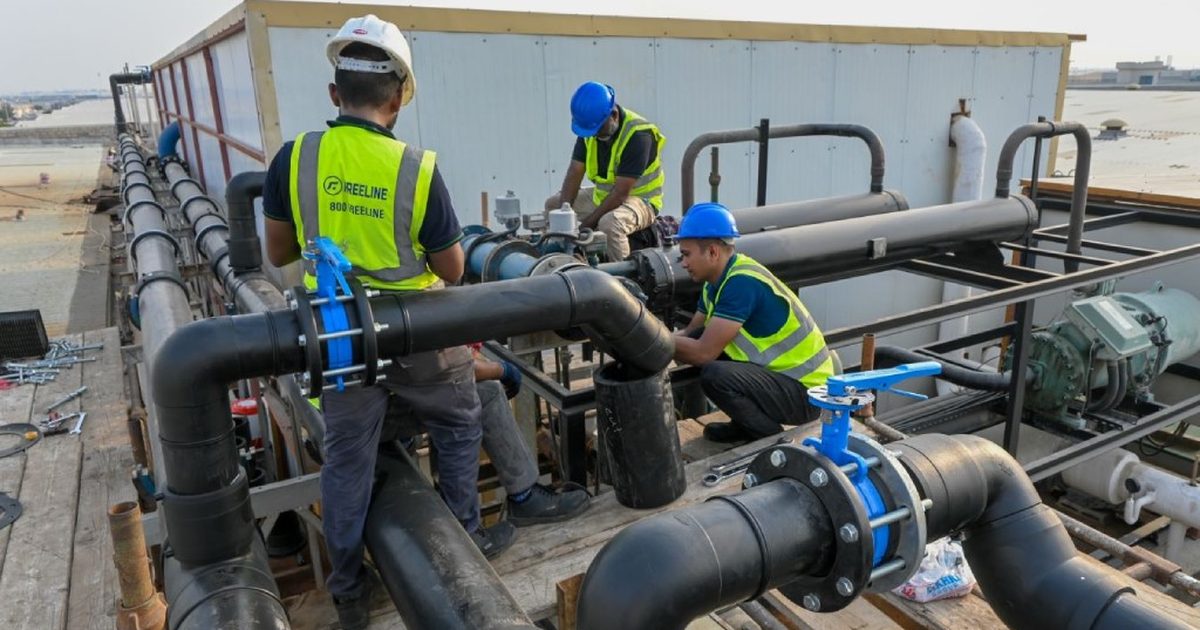
Water Pipeline Disinfection in Dubai: When It Is Mandatory
Building owners rarely ask for water pipeline disinfection in Dubai out of curiosity. They ask because a consultant has requested it, a handover is blocked, or a laboratory result has come back wrong and nobody is sure what it means. This article sets out the situations that create a requirement, explains who is responsible for signing the work off, describes what the completed documentation should contain, and covers what happens when a first result does not pass.
Key Takeaways
- Disinfection requirements are usually triggered by an event rather than a calendar, most often new installation, pipework repair, prolonged stagnation or a failed water test.
- Sign off depends on laboratory evidence, not a contractor declaration. The certificate confirms the visit while the analysis confirms the outcome.
- A failed result is a normal part of the process. What matters is that responsibility for redosing and retesting is agreed before the work begins.
The Situations That Create a Requirement
New installation is the clearest case. Pipework delivered to a site is cut, stored, walked over and left open at both ends for weeks. By the time it is commissioned the interior has collected construction dust and whatever else the environment provided. It cannot carry potable water until it has been cleaned, disinfected and tested.
Repair and modification create the same exposure on a smaller scale. Every time a live line is cut, the protected interior meets the surrounding environment. The affected section needs disinfection afterwards, and this is the requirement most often skipped, because the repair itself feels like the whole job and the building is usually in a hurry.
Stagnation is the quiet trigger. A vacant floor, a wing taken out of service, a property between tenants or a seasonal villa all leave water standing. Micro organisms multiply in still warm water, and returning that system to service without disinfection passes the result directly to the first occupants.
The health basis for these requirements is well established. The World Health Organization reports that microbiologically contaminated drinking water transmits diseases including diarrhoea, cholera, dysentery and typhoid. Those figures describe a global picture, but the mechanism inside a stagnant building riser is the same one.
A failed water quality test is the fourth. Here disinfection is remedial rather than preventive, and it carries an extra obligation. The corrective action is not complete until repeat sampling confirms the problem has actually been cleared rather than temporarily diluted by the flushing that accompanied it.
Disinfection at Building Handover
On a new development, disinfection sits inside the commissioning sequence rather than alongside it. The system is pressure tested, flushed, disinfected, sampled and only then released. Each step depends on the one before, so a delay early in the chain compresses everything after it.
This is where programmes commonly slip. Disinfection needs the system complete, isolated and stable, which conflicts with the reality of a site still finishing outlets and fittings. Work carried out while trades are still cutting into lines will be invalidated by the next connection, and the exercise has to be repeated at the contractor's cost.
The practical answer is to fix the disinfection date against a genuine completion milestone rather than an optimistic one, and to lock the system down once it is reached. Where new HDPE pipe installation or similar works form part of the package, those connections need to be finished before the system is dosed, not after.
It is also worth agreeing early who holds the resulting documentation. Handover packages move between contractor, consultant, developer and eventually the owner or managing agent, and water quality certificates are among the easiest to lose in that chain. They matter later, so they should be filed deliberately.
Who Signs Off the Work
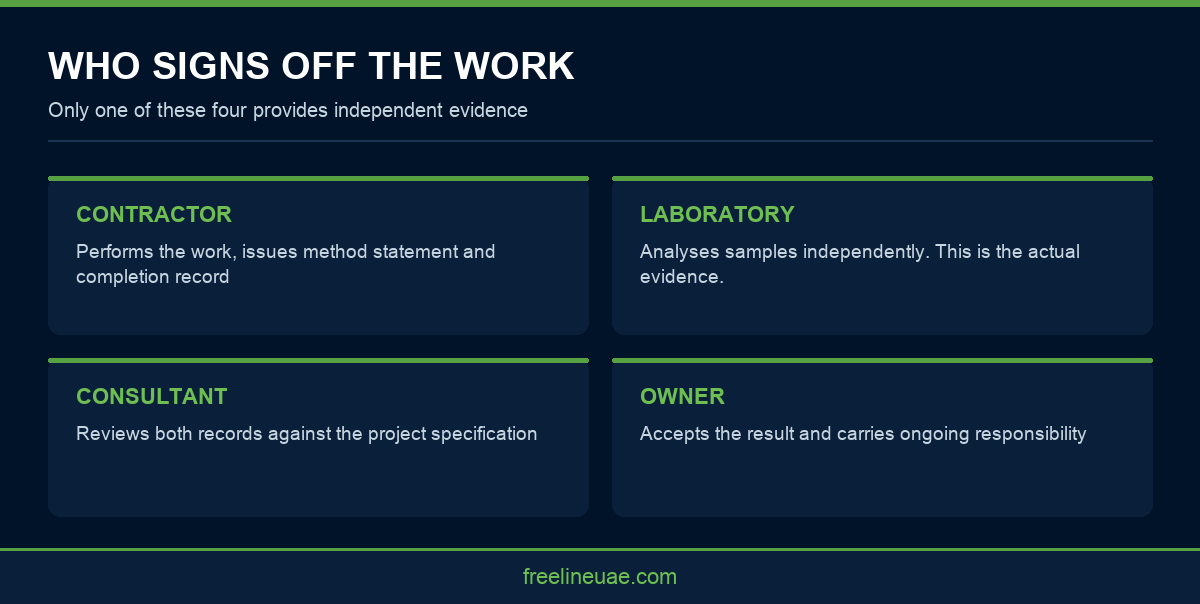
Four parties usually have a role. The contractor performs the work and issues a method statement and completion record. An accredited laboratory analyses the samples and issues the analysis independently. A consultant or the managing agent reviews both against the specification. The building owner accepts the result and carries the ongoing responsibility.
The important separation is between the third and fourth items on that list. The contractor certificate states what was done. The laboratory analysis states what the water is. Only the second is independent evidence, which is why a package containing a contractor certificate but no laboratory report should not be accepted as complete.
Accreditation of the laboratory is worth confirming rather than assuming. An analysis from an unaccredited source may be perfectly accurate, but it is difficult to rely on in a dispute and may not satisfy a consultant reviewing the handover on behalf of a client.
For occupied buildings the review role often falls to whoever manages the property day to day. Where disinfection is delivered within a broader building maintenance arrangement, that review is easier, because the same party holds the history and can see whether a result represents an improvement or a repeat of last year.
What the Sign Off Package Should Contain
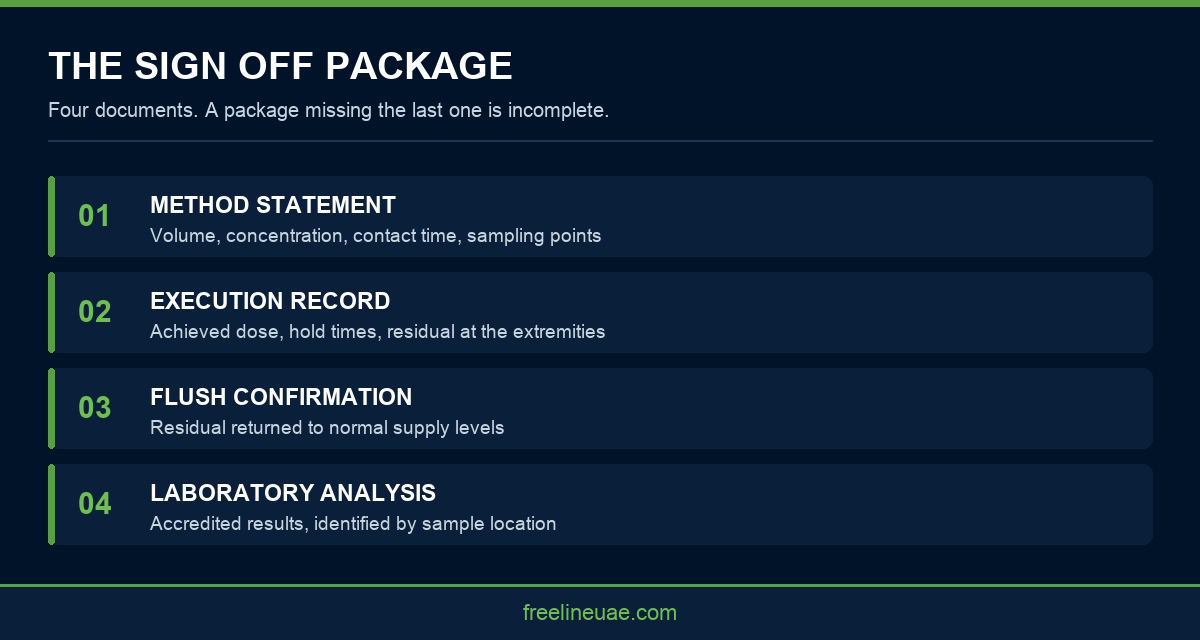
The method statement comes first, ideally issued before the work rather than with the invoice. It should state system volume, target concentration, planned contact time, isolation arrangements, sampling locations and the acceptance criteria being worked to.
The execution record follows. Actual concentration achieved, start and end times for the contact period, residual readings taken at the extremities of the system, and confirmation that flushing continued until residual returned to normal supply levels.
The laboratory analysis completes it. Bacteriological results should show absence of coliform organisms, and good practice uses two consecutive sample sets taken at an interval rather than a single result. Each sample must be identified by location, because results without locations cannot be interpreted.
Sampling method is part of the record too. Outlets should be sampled in a defined condition rather than after running for several minutes, since the objective is to characterise the water quality the system actually delivers rather than the quality it can produce under favourable conditions.
Finally the package should record who performed the work, when, and under what approval. Water related services in Dubai are overseen by Dubai Municipality, and a provider operating in this field should be able to evidence their standing without delay. Related scopes such as water tank cleaning and disinfection should appear in the same record where they formed part of the job.
What Happens When a Result Fails
A failed result is not unusual, particularly on older systems or where cleaning was limited. The most common causes are chlorine demand exceeding the dose, dead legs that were never reached, sampling carried out too soon after flushing, or recontamination from a section that was not isolated.
The response is diagnostic before it is chemical. Repeating an identical dose on an identical system tends to produce an identical failure. The useful questions are whether the residual held at the end of the contact period, whether every branch was actually filled, and whether any part of the network stayed connected to untreated water.
Dead legs deserve particular attention here. A capped branch left from an earlier alteration holds water that never moves and will reseed the system after every treatment. That is a plumbing correction rather than a disinfection problem, and until it is removed the results will keep repeating.
Timing of the retest matters as well. Resampling immediately after a second dose repeats the original error of measuring disinfectant rather than condition, so the sequence of flush, verify residual, then sample must be followed again in full.
The commercial dimension should be settled in advance. Who pays for redosing and retesting when the first result fails is a straightforward question with an awkward answer if it is raised for the first time with the building out of service. Agreeing it at quotation stage costs nothing and prevents a stalemate later.
Conclusion
Water pipeline disinfection in Dubai becomes mandatory at predictable moments, namely new installation, pipework repair, extended stagnation and a failed water test. The requirement is only satisfied when independent laboratory analysis confirms it, and the documentation is what carries that proof forward to the next owner, tenant, purchaser or consultant who asks to see it. If you are approaching handover, or holding a laboratory result you cannot interpret, contact Freeline for a site survey and a fully specified scope of work.
