Water Tank and Pipeline Disinfection: Why Both Together
Water tank and pipeline disinfection are sold as two services and quoted on two lines, which is exactly why so many Dubai buildings buy one and not the other. The tank gets cleaned, the invoice gets paid, and the same complaints return within weeks. The reason is simple and structural. Storage and distribution form one connected system, and treating either half alone leaves a reservoir that recolonises the treated half almost immediately. This article explains why half a scope fails, the order the work must follow, and how to verify that the whole system is genuinely clean. For the scope Freeline works to, see how Freeline sanitises a stored water system.
Key Takeaways
- A tank and its pipework are one system. Clean water from a treated tank entering contaminated pipework is contaminated water by the time it reaches an outlet.
- Order matters as much as scope. Tanks are cleaned first, because dosing a distribution network fed from a dirty tank pushes sediment into the lines being treated.
- Doing both in one mobilisation costs less than two separate visits, because the isolation, the outage notice and the laboratory round trip are all shared.
Why Treating Half the System Fails
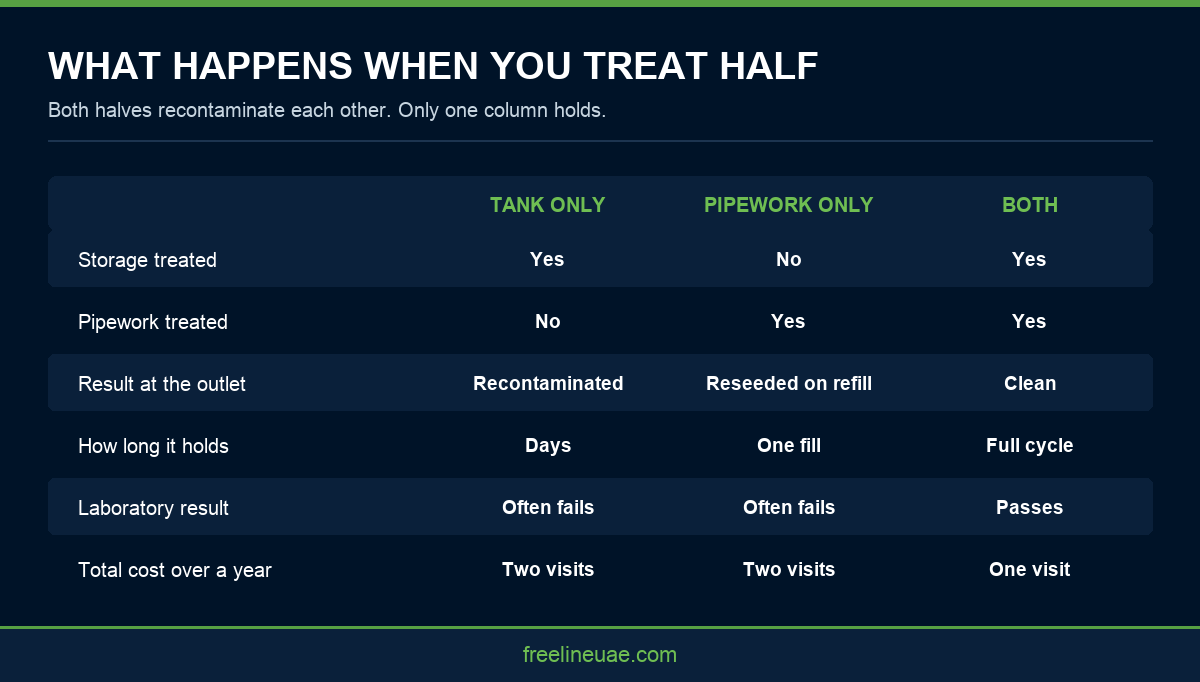
Picture a building where the tank has just been cleaned properly. Sediment removed, surfaces disinfected, laboratory result clear. That water now enters a distribution network whose pipe walls carry an established microbial layer built up over years, and it travels through hundreds of metres of it before anyone drinks it.
The clean water does not sterilise the pipework on its way past. The opposite happens. The biofilm on those walls continuously sheds organisms into whatever flows over it, so the water arriving at an outlet reflects the condition of the pipework far more than the condition of the tank it came from.
The scale of the pipework relative to the tank is what makes this decisive. A building water system holds far more internal surface area in its distribution network than in its storage, so the water supply network inside the building is where most of the microbial habitat actually sits.
The reverse case fails just as reliably. Disinfect the pipework thoroughly, then refill the system from a tank holding years of sediment, and the treated network is reseeded on the very first fill. The chemical was correct, the contact time was correct, and the outcome is still temporary.
Timescales explain why the pattern is so easy to misread. A treated tank feeding untreated pipework can deliver acceptable water for a few days before results drift back, which is long enough for the job to look successful at handover and to have failed by the next test.
This is why owners often report that cleaning made no difference. It frequently did make a difference, briefly, and then the untreated half of the system reasserted itself. Without knowing that the scope was only ever half the system, the reasonable conclusion is that the contractor did poor work.
The Correct Order of Work
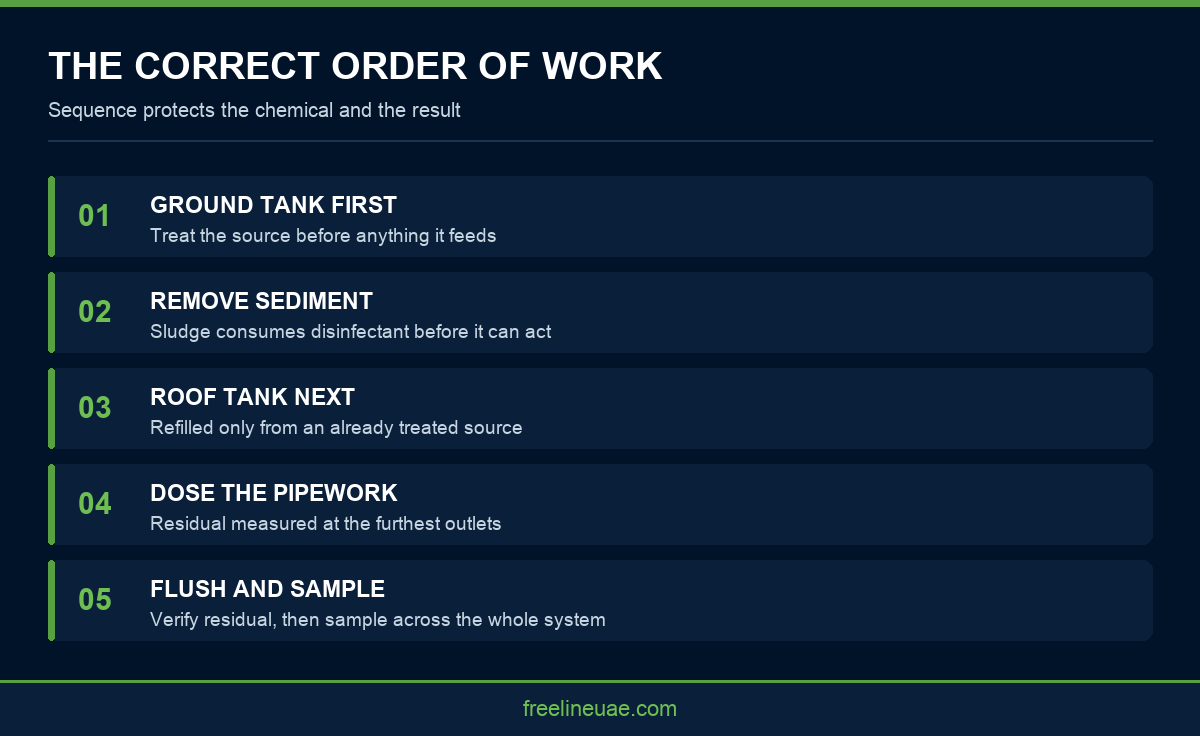
Tanks come first, and the reason is mechanical rather than chemical. A distribution system dosed while being fed from an uncleaned tank draws sediment straight into the pipework it is trying to treat, which both consumes the disinfectant and deposits material in the lines.
Sediment itself is worth understanding, because it is not merely dirt. It is a mixture of settled mineral solids, corrosion products from pipework and accumulated organic matter, and each of those components consumes disinfectant that was intended for the surfaces underneath.
Sediment removal precedes dosing within the tank stage too. Sludge on a tank floor absorbs chlorine rapidly and shelters organisms beneath it, so a tank dosed over an untouched floor produces a collapsed residual and a failed laboratory result at the end of the contact period.
Once storage is clean, the distribution system is dosed to a stated concentration and held for a defined contact period, with residual measured at the extremities rather than at the dosing point. Only then is the system flushed until residual returns to normal supply levels.
Multiple tank arrangements add a further sequencing rule. Buildings commonly run a ground level tank feeding a roof tank, and the ground tank must be handled first, otherwise the treated roof tank is refilled from an untreated source and the work is undone before anyone has finished writing it up.
Dead Legs and the Problem That Keeps Returning
Some buildings do everything correctly and still fail repeatedly at the same sample points. In most of those cases the explanation is a dead leg, meaning a capped or disused branch that holds water which never moves while remaining connected to the live system.
Dead legs accumulate quietly through ordinary building life. Every alteration that removes an outlet, splits a floor, converts a unit or reconfigures a layout risks leaving a stub of pipework behind, and closing it off feels tidy at the time rather than like storing up a problem.
They cannot be solved chemically. A dead leg will not fill and flush properly during treatment, so it is never adequately dosed, and it then reseeds the treated network afterwards. Repeating the disinfection reproduces the same result at the same cost with the same disappointment.
The answer is physical. Dead legs need identifying during survey and cutting back to the main, which is a plumbing correction rather than a water treatment task. Until that happens, no amount of chemistry will produce a durable outcome in the affected part of the system.
The Commercial Case for One Combined Scope
Combining the work is not simply tidier, it is cheaper. A single mobilisation shares the isolation arrangements, the out of hours labour, the resident notice, the flushing effort and the laboratory round trip, all of which have to be repeated and paid for twice if the scopes are split.
Splitting also creates an accountability gap that owners discover at the worst moment. When the tank contractor and the pipework contractor are different companies and a result fails, each has a credible reason to point at the other, and the building funds a third visit to establish which was right.
Programme length is the other saving. A combined scope completes in one outage, whereas split scopes require two separate shutdowns, two rounds of resident notice and two periods where the building is without water, which occupants notice far more than owners expect.
Reading quotations for this is straightforward once you know to look. A proposal covering storage but silent on distribution has addressed half the system at full price, and the omission is usually visible in what the exclusions section does not mention rather than in what the scope claims.
Where the work sits inside a wider building upkeep arrangement, the same provider holds the history for both halves. That matters when a future result comes back marginal, because the question of whether the building is deteriorating can be answered from records rather than from a fresh investigation.
Proving That the Whole System Is Clean
Verification has to reflect the combined scope, which means sampling cannot stop at the tank. A sample drawn at storage describes storage. Samples drawn at the furthest and least used outlets describe what the distribution network is actually delivering to residents.
Sample points should be named in the method statement before work starts rather than chosen afterwards, and every result must carry its location. A laboratory report showing three passes without stating where the samples came from cannot be compared against anything later and settles very little in a dispute.
Timing follows the same discipline as any disinfection. Sampling before flushing is verified captures leftover disinfectant rather than system condition, which produces a comfortable result from a system nobody has actually assessed. Flush, measure the residual, then sample.
Two consecutive sample sets taken at an interval give a far stronger picture than one. Consistency across identified points on separate days describes a system, whereas a single clear result describes a moment, and it is the system that the building has to live with afterwards.
Conclusion
Water tank and pipeline disinfection belong in the same scope, in the right order, verified across the whole system rather than at the tank alone. Buildings that buy the halves separately usually pay more, wait longer and end up repeating work that was competently performed but incompletely specified. If your last clean covered only the tanks, or the same outlets keep failing after treatment, contact Freeline for a survey covering storage, distribution and any dead legs.
