Month: October 2026
Commercial Kitchen Duct Cleaning in Dubai: Full Guide
Commercial kitchen duct cleaning in Dubai is bought as a hygiene service and is really a fire safety measure. Grease deposits inside an extract system are fuel, sitting directly above the only reliable ignition source in the building. This guide covers what a full extract system contains, how often each part needs cleaning, what a competent contractor actually does, and how an operator can verify that the work actually reached the parts of the system nobody can see, which is where the fire load sits. For the scope Freeline works to, see how Freeline degreases a canopy and its ductwork.
Key Takeaways
- The hood is the visible tenth of the system. Fire risk concentrates in the horizontal duct runs and the riser, which is where cheap cleaning stops.
- Frequency follows cooking type and volume rather than the calendar. A charcoal grill loads an extract system far faster than a bakery does.
- Verification means photographs of the duct interior at identified access points, plus deposit measurement where the system is heavily loaded.
What a Commercial Extract System Contains
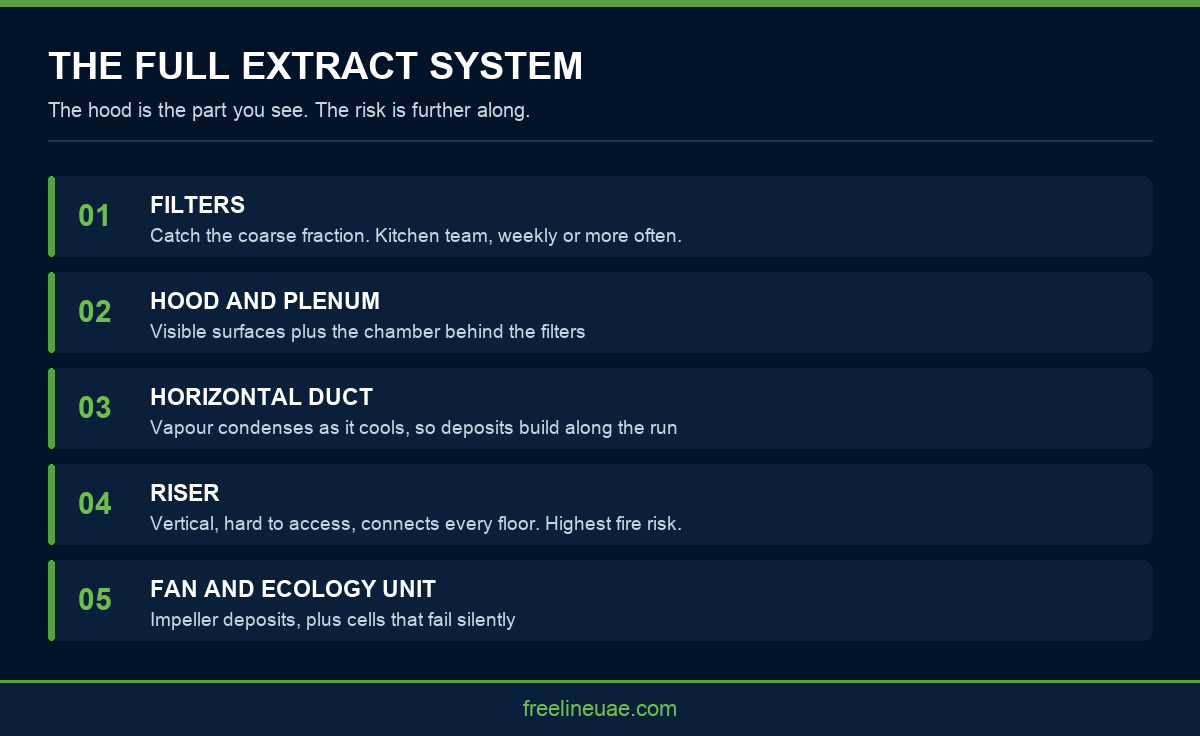
Most operators picture the hood, because it is the part they see every day. The hood is one component of a system that also includes grease filters, a plenum behind the filters, horizontal ductwork above the ceiling, a vertical riser, an extract fan and often an odour or pollution control unit near the discharge.
Getting commercial kitchen duct cleaning in Dubai right therefore starts with knowing what the system contains, because a scope written around the visible canopy will be priced and delivered around the visible canopy.
Grease behaves differently in each of those sections. Filters catch the coarse fraction and are designed to be removed and washed. What passes them condenses as the vapour cools, so deposits build progressively along the duct, and the heaviest accumulation often sits well away from the kitchen itself.
The riser is the section that matters most for fire and the section least likely to be cleaned. It is vertical, difficult to access, frequently has no access panels at all, and it connects every floor between the kitchen and the roof, which is precisely why a fire in it spreads so effectively.
Ecology units, sometimes called ESP or pollution control units, sit near the discharge and use electrostatic cells to capture grease and smoke before air leaves the building. They are common in Dubai because of proximity requirements between kitchen discharges and neighbouring occupancies.
Those cells need their own cleaning regime and they fail quietly. An ecology unit whose cells are saturated stops collecting, so the grease that it should have captured continues to the discharge point and starts appearing on the roof, on adjacent facades and in neighbour complaints.
Make up air is the component nobody lists and every busy kitchen depends on. If the extract removes more air than the supply replaces, the kitchen goes into deficit, doors become hard to open, appliances misbehave and the hood stops capturing properly, and none of that is solved by cleaning the duct.
The extract fan collects deposits on the impeller, which causes imbalance, vibration, noise and eventually bearing failure. It is also the component that determines whether the system still pulls the air volume the kitchen was designed around.
Duct construction varies more than operators realise. Older installations may be assembled from sections that were never intended to be opened, while newer work is often built with cleaning in mind, and the difference determines how much access provision a first clean will require.
Understanding the system as a whole is the difference between buying a clean and buying a photograph of a clean hood. Every component listed above needs to appear in a scope of work, because anything not named will reasonably be treated as excluded.
Why Grease in Ductwork Is a Fire Problem
Deposited grease is combustible, and in an extract system it forms a continuous layer along a duct that runs from a heat source through the structure of the building. A flare up at the appliance can ignite deposits at the hood, and the duct then carries fire away from the kitchen.
The geometry makes this worse rather than better. A duct is an enclosed channel with airflow through it, which is close to an ideal arrangement for propagating a fire, and the extract fan continues to supply air until somebody isolates it or it fails.
Suppression systems installed over cooking ranges protect the appliance and the hood. They do not protect the ductwork beyond it, so a system with excellent suppression and a heavily loaded riser still carries substantial risk further along the route.
This is why the recognised approach to fire safety in commercial kitchens treats deposit removal as the primary control. Suppression handles ignition at the appliance, and cleaning removes the fuel everywhere else, and neither substitutes for the other.
Fire spread through a concealed route is also harder to fight than fire in an open space. Crews cannot see the extent of it, the duct passes through compartment lines that were designed to stop fire moving, and access to a burning riser usually means opening the structure while it is alight.
Insurance is the practical consequence most operators encounter first. Policies commonly require documented extract cleaning at stated intervals, and a claim following a kitchen fire will attract scrutiny of exactly that documentation, which is a poor moment to discover the records only cover the hood.
Dubai enforces kitchen hygiene and fire requirements through municipal inspection, and extract condition is a visible part of that. An operator who can produce a dated cleaning record with interior photographs is in a far stronger position during an inspection than one relying on the appearance of a clean canopy.
How Often Each Part Needs Cleaning
Frequency is the question operators ask first about commercial kitchen duct cleaning in Dubai, and it is the one with the least satisfying answer, because the honest response depends on measurements nobody has taken yet.
There is no single interval that suits every kitchen, and any contractor offering one has not asked what is being cooked. The workable approach is to inspect, set the interval from measured deposit, then adjust as subsequent inspections show whether the system is loading faster or slower than expected.
Deposit measurement makes this objective. Where a contractor records deposit thickness at fixed points at each visit, the operator gains a trend rather than an opinion, and the interval can be shortened or extended on evidence rather than negotiated on price.
Operating hours matter as much as menu. A kitchen that extends from a single service to all day trading has roughly doubled the hours its extract runs, and deposit accumulates against running time rather than against the calendar the interval was written on.
Menu changes should trigger a review. A kitchen that adds a grill, changes its frying volume or extends its operating hours has changed its loading rate, and an interval set before that change will no longer be appropriate.
By cooking type and volume
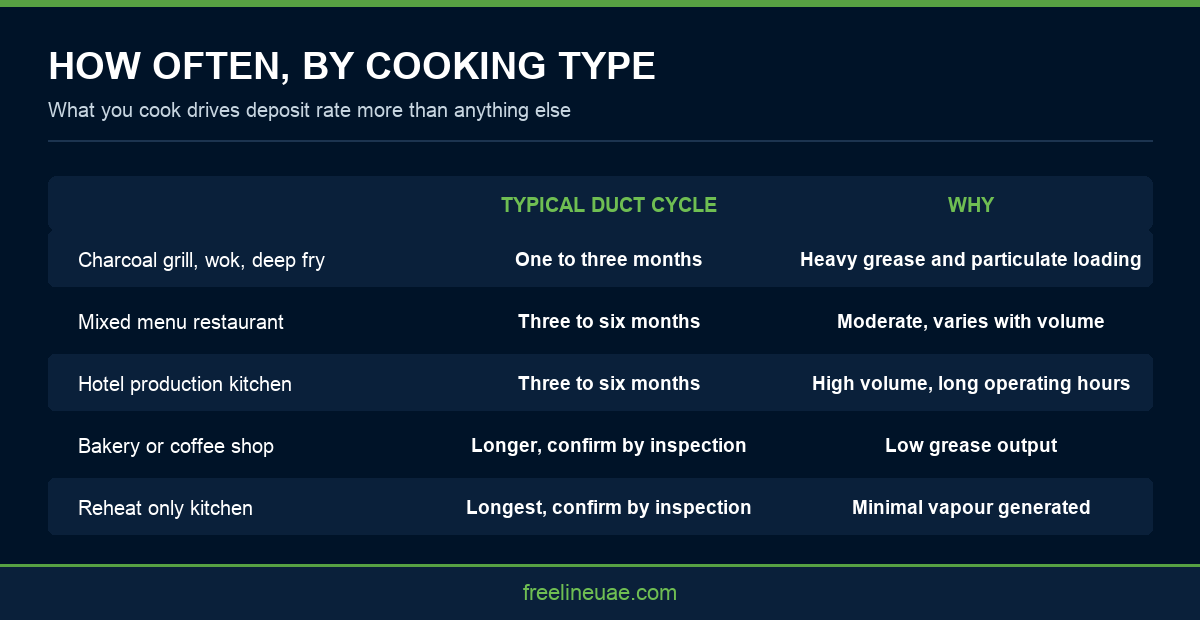
Cooking method drives deposit rate more than anything else. Charcoal grilling, wok cooking, deep frying and high volume shawarma production generate heavy grease and particulate loading, and systems serving them can require attention every one to three months.
Moderate operations such as mixed menu restaurants and hotel kitchens commonly sit on a three to six month cycle for ductwork. Low grease operations including bakeries, coffee shops and reheat only kitchens can often run longer, provided the interval is confirmed by inspection rather than assumed.
Component intervals differ
Filters are the shortest cycle and belong to the kitchen team rather than the contractor, typically washed weekly or more often in heavy use. Hoods and plenums sit next, then horizontal ductwork, with the riser and fan usually cleaned on the same visit as the ducts.
Ecology unit cells need separate scheduling and are frequently forgotten. Where they are fitted, cell cleaning should appear in the maintenance calendar in its own right rather than being assumed to happen alongside the duct clean.
What Proper Extract Cleaning Involves
The kitchen hood is where the work starts and it is the least demanding part of it. Everything downstream of the filters requires access, planning and physical removal of deposit rather than wiping of a visible surface.
Work begins with inspection and access planning rather than with equipment. The contractor needs to establish the duct route, locate existing access panels, identify where new ones are required and agree how the kitchen will be protected during the work.
Access provision is the single biggest differentiator between thorough and superficial contractors. Ductwork cannot be cleaned along its length without openings at reasonable intervals, and a great many Dubai kitchens have far too few, particularly in the riser.
Creating access panels and making them good afterwards is legitimate, necessary work. A contractor who never proposes new panels is telling you that they clean what they can reach through existing openings and leave the rest, which is where the deposits actually are.
The cleaning itself combines scraping, brushing and chemical treatment appropriate to the deposit, followed by rinsing and full removal of the residue. Kitchen surfaces, equipment and floors need protecting before any of it starts, because the material coming out is unpleasant and gets everywhere.
Fire dampers within the duct route need checking while access is open. They are often painted over, seized or missing entirely, and a damper that cannot close removes the compartmentation the building design assumed was there.
Filters, the plenum, the hood interior, the horizontal ducts, the riser, the fan and the ecology unit cells should each be addressed and each be evidenced. A scope that names only the hood and ducts will be delivered exactly as written, and the fan and cells will still be loaded afterwards.
Fan cleaning deserves naming explicitly in the scope. The impeller collects a heavy uneven deposit that causes imbalance and vibration, and a fan left uncleaned across several duct cleans will eventually fail in a way that stops the kitchen entirely.
Reinstatement matters more in kitchens than elsewhere because the space must be handed back food safe. Surfaces need cleaning down, protection removing and the system running and checked before service resumes, and that time belongs in the programme rather than being absorbed by the operator.
Protecting the kitchen before work starts
Extract cleaning is dirty work carried out in a food production space, so protection is part of the method rather than a courtesy. Equipment, preparation surfaces, floors and drainage need covering before any panel is opened, because the material removed is heavy, greasy and travels further than operators expect.
Handback condition matters as much as the cleaning. The space must be returned food safe, which means surfaces cleaned down, protection removed and disposed of properly, and the system run and checked before the kitchen reopens for service.
Chemical selection and residue removal
Products are selected against the deposit rather than applied uniformly. Light condensate responds to a mild degreaser, whereas baked carbonised deposit near the hood usually needs mechanical scraping first, and no chemical substitutes for physical removal at that end of the system.
Residue removal is the stage that separates a clean from a smear. Loosened grease must be collected and taken away rather than rinsed further along the duct, since flushing deposits deeper into the run simply relocates the fire load to a less accessible section.
How the Result Should Be Proved
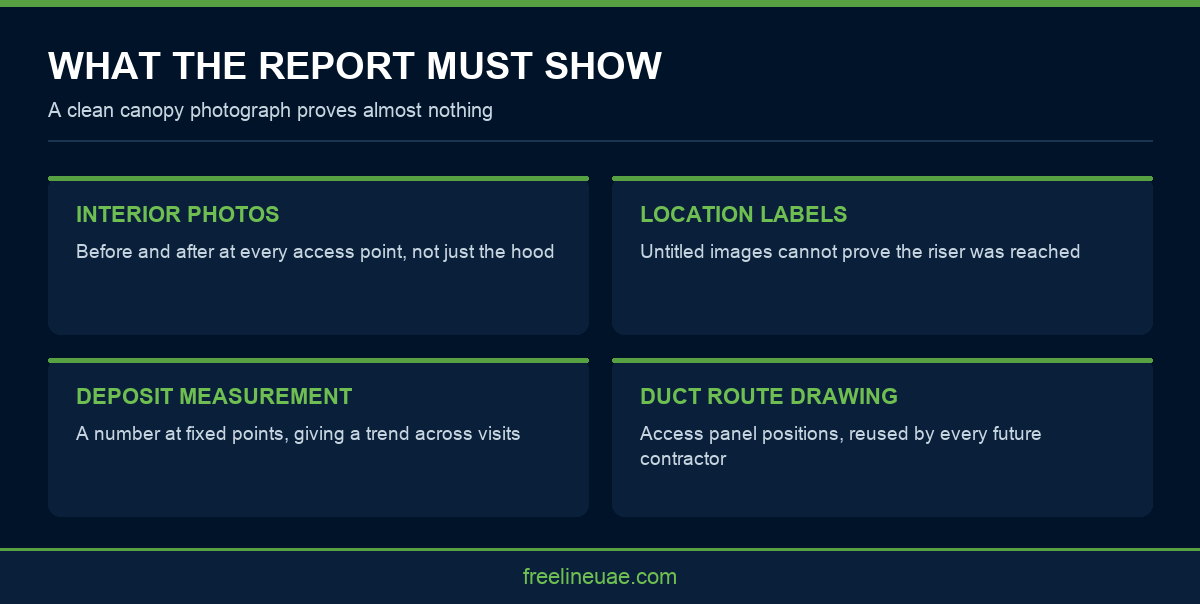
The deliverable is interior evidence. Before and after photographs taken at each access point, labelled with their location, are the only practical way an operator can confirm what happened inside a duct they will never see themselves.
Location labelling is what makes those images usable. A folder of untitled photographs proves that something was cleaned somewhere, which is not the same as demonstrating that the riser between the second and fourth floors was reached.
Where a kitchen also runs comfort cooling, keep the two records separate. Extract cleaning and ductwork cleaning address entirely different systems with different standards, and conflating them in a maintenance file confuses everyone reviewing it later.
Deposit measurement adds objectivity where the system is heavily loaded. Recording deposit thickness at fixed points before and after gives a number rather than an impression, and repeated over several visits it produces the trend that sets a defensible interval.
Airflow measurement is worth taking alongside the photographs. Recording extract volume before and after gives an objective figure, and where the reading has fallen well below design it usually points at the fan or a blocked ecology unit rather than at the ductwork.
A duct route drawing marked with access panel positions is worth requesting once and reusing thereafter. It tells every future contractor where the openings are, prevents the same access being cut twice, and reveals immediately if a section has no access at all.
Consistency of access points across visits is what makes the evidence comparable. Where each contractor photographs different openings, the operator accumulates images that cannot be read as a sequence, and the trend that should inform the interval never becomes visible.
Keep the records with the fire documentation rather than with general maintenance invoices. That is where they will be looked for during an insurance review or an incident investigation, and it is where their absence would be most costly.
Ecology Units and Odour Control
Ecology units are common in Dubai because kitchen discharges frequently sit close to residential windows, hotel terraces or neighbouring commercial premises. They use an electrostatic precipitator to charge and collect grease and smoke particles before air leaves the building.
Roof condition tells you how well the unit is working. Where grease is visible around the discharge or on the surrounding waste management and plant areas, the collection stage has been failing for some time regardless of what the service record says.
Their weakness is that they degrade invisibly. Collection efficiency falls as the cells load, and there is no obvious symptom inside the kitchen, so the first indication is usually grease appearing at the discharge or a complaint from a neighbouring occupier.
Cell cleaning is a specific task with its own frequency, generally more often than duct cleaning in a busy kitchen. Cells are removed, washed, dried and refitted, and any damaged plates or failed high voltage components are found during that process rather than during a complaint.
Cell condition is worth inspecting rather than assuming. Bent or damaged collector plates short out, high voltage supplies fail, and a unit can appear to be running while collecting almost nothing, which is why a cell clean should include a functional check.
Carbon filtration is sometimes added downstream for odour rather than grease, and it is worth understanding that the two do different jobs. Carbon adsorbs odour compounds and saturates over time, and a saturated carbon stage stops working without any visible change.
Discharge position is the underlying constraint and it is rarely changeable after the event. Where a flue terminates close to windows, terraces or an air intake, the pollution control equipment is doing work that separation would otherwise have done, so its maintenance is not optional.
Where a kitchen discharges near sensitive neighbours, the ecology unit and any carbon stage should be treated as critical assets with their own maintenance record. Their failure produces complaints and enforcement attention long before anyone notices a performance change inside the kitchen itself.
Choosing a Kitchen Extract Contractor
Ask how the riser will be cleaned first, because the answer separates the market immediately. A contractor with a considered approach to vertical duct access, including where panels will be created, is describing real work rather than a canopy wipe.
Ask about crew competency for confined and vertical access. Riser cleaning frequently involves working at height and in restricted spaces, and a contractor without documented procedure for it will either avoid the riser or take risks in your building.
Ask what evidence will be provided and request an anonymised example from another site. A provider used to this work will produce location labelled interior photographs and a duct route drawing, not a handful of pictures of a clean stainless steel canopy.
Ask whether drainage in the kitchen is included or separate. Extract cleaning and drain line clearing frequently need the same out of hours window, and buying them together avoids a second closure later in the month.
Ask how the work fits around service. Most kitchen extract cleaning happens overnight or on closure days, and a contractor who has not raised timing, protection and food safe reinstatement has not thought about the operational reality of your site.
Ask whether ecology unit cells, the extract fan and the ecology unit servicing scope are included or priced separately, because these are the components most often omitted and most likely to generate complaints when neglected.
Ask how variations will be handled once panels are open. Collapsed duct sections, missing fire dampers, corroded riser plate and previously undiscovered blind sections are all common findings, and a stated approach avoids a negotiation during a night shift.
Finally, consider scope breadth across the kitchen. Extract cleaning sits alongside interceptor servicing and drainage in the same premises, and a single provider covering both keeps the compliance records together and avoids two sets of night visits.
Freeline has served UAE commercial kitchens since 2012 across Dubai, Sharjah and Abu Dhabi, covering hoods, ducts, risers, fans and ecology units alongside its wider services.
Conclusion
Commercial kitchen duct cleaning in Dubai is a fire control measure that happens to improve hygiene, and it is only as good as the parts of the system it reaches. Insist on a scope naming every component, access panels where the duct route needs them, interior photographs labelled by location, and deposit measurement where loading is heavy. If your records only cover the hood, or nobody can tell you when the riser was last cleaned, contact Freeline for a survey.
