

Pipe Disinfection Services in Dubai: New Builds vs Existing
Pipe disinfection services in Dubai are quoted as a single product, but they are really two different jobs. Disinfecting an empty building before handover and disinfecting an occupied tower already in service share the same chemistry and almost nothing else. Scope, sequencing, access, risk and cost all diverge sharply between them. Knowing which of the two situations your property is actually in is what prevents you from buying a scope written for somebody else’s building.
Key Takeaways
- New build disinfection is a commissioning activity governed by programme. Existing building disinfection is a maintenance activity governed by occupancy.
- The technical process is identical. What changes is access, isolation, outage planning and the amount of unknown pipework involved.
- Existing buildings usually need a survey and a cleaning stage first, which is the step most often missing from a quotation written for a new build.
Why New Builds and Existing Buildings Differ
On a new development the system is documented, empty and accessible. Drawings exist, isolation valves are known, nobody is drawing water and the pipework has never been in service. The contamination present is construction debris rather than established biological growth.
An occupied building is the opposite on every count. Drawings may be outdated or missing, alterations have accumulated over years, valves may not hold, and the system contains mature growth on the pipe walls. Water is also being consumed continuously, which means any treatment requires an outage that affects people.
That difference changes the chemistry as well as the logistics. Construction debris consumes some chlorine, but established biological growth consumes far more and shields itself while doing so. The same dose that comfortably passes on a new system can collapse on an old one, which is why transferring a new build method statement onto an existing building tends to fail.
Material matters too. Modern developments commonly use high density polyethylene and similar plastics, while older buildings may combine several generations of pipework with different surface characteristics. Mixed material systems behave less predictably under dosing, which is another reason the survey is not optional.
It also changes what success looks like. On a new build the objective is to hand over a clean system with documentation. On an occupied building the objective is to correct a condition that developed over time and to leave the building operating in a way that slows its return.

Scope for New Builds
The work sits inside commissioning, after pressure testing and before handover. The sequence is flush, disinfect, sample, release, and each stage depends on the one before it, so the programme has little tolerance for slippage.
The main risk is starting too early. Disinfection performed while trades are still cutting into lines to fit outlets will be invalidated by the next connection, and the exercise has to be repeated. The system must be genuinely complete and then locked down, which is a site management decision rather than a technical one.
Coordination with the installing contractor matters. Where the package includes new HDPE pipe installation or similar pipework, the disinfection crew needs final connection dates rather than planned ones, and needs to know that no further breaks are scheduled.
Documentation is the deliverable. A new build package should carry the method statement, the execution record and accredited laboratory analysis identified by sample location. That package follows the building for years, so it should be filed deliberately rather than left in a contractor’s email.
Scope for Occupied Buildings
Existing buildings need a survey first, and it is not a formality. The survey establishes system volume, locates isolation points, identifies pipe materials, records which outlets exist and finds the dead legs that drawings do not show. Every figure in the method statement depends on it.
Cleaning normally precedes dosing. Tanks holding years of sediment will strip a chlorine dose before it reaches the pipework, so water tank cleaning and disinfection is generally carried out first. Attempting to overcome accumulated deposit with chemistry alone is more expensive than removing it.
Dead legs deserve explicit treatment. Capped branches left behind by past alterations hold water that never moves, and they will reseed the system after every treatment. Identifying and removing them is a plumbing correction, and until it happens the results will keep repeating.
Temperature control belongs in the conversation for older properties. Disinfection resets the condition, but warm cold water lines and low flow branches allow organisms such as Legionella to re establish, so operational changes should accompany the treatment rather than follow the next failure.
Expect a higher chance of first pass failure than on a new build, and price for it. This is not a sign of poor workmanship. It reflects the condition of an older system, and the sensible response is to agree in advance how retreatment will be handled commercially.
Planning the Outage in a Live Building
The contact period requires the water system to be out of service, and in an occupied property that is the hardest part of the job to arrange. Night working is common, and phasing by riser allows part of the building to keep supply while another part is treated.
Access is the second constraint. Outlets inside private units cannot be flushed unless somebody can enter them, so access arrangements need to be agreed with occupants in advance rather than negotiated on the night with a crew waiting.
Notice is a genuine deliverable rather than a courtesy. Residents and tenants need to know the date, the duration, what will not work and when normal supply resumes. Most complaints about this work concern communication rather than the work itself.
Some facilities cannot lose supply at all. Clinics, kitchens, data halls with humidification and certain retail units may need a temporary supply arrangement or a separate phase. These need identifying at survey, because discovering them on the night converts a planned outage into an incident.
The building also needs a return to service plan. Every outlet in scope should be run and checked during flushing, including those in vacant units, because a branch left unflushed holds concentrated water that will reach someone eventually. This is tedious work and it is where corners are most often cut.

Choosing the Right Scope for Your Property
If the building is new and approaching handover, the requirement is a commissioning scope tied to a firm completion date, with documentation as the output. The main thing to protect is the lockdown period between completion and sampling.
If the building is occupied and has never been treated, the requirement is a survey led scope covering tanks, pipework, dead leg identification and a realistic outage plan. A quotation that skips the survey is quoting for a job nobody has yet defined.
If the building has failed a water test, the requirement is diagnostic before it is chemical. Repeating a dose on a system whose failure cause is unknown usually reproduces the failure, so investigation should come first and treatment second.
If the building is simply due for review, the sensible route is to place disinfection inside a planned building maintenance cycle alongside tank cleaning. Records then accumulate into a history, and a future result can be compared against a baseline instead of interpreted in isolation.
Portfolio owners benefit from standardising the approach across properties. Consistent method statements and comparable records make it possible to see which buildings are deteriorating and which are stable, which turns disinfection from a recurring cost into planning information.
Across all four, the technical requirements do not change. Concentration, contact time, residual verification, controlled flushing and independent laboratory analysis apply equally to a tower at handover and a villa returning from a long vacancy.
Conclusion
Pipe disinfection services in Dubai are priced as a single line item and delivered as two very different jobs. New builds need programme discipline and a locked down system. Occupied buildings need a survey, a cleaning stage, an outage plan and a realistic view of first pass failure. Matching the scope to the situation is what determines whether the result holds. Contact Freeline for a survey and a scope written for your building rather than a generic quotation.
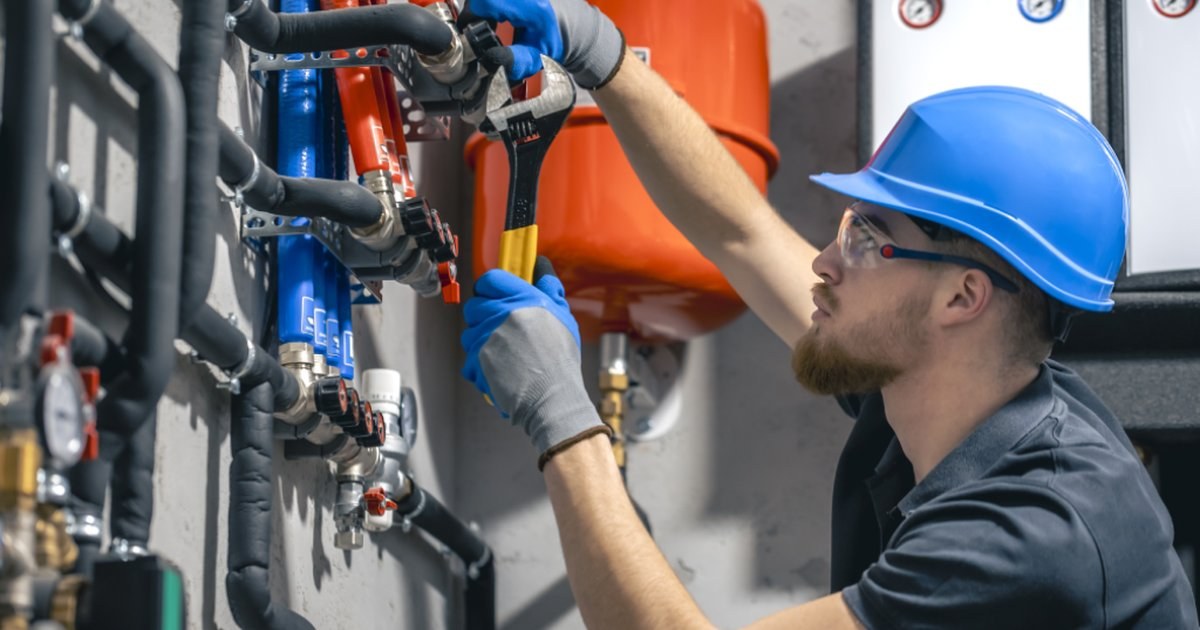
Choosing a Water Pipeline Disinfection Company in Dubai
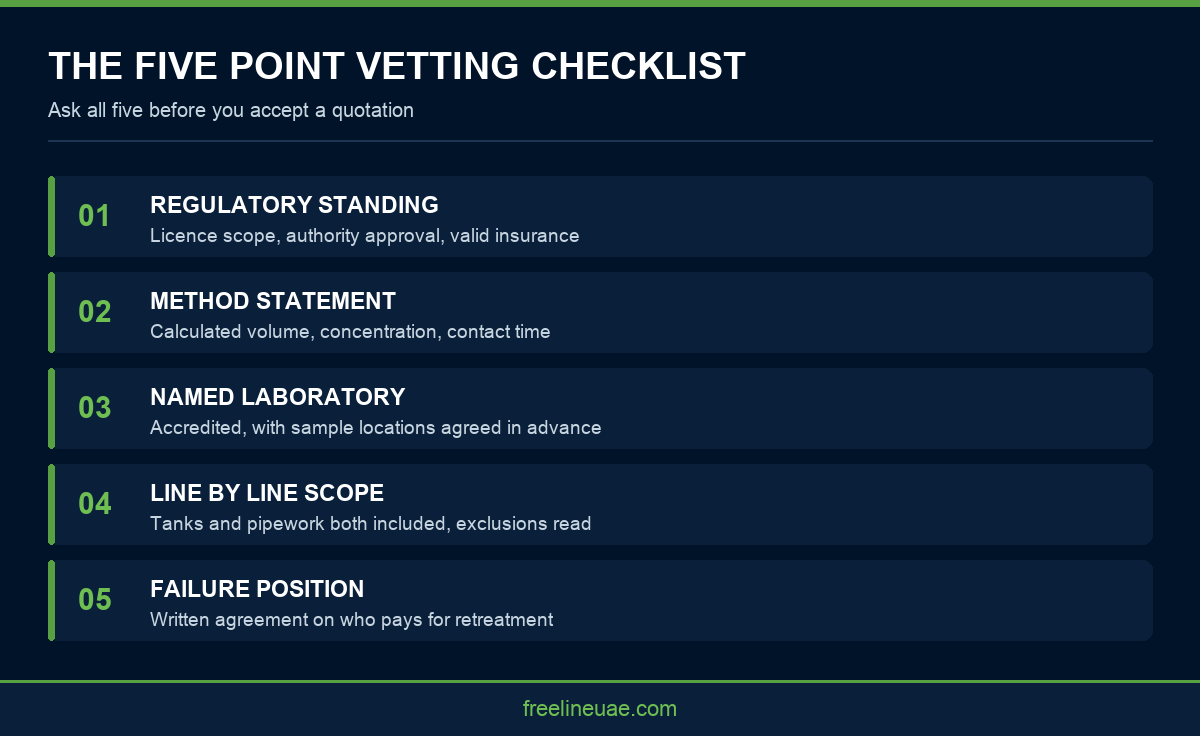
Choosing a water pipeline disinfection company in Dubai is difficult because the finished work is invisible. Every provider produces water that looks identical afterwards, and almost every provider produces a certificate to go with it. The difference between a genuine disinfection and an expensive flush only appears in the detail of how the work is specified, executed and independently proved. These five checks separate the two before you commit to a contract rather than after the invoice arrives.
Key Takeaways
- Regulatory standing and an accredited laboratory relationship are the two non negotiable qualifications. Everything else is a preference.
- A method statement issued before the work, stating volume, concentration and contact time, is the clearest signal of a defined procedure.
- Quotations should be compared line by line. The cheapest price in a tender usually differs in scope, and most often the missing item is laboratory testing.
Start With Regulatory Standing
Water related services in Dubai are overseen by Dubai Municipality, and any company working on potable water systems should be able to evidence its approval status immediately. A provider who needs several days to locate documentation is telling you something about how often it is asked for.
Trade licence scope matters as well as approval. A general cleaning licence does not necessarily cover potable water disinfection, and a mismatch between the licensed activity and the work performed can create difficulty later if a consultant or insurer reviews the file.
Ask how long the company has worked on water systems specifically rather than in maintenance generally. Disinfection sits at the intersection of plumbing, chemistry and documentation, and experience in one of those three does not imply competence across all of them.
Technical grounding is worth probing too. A provider should be comfortable explaining why a residual matters, how water chlorination behaves in a fouled line and why contact time cannot simply be traded for a stronger dose. Fluency here is difficult to fake.
Insurance is the quiet item on this list. Work on a live building water system carries the risk of contamination, chemical handling incidents and supply interruption. Confirming that the cover exists and extends to this activity costs one email and prevents an expensive discussion later.
Ask for the Method Statement
A serious provider issues a method statement before the work rather than an invoice after it. That document should state the calculated system volume, the target concentration, the intended contact period, the isolation arrangements, where residual will be measured and the criterion that constitutes a pass.
The volume figure is the most revealing entry. It requires someone to have surveyed the site, measured tank capacity and calculated the water held in the pipework. A method statement without it means the chemical quantity was estimated, and an estimate at that stage is usually an underdose.
Contact time deserves a direct question, because it determines how long the building loses supply. A provider who cannot state the holding period in advance cannot plan an outage, and a provider who offers a suspiciously short outage is likely trading contact time for convenience.
The isolation plan matters in occupied properties. Which risers come off, in what order, what stays live and how residents are notified are practical questions that reveal whether the company has worked in a live building or only on empty sites. Coordination with plumbing works should be addressed rather than assumed.
Check How Verification Is Handled
Verification is where the market separates. Ask which laboratory will analyse the samples, whether it is accredited, how many sample sets will be taken and at which outlets. Specific answers indicate an established relationship. Vague answers usually mean testing is an optional extra that will appear as a variation later.
Two consecutive sample sets taken at an interval are better practice than a single set. One clear result can reflect residual disinfectant or a favourable outlet, whereas consistent results across identified locations describe the system rather than a moment.
Ask what the analysis actually covers. Bacteriological testing for coliform organisms is the standard confirmation, and a provider should be able to explain what the parameters mean rather than simply forwarding a laboratory sheet. Broader water quality testing is available where a building has a specific concern.
Sample locations should be named in advance. Drawing samples at the plant room produces reassuring results and very little information. The meaningful points are the furthest and least used outlets, because those are where dosed water arrived last and where problems persist.
Ask what happens if a result fails. A company that has done this work often will answer without hesitation and will already have a position on who bears the cost of redosing and retesting. A company that treats the question as hypothetical has probably not been tested by one.
Compare Quotations on Scope, Not Price
Disinfection pricing varies with system volume, isolation complexity, out of hours working and whether laboratory analysis is included. Those four variables explain almost every price gap in a tender, and none of them are visible in a total.
Ask for the quotation to be structured by stage rather than as a single figure, covering survey, cleaning, dosing, flushing and testing. A staged breakdown makes gaps visible immediately.
Read for exclusions rather than inclusions. A quotation covering the storage tanks but silent on distribution pipework addresses half the system, and the untreated half will reseed the treated half within days. Tank work and water tank cleaning and disinfection should appear alongside the pipework scope, not instead of it.
Check whether repeat treatment is priced. On older systems a first pass failure is common enough that the commercial treatment of it should be written down. A quotation that is silent has not removed the risk, it has simply left it with you.
Payment terms tied to results are worth proposing. Where a portion of the fee is linked to a satisfactory laboratory outcome rather than to attendance alone, the incentive to complete the contact period properly is aligned with the building owner rather than against them.
Consider what else the provider can carry. Where disinfection is delivered alongside broader building maintenance, the same party holds the system history, which makes future results interpretable rather than isolated. Splitting the work across providers is cheaper per visit and more expensive per problem.
Red Flags Worth Walking Away From
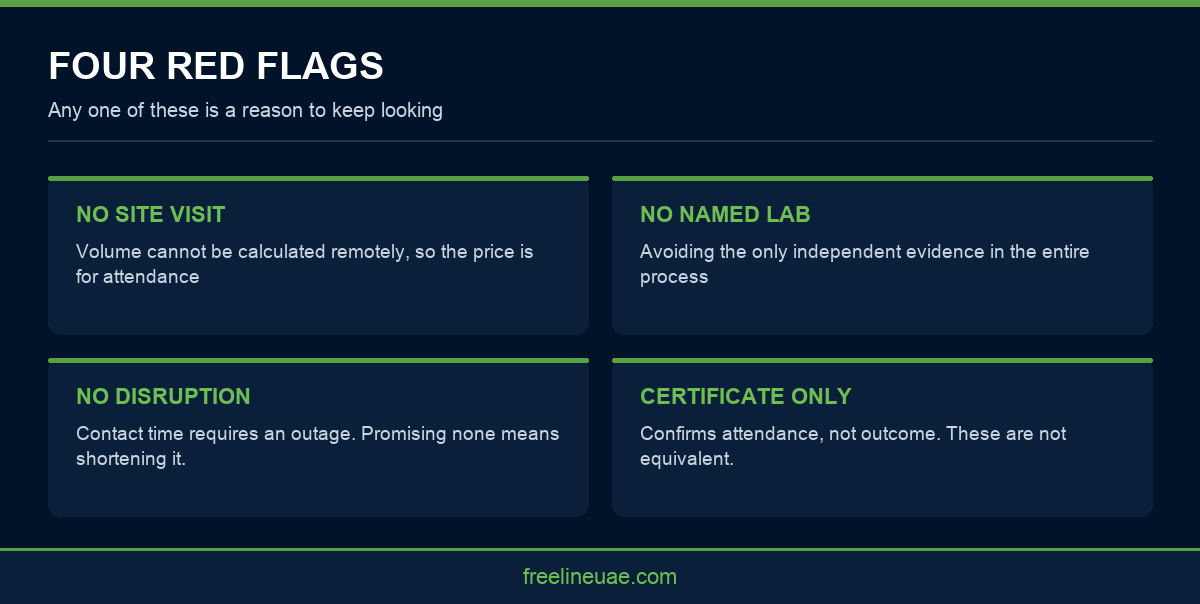
The first is a quotation issued without a site visit. Volume cannot be calculated remotely, so a price produced from a phone call is a price for attendance rather than for a specified piece of work.
The second is reluctance to name a laboratory. Independent analysis is the only part of the process that is not self reported, and a provider avoiding it is avoiding the only objective evidence in the job.
The third is a promise of no disruption. Disinfection requires the system to be out of service for a contact period. A provider promising uninterrupted supply is either planning to shorten contact time or has not understood the request.
The fourth is a certificate offered as the deliverable. A certificate confirms attendance. Laboratory analysis confirms outcome. Any provider treating the two as equivalent is selling paperwork, and the distinction becomes expensive the first time a tenant or purchaser asks for evidence.
The fifth is pressure to sign immediately. Disinfection is rarely a genuine emergency outside a failed test, and a provider manufacturing urgency is usually protecting a price from comparison rather than protecting your building from risk.
The sixth is a refusal to discuss method in technical terms. Concentration, contact time, residual and sampling location are the working vocabulary of this trade, and a provider who cannot use them comfortably has not performed the work often enough to be trusted with an occupied building.
Conclusion
A competent water pipeline disinfection company in Dubai will welcome every question in this article, because answering them is how it distinguishes itself from cheaper providers. Ask for regulatory evidence, a method statement with a calculated volume, a named accredited laboratory, a line by line scope and a written position on retesting. Freeline has delivered water system services across Dubai, Sharjah and Abu Dhabi since 2012. Contact the team for a site survey and a fully specified proposal.
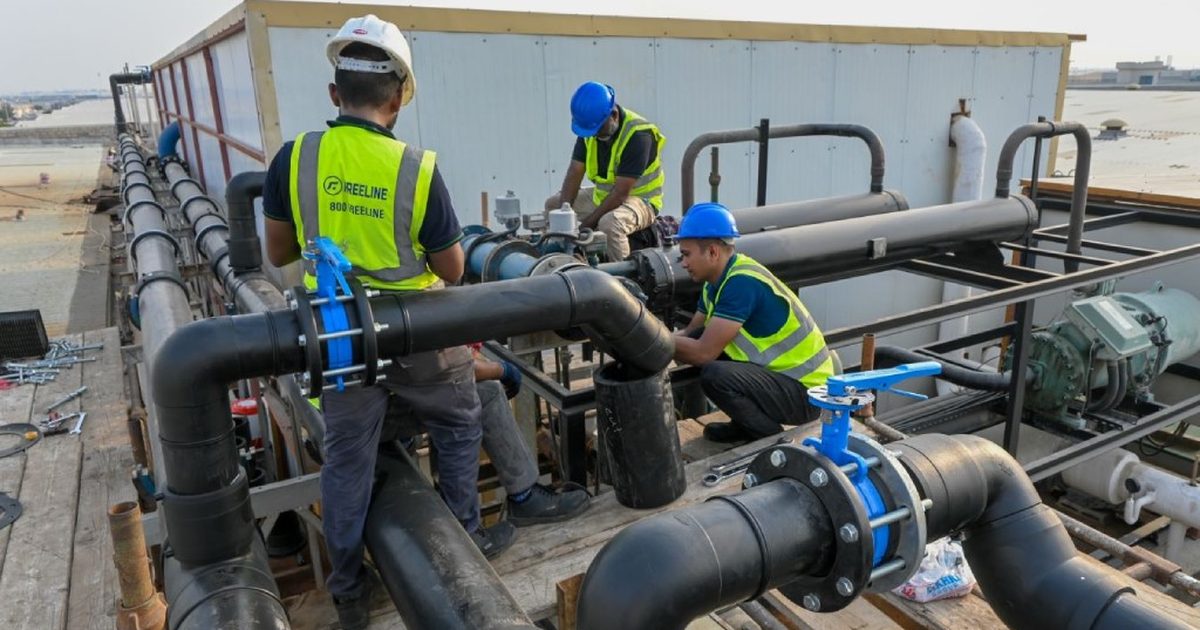
Water Pipeline Disinfection in Dubai: When It Is Mandatory
Building owners rarely ask for water pipeline disinfection in Dubai out of curiosity. They ask because a consultant has requested it, a handover is blocked, or a laboratory result has come back wrong and nobody is sure what it means. This article sets out the situations that create a requirement, explains who is responsible for signing the work off, describes what the completed documentation should contain, and covers what happens when a first result does not pass.
Key Takeaways
- Disinfection requirements are usually triggered by an event rather than a calendar, most often new installation, pipework repair, prolonged stagnation or a failed water test.
- Sign off depends on laboratory evidence, not a contractor declaration. The certificate confirms the visit while the analysis confirms the outcome.
- A failed result is a normal part of the process. What matters is that responsibility for redosing and retesting is agreed before the work begins.
The Situations That Create a Requirement
New installation is the clearest case. Pipework delivered to a site is cut, stored, walked over and left open at both ends for weeks. By the time it is commissioned the interior has collected construction dust and whatever else the environment provided. It cannot carry potable water until it has been cleaned, disinfected and tested.
Repair and modification create the same exposure on a smaller scale. Every time a live line is cut, the protected interior meets the surrounding environment. The affected section needs disinfection afterwards, and this is the requirement most often skipped, because the repair itself feels like the whole job and the building is usually in a hurry.
Stagnation is the quiet trigger. A vacant floor, a wing taken out of service, a property between tenants or a seasonal villa all leave water standing. Micro organisms multiply in still warm water, and returning that system to service without disinfection passes the result directly to the first occupants.
The health basis for these requirements is well established. The World Health Organization reports that microbiologically contaminated drinking water transmits diseases including diarrhoea, cholera, dysentery and typhoid. Those figures describe a global picture, but the mechanism inside a stagnant building riser is the same one.
A failed water quality test is the fourth. Here disinfection is remedial rather than preventive, and it carries an extra obligation. The corrective action is not complete until repeat sampling confirms the problem has actually been cleared rather than temporarily diluted by the flushing that accompanied it.
Disinfection at Building Handover
On a new development, disinfection sits inside the commissioning sequence rather than alongside it. The system is pressure tested, flushed, disinfected, sampled and only then released. Each step depends on the one before, so a delay early in the chain compresses everything after it.
This is where programmes commonly slip. Disinfection needs the system complete, isolated and stable, which conflicts with the reality of a site still finishing outlets and fittings. Work carried out while trades are still cutting into lines will be invalidated by the next connection, and the exercise has to be repeated at the contractor's cost.
The practical answer is to fix the disinfection date against a genuine completion milestone rather than an optimistic one, and to lock the system down once it is reached. Where new HDPE pipe installation or similar works form part of the package, those connections need to be finished before the system is dosed, not after.
It is also worth agreeing early who holds the resulting documentation. Handover packages move between contractor, consultant, developer and eventually the owner or managing agent, and water quality certificates are among the easiest to lose in that chain. They matter later, so they should be filed deliberately.
Who Signs Off the Work
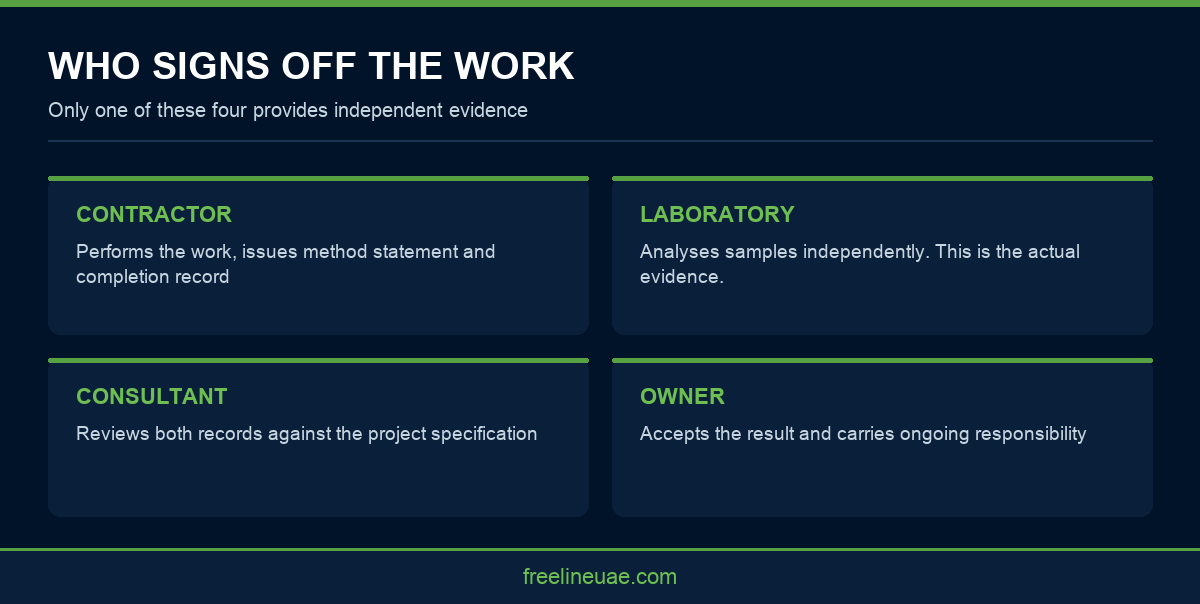
Four parties usually have a role. The contractor performs the work and issues a method statement and completion record. An accredited laboratory analyses the samples and issues the analysis independently. A consultant or the managing agent reviews both against the specification. The building owner accepts the result and carries the ongoing responsibility.
The important separation is between the third and fourth items on that list. The contractor certificate states what was done. The laboratory analysis states what the water is. Only the second is independent evidence, which is why a package containing a contractor certificate but no laboratory report should not be accepted as complete.
Accreditation of the laboratory is worth confirming rather than assuming. An analysis from an unaccredited source may be perfectly accurate, but it is difficult to rely on in a dispute and may not satisfy a consultant reviewing the handover on behalf of a client.
For occupied buildings the review role often falls to whoever manages the property day to day. Where disinfection is delivered within a broader building maintenance arrangement, that review is easier, because the same party holds the history and can see whether a result represents an improvement or a repeat of last year.
What the Sign Off Package Should Contain
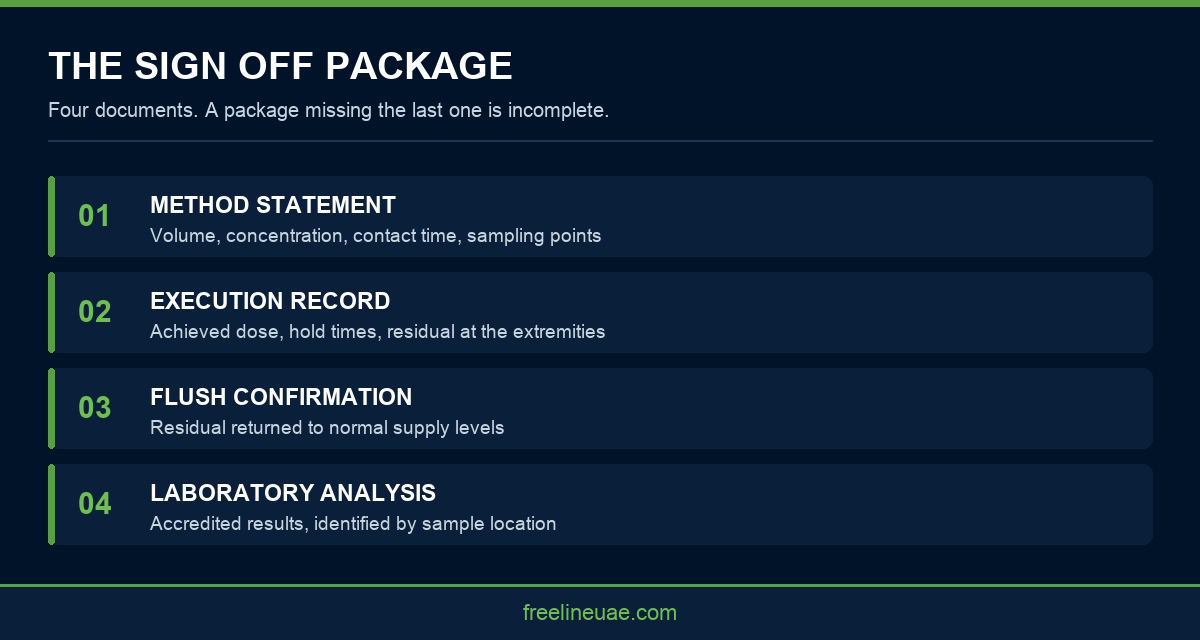
The method statement comes first, ideally issued before the work rather than with the invoice. It should state system volume, target concentration, planned contact time, isolation arrangements, sampling locations and the acceptance criteria being worked to.
The execution record follows. Actual concentration achieved, start and end times for the contact period, residual readings taken at the extremities of the system, and confirmation that flushing continued until residual returned to normal supply levels.
The laboratory analysis completes it. Bacteriological results should show absence of coliform organisms, and good practice uses two consecutive sample sets taken at an interval rather than a single result. Each sample must be identified by location, because results without locations cannot be interpreted.
Sampling method is part of the record too. Outlets should be sampled in a defined condition rather than after running for several minutes, since the objective is to characterise the water quality the system actually delivers rather than the quality it can produce under favourable conditions.
Finally the package should record who performed the work, when, and under what approval. Water related services in Dubai are overseen by Dubai Municipality, and a provider operating in this field should be able to evidence their standing without delay. Related scopes such as water tank cleaning and disinfection should appear in the same record where they formed part of the job.
What Happens When a Result Fails
A failed result is not unusual, particularly on older systems or where cleaning was limited. The most common causes are chlorine demand exceeding the dose, dead legs that were never reached, sampling carried out too soon after flushing, or recontamination from a section that was not isolated.
The response is diagnostic before it is chemical. Repeating an identical dose on an identical system tends to produce an identical failure. The useful questions are whether the residual held at the end of the contact period, whether every branch was actually filled, and whether any part of the network stayed connected to untreated water.
Dead legs deserve particular attention here. A capped branch left from an earlier alteration holds water that never moves and will reseed the system after every treatment. That is a plumbing correction rather than a disinfection problem, and until it is removed the results will keep repeating.
Timing of the retest matters as well. Resampling immediately after a second dose repeats the original error of measuring disinfectant rather than condition, so the sequence of flush, verify residual, then sample must be followed again in full.
The commercial dimension should be settled in advance. Who pays for redosing and retesting when the first result fails is a straightforward question with an awkward answer if it is raised for the first time with the building out of service. Agreeing it at quotation stage costs nothing and prevents a stalemate later.
Conclusion
Water pipeline disinfection in Dubai becomes mandatory at predictable moments, namely new installation, pipework repair, extended stagnation and a failed water test. The requirement is only satisfied when independent laboratory analysis confirms it, and the documentation is what carries that proof forward to the next owner, tenant, purchaser or consultant who asks to see it. If you are approaching handover, or holding a laboratory result you cannot interpret, contact Freeline for a site survey and a fully specified scope of work.
Pipeline Chlorination in Dubai: Dose, Contact Time and Flushing
Most quotations for pipeline chlorination in Dubai describe an outcome rather than a method. They promise a disinfected system without stating the concentration, the holding period, or how the result will be proved afterwards. Those three details are the whole job, and everything else in the document is packaging. This article explains how the dose is actually calculated, why contact time cannot be shortened to suit a programme, what a correct flush looks like, and which mistakes make a chlorination impossible to verify later.
Key Takeaways
- Chlorination is defined by two measured variables, concentration and contact time. Neither is meaningful without the other.
- The pass criterion is the residual remaining at the end of the holding period, measured at the far end of the system rather than at the dosing point.
- Flushing is a controlled stage with its own endpoint, not simply running taps until the smell fades.
What Chlorination Does Inside a Water Line
Chlorine added to water forms compounds that attack the cell structure of micro organisms. In a pipe the target is rarely free floating bacteria in the water itself. It is the layer of growth attached to the pipe wall, which shelters organisms and continuously reseeds the water passing over it.
That layer is why concentration alone does not solve the problem. A strong dose passing quickly through a line contacts the outer surface of the growth and little else. A sustained concentration held against it has time to break the structure down and reach what is underneath.
Chlorine is also consumed as it works. Organic matter, sediment, corrosion products and the growth itself all absorb chlorine, and that absorption is called demand. A system with high demand will strip a dose within hours. This is the single most common reason a chlorination fails, and it is entirely predictable if anyone measures.
Temperature adds a further variable in the UAE. Chlorine acts faster in warm water but also dissipates faster, so a system sitting at high ambient temperature both responds well initially and loses residual more quickly than the same system would in a cooler climate. That shortens the margin for error and makes the end of period reading more important, not less.
The practical consequence is that dosing is not a fixed recipe. The same building, chlorinated before and after a tank clean, will show markedly different demand. Applying a standard figure to every system produces a pass in clean pipework and a silent failure in dirty pipework, which is exactly the situation where the work mattered most.
How the Chlorination Dose Is Calculated
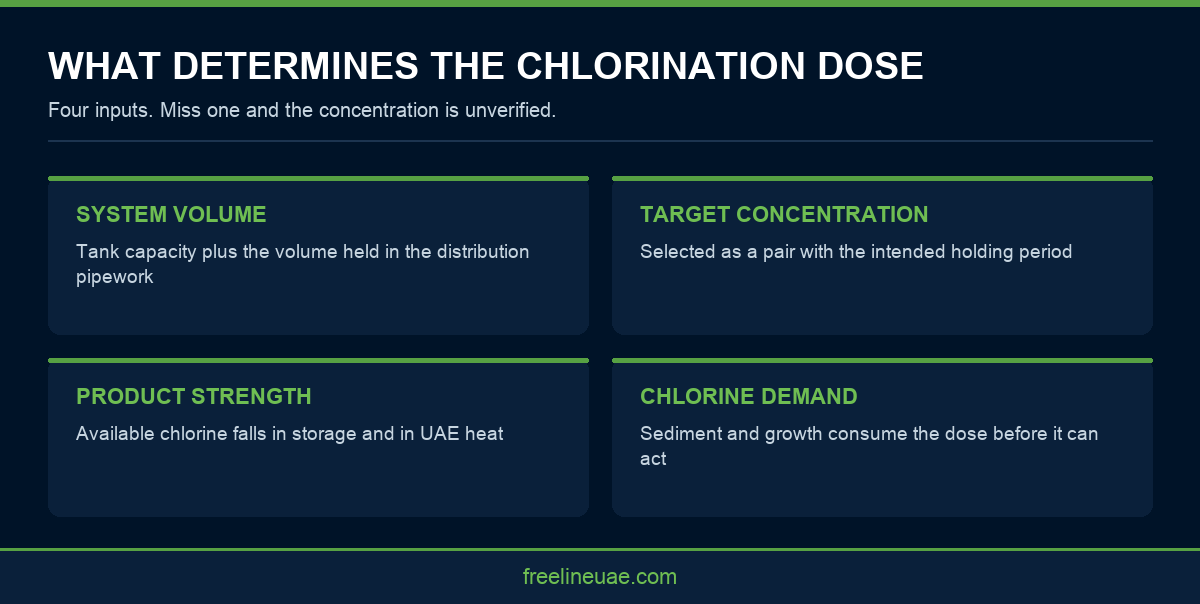
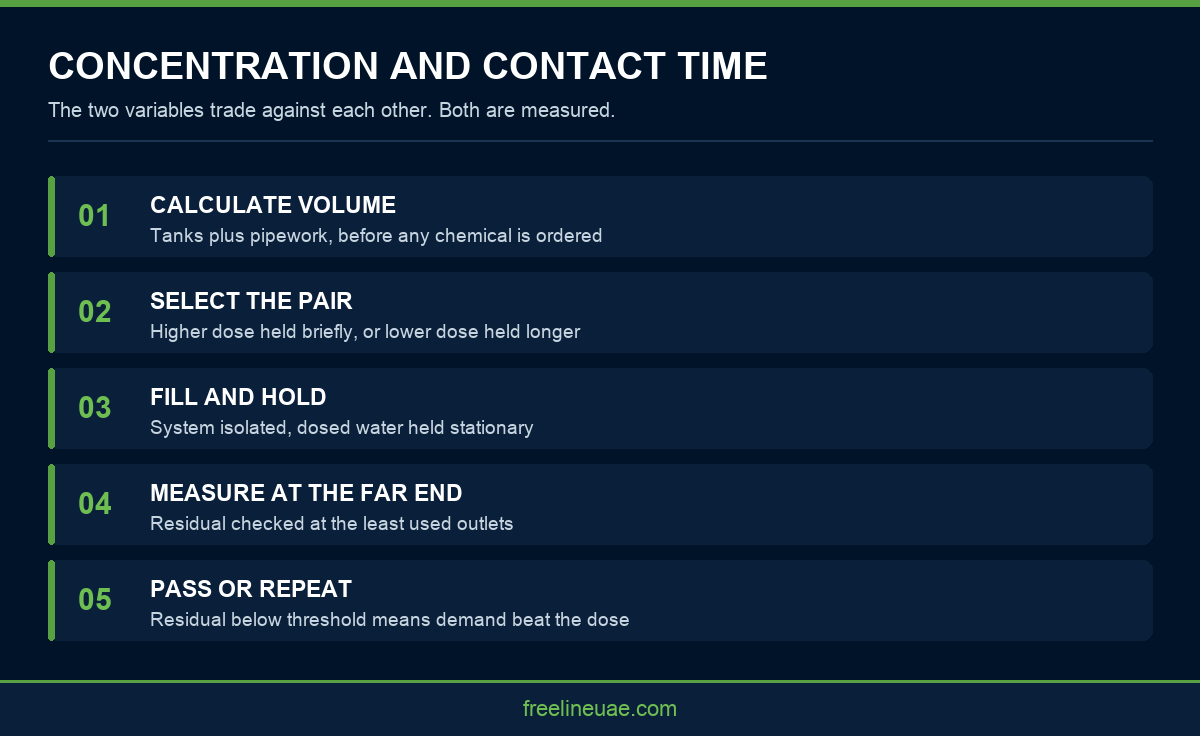
The dose starts with volume. The crew needs the capacity of the tanks plus the volume held in the distribution pipework, calculated from pipe diameter and run length. Without that figure the quantity of chemical is a guess, and a guess in this context is usually an underdose.
The target concentration is then selected. The recognised international reference for potable mains is the AWWA C651 methodology, which sets out accepted pairings of concentration and holding period rather than one universal number. Higher concentrations are held briefly, lower concentrations for longer, and both are valid when applied correctly.
Chemical quantity follows from volume, target concentration and the strength of the product being used. Most contractors in the region work with sodium hypochlorite, whose available chlorine content falls over time in storage and in heat. A drum that has sat in a UAE yard through summer will not deliver its labelled strength, and dosing from the label rather than from a test is a routine source of underdosing.
Finally the dose must account for demand. Where a system is known to be heavily fouled, the practical approach is to clean first, then chlorinate, rather than trying to overcome years of deposit with chemistry alone. Cleaning is cheaper than repeat dosing, and it makes the result predictable.
Contact Time and Why It Cannot Be Rushed
Contact time is the period the dosed water is held stationary in the system. It is the variable most often compressed, because it is the variable that keeps the building out of service. A crew under pressure to restore supply will be tempted to flush early, and nothing about the finished job looks different if they do.
The check that exposes this is the end of period residual. Whatever concentration and duration are chosen, a defined minimum must still be present when the holding period ends. If the residual has collapsed, demand exceeded the dose and the system was not disinfected, regardless of how long the water sat there.
Where that reading is taken matters as much as the number. A sample drawn at the plant room reflects the dosing point, where concentration is naturally highest. The meaningful reading comes from the furthest and least used outlets, because those are the parts of the system the dosed water reached last and weakest.
A useful question to ask any contractor is simple. At which outlets will you measure residual at the end of the contact period, and what reading constitutes a pass. A provider with a defined procedure answers immediately. A provider improvising will answer in generalities.
Flushing and Returning the System to Service
Once the contact period is complete the chlorinated water is displaced. Flushing continues until the free chlorine residual in the system falls back to normal supply levels. That is a measured endpoint, not a matter of judgement or elapsed time.
Long branches, upper floors and rarely used outlets clear far more slowly than main runs. A flush that clears the risers in twenty minutes may leave concentrated water sitting in a capped branch for far longer. Every outlet in scope needs to be run and checked, which is tedious and is therefore frequently abbreviated.
Disposal deserves attention. Highly chlorinated water should be neutralised or discharged through an appropriate route rather than tipped into the nearest drain without thought. This is both an environmental obligation and, in a building with its own drainage assets, a matter of protecting them.
Only after the flush is verified should sampling for laboratory analysis take place. Sampling too early captures residual disinfectant in the bottle rather than the true condition of the system, and produces a clean result that means very little. Sequence protects the integrity of the evidence.
Common Chlorination Mistakes in Dubai Buildings
The first is dosing without knowing the system volume. It guarantees the concentration is unverified from the outset and makes every subsequent measurement difficult to interpret.
The second is treating tanks and pipework as separate jobs. Chlorinating a tank and leaving the distribution lines untouched simply feeds clean water into a contaminated network, and the benefit disappears within days. Tank work and water tank cleaning and disinfection should be scoped together with the pipework.
The third is ignoring dead legs. Capped branches left from past alterations hold water that never moves. They will not be reached properly by a normal fill, and they will reseed the system afterwards, so they need to be identified during survey and dealt with as a plumbing correction rather than a chemistry problem.
The fourth is skipping the laboratory stage. Pipeline chlorination in Dubai without bacteriological confirmation is an activity, not a result. It may well have worked, but nobody can demonstrate that it did, which is worthless the moment a tenant, a purchaser or an insurer asks the question.
The fifth is treating the survey as optional. Volume, isolation points, pipe material, outlet locations and dead legs all come from the survey, and every number in the method statement depends on them.
The sixth is poor record keeping. Concentrations, times, sample points and laboratory certificates should arrive as a package. Where this is handled inside a wider building maintenance programme the records accumulate into a useful history rather than a one off receipt.
Conclusion
Pipeline chlorination in Dubai is straightforward when it is done properly and impossible to audit when it is not. Insist on a stated system volume, a defined concentration and contact time, residual readings from the far end of the network, a verified flush and laboratory confirmation. Any provider unwilling to commit to those five points is quoting for a visit rather than a result. Contact Freeline to arrange a survey and a fully specified chlorination proposal.
Pipeline Disinfection in Dubai: A Complete Guide for Buildings
Pipeline disinfection in Dubai is the controlled process that restores water quality inside a building. Every property receives treated water at the boundary, but what happens after that point is the owner's responsibility. Water sits in tanks, moves slowly through long runs of pipe and warms in ambient heat, and that is precisely where quality is lost. This guide explains what the work involves, when it is required, how chlorination is dosed and verified, and what a properly documented handover should contain before anyone signs it off.
Key Takeaways
- Pipeline disinfection removes biofilm and microbial contamination from the pipework inside a building, not from the supply network outside it.
- The process is a sequence of cleaning, dosing, contact time, flushing and laboratory testing. Skipping the testing step makes the whole job unverifiable.
- New buildings, repaired mains, long vacancies and failed water tests are the four situations that most often trigger a requirement for water pipeline disinfection in Dubai.
What Pipeline Disinfection Actually Involves
Pipeline disinfection is the controlled application of a disinfectant to the inside surface of a water distribution system, held for a defined period, then flushed out and verified by laboratory testing. It is not a cleaning product poured into a tank. It is a measured chemical process with a dose, a contact time and a pass criterion.
The confusion in the market is understandable. Many contractors use the words cleaning, flushing, sanitising and disinfection as if they mean the same thing. They do not. Flushing moves water at high velocity to carry loose sediment out of the line. Cleaning removes physical deposits from a surface. Disinfection inactivates the micro organisms living on that surface. A pipe can be visually clean and still carry a mature microbial film.
The distinction matters commercially, not just technically. Building owners routinely pay for a service labelled disinfection and receive a flush, because the invoice looks the same and the water looks clearer afterwards. The difference only becomes visible when a laboratory test is run, or when the same complaint returns three months later. Understanding what separates the two is the single most useful thing an owner can know before commissioning the work.
That film is the real target. Biofilm is a layer of micro organisms that attaches to pipe walls and protects itself inside a matrix it secretes. Once established it is far more resistant to disinfectant than free floating bacteria, which is why a brief rinse with chlorinated water achieves very little. Effective work depends on holding an adequate concentration against that film for long enough to break it down.
There is a second reason the vocabulary matters. Scope written loosely tends to be delivered loosely. A contract that says the contractor will sanitise the water system creates no obligation to reach a concentration, hold it, or prove anything afterwards. A contract that specifies dose, contact time, sampling points and acceptance criteria creates a measurable deliverable.
This is why the two variables that matter most are concentration and time. A low dose held for a long period and a high dose held briefly can achieve comparable results, but only if both are measured. A contractor who cannot tell you the residual concentration at the end of the contact period has not performed a disinfection. They have performed a rinse.
Why Dubai Buildings Need Pipeline Disinfection
This is the gap that pipeline disinfection in Dubai is intended to close, and it is why the work is treated as a building service rather than a supply problem.
The wider public health case is not in dispute. The World Health Organization reports that microbiologically contaminated drinking water transmits diseases including diarrhoea, cholera, dysentery and typhoid, and is estimated to cause around 505,000 diarrhoeal deaths every year. Those figures describe a global picture rather than a UAE one, but the mechanism is identical wherever water stands still in warm pipework.
Occupancy patterns add a further layer. A building at partial occupancy draws less water than it was designed for, so residence time in the tanks and risers increases at exactly the point when budgets are tightest. The result is that water quality problems often appear during quiet periods rather than busy ones, which is the opposite of what most owners expect.
It is worth being precise about where the problem starts. The water arriving at a Dubai property is treated and monitored before it reaches the boundary, and the supply network is not the usual source of building level complaints. Responsibility and risk transfer at the point where water enters private infrastructure. From that point the tank, the riser, the branch lines and the outlets are all owner maintained assets, and their condition is not visible from the outside.
For a building owner the practical consequence is narrower. Water quality complaints, discoloured supply, taste and odour issues and failed tenant tests almost always originate inside the building rather than at the supply point. Disinfecting the pipework, alongside water tank cleaning and disinfection, addresses the part of the system the owner actually controls.
Stored water is the weak point
Dubai buildings almost universally store water on site before distributing it. Storage is necessary, but it introduces a pause. Water that moves continuously carries a disinfectant residual and has little opportunity to develop microbial growth. Water that sits loses that residual, and the pipework downstream of the tank inherits the problem.
The longer the pause, the greater the risk. Tanks sized generously for peak demand often hold several days of supply in a partly occupied building, and low occupancy makes the situation worse rather than better.
Heat accelerates everything
Ambient temperature in the UAE pushes cold water systems into the range where microbial growth accelerates. Pipework in roof voids, service risers and external runs can sit well above the temperature a cold water system is designed to hold.
That matters for organisms such as Legionella, which multiply in warm stagnant water and are controlled by a combination of temperature management and disinfection. The World Health Organization notes that legionellosis is preventable through proper water system management, and building water systems are the setting where that management either happens or does not.
When Pipeline Disinfection Is Required
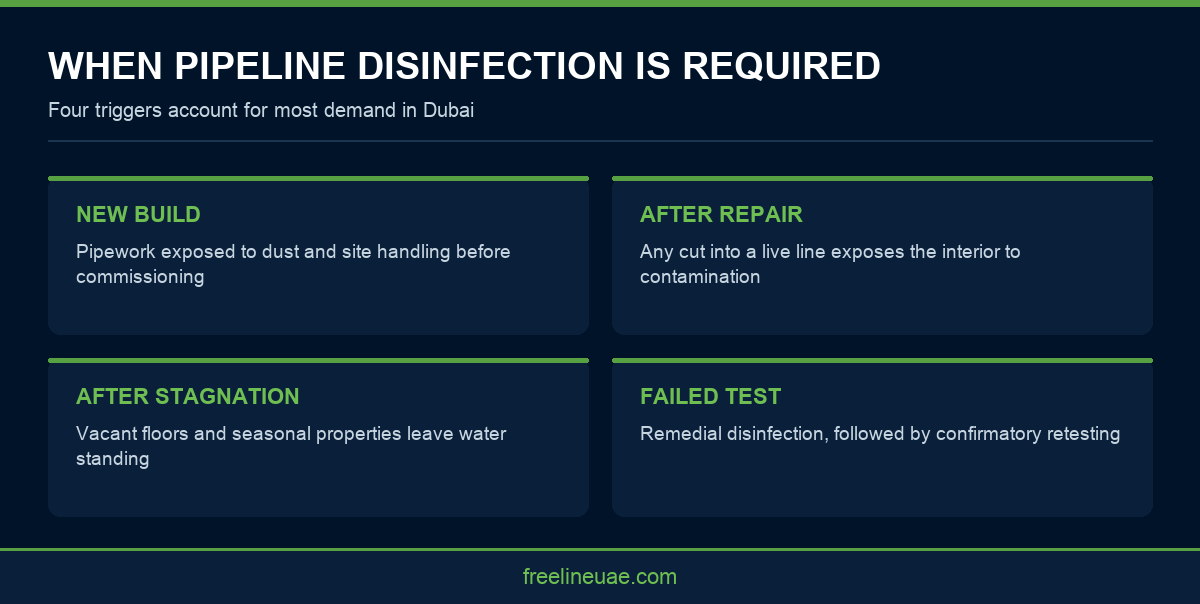
Four situations account for most of the demand. The first is new construction. A newly installed water line has been cut, stored on site, handled by many trades and left open to dust and debris. It must be cleaned and disinfected before it carries potable water, and a satisfactory result is normally part of the handover package.
The second is repair or modification. Any time a pipe is cut into, the interior is exposed to whatever is in the surrounding environment. Disinfection of the affected section restores the barrier. This applies to planned modifications and to emergency repairs, and it is the step most often skipped under time pressure.
The third is stagnation. A building left vacant, a wing taken out of service, a floor between tenants or a seasonal property all leave water standing in pipework for extended periods. Bringing that system back into use without disinfection means the first occupants receive whatever developed during the pause.
Change of use belongs on the list as well. A floor converted from office to residential, a unit turned into a clinic or a kitchen added to a previously dry area all alter both the demand pattern and the risk profile of the water system. The pipework may be sound, but the assumptions it was designed and commissioned under no longer hold, and a disinfection at that point resets the baseline.
The fourth is a failed water quality test. When a laboratory result comes back with coliform present or an unacceptable count, disinfection is the corrective action. In this case the work is not preventive, it is remedial, and it must be followed by repeat testing to confirm the problem has actually been resolved rather than diluted.
Dead legs deserve separate mention. When a building is reconfigured, an outlet removed or a floor replanned, sections of pipework are frequently capped rather than cut back to the main. The water in those sections never moves again. It continues to connect to the live system, and it continues to seed it. Disinfection addresses the immediate contamination, but a dead leg will regenerate the problem, so the survey should identify them and the remedial plan should remove them.
Owners often ask whether pipeline disinfection in Dubai is a one off exercise or a recurring commitment. The honest answer is that it depends on which of these triggers applies to the property.
There is also a routine case. Buildings with complex systems, long dead legs or a history of quality problems benefit from disinfection on a planned interval rather than in response to a failure. Where this is adopted it usually sits within a wider building maintenance programme alongside tank cleaning.
How the Disinfection Process Works Step by Step
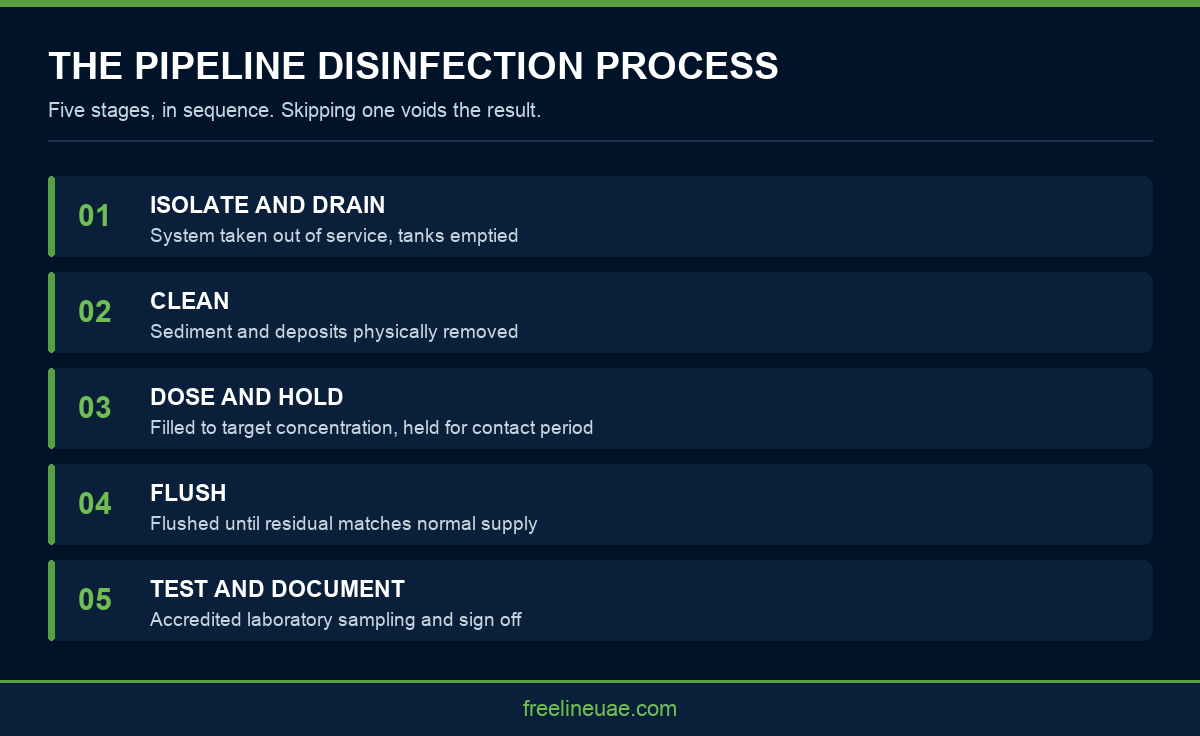
Before any of this begins there should be a survey. The crew needs to know the system volume in order to calculate the chemical quantity, the isolation points in order to plan the outage, the material of the pipework in order to select an appropriate concentration, and the location of the furthest outlets in order to know where residual will be measured. Disinfection quoted without a survey is disinfection quoted without knowing the dose, and the figure is therefore an estimate of price rather than of work.
The sequence matters as much as the chemistry. Dosing before cleaning wastes chemical. Flushing before the contact period ends voids the process. Testing before flushing produces a meaningless result. Where the work touches plumbing services and mechanical isolation, coordination between the disinfection crew and the site team is what keeps the sequence intact.
Isolation, draining and physical cleaning
The system or the affected section is isolated and drained. Where tanks form part of the scope they are emptied, cleaned and the internal surfaces treated. Physical removal of sediment comes first because loose material consumes disinfectant and shields organisms beneath it.
This stage is unglamorous and frequently rushed. A disinfectant dose applied over a layer of sediment will be consumed by that sediment rather than acting on the pipe wall.
Dosing and contact time
The system is then filled with water dosed to a target free chlorine concentration and held. The recognised international reference for potable water mains is the AWWA C651 methodology, which sets out several accepted combinations of concentration and holding period rather than a single figure. Higher concentrations are held for shorter periods, lower concentrations for longer.
Whichever combination is chosen, the controlling requirement is the same. A minimum residual must still be present at the end of the holding period, measured at the far end of the system rather than at the dosing point. If the residual has fallen below the threshold, the demand exceeded the dose and the process must be repeated.
Flushing and return to service
The chlorinated water is then flushed out until the residual in the system matches normal supply levels. This step protects both the occupants and the pipework, since concentrated disinfectant is not intended to remain in a system in use.
Verification during this stage is what separates a controlled flush from an optimistic one. Residual should be measured as the flush proceeds rather than assumed to have cleared after a set number of minutes, because long branches and low use outlets clear far more slowly than the main runs.
Flushing also has an environmental dimension. Highly chlorinated water should be neutralised or discharged appropriately rather than released without thought, and a competent contractor will have a defined method for this.
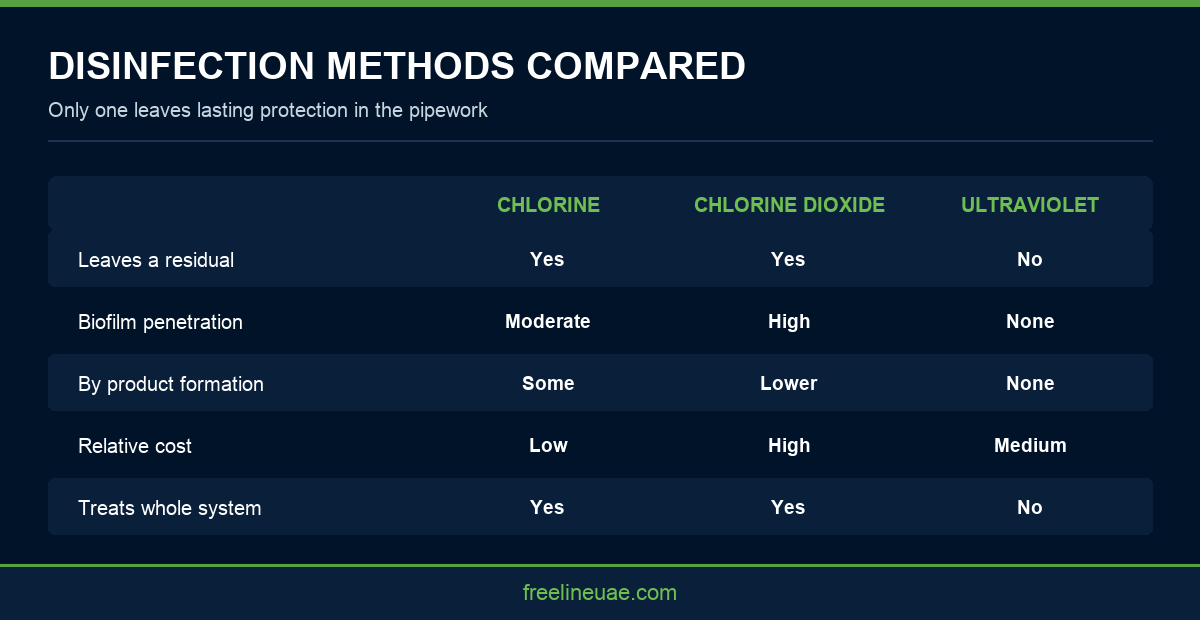
Chlorination and the Alternatives
Chlorine remains the default because it is effective, inexpensive, easy to measure and leaves a residual that continues to protect the system after the crew leaves. That residual is the property no alternative fully replicates.
The main objection to chlorination is by product formation. When chlorine reacts with organic matter it can form trihalomethanes and haloacetic acids. This is a genuine consideration, though it should be kept in proportion. As noted in the technical literature on water chlorination, the World Health Organization has stated that the health risks from these by products are extremely small in comparison with the risks associated with inadequate disinfection.
Method selection should follow the system rather than fashion. For the great majority of Dubai buildings, chlorination correctly dosed and properly verified is the appropriate answer, and the alternatives earn their place only where a specific constraint applies. A provider who recommends an expensive alternative before surveying the system is selling a product rather than solving a problem.
Cost is not the only trade off. Every method has an operational profile covering handling, storage, competency and monitoring, and a building that cannot support that profile will not sustain the treatment. The best method for a site is the one it can actually run correctly over time.
Chlorine dioxide
Chlorine dioxide is used where biofilm penetration is the priority or where taste and odour from chlorine are a concern. It works across a wider pH range and forms fewer trihalomethanes. It is more expensive, must be generated on site and requires tighter handling controls, which limits it to systems where those trade offs are justified.
Ultraviolet treatment
Ultraviolet germicidal irradiation inactivates organisms as water passes a lamp. It adds no chemicals and no taste. Its limitation is decisive for pipework disinfection. It treats only the water flowing through the unit and leaves no residual, so it cannot address a biofilm already established downstream. It is a supplementary control rather than a substitute for chlorination.
How Results Are Verified and Documented
A disinfection job is only as good as its evidence. The deliverable is not the visit, it is the record. At minimum a competent contractor should hand over the dosing record showing target and achieved concentration, the contact period start and end times, residual readings taken at the extremities of the system, confirmation of the final flush, and laboratory results from an accredited testing facility.
The laboratory element is where weak providers are exposed. Bacteriological confirmation normally requires samples showing absence of coliform organisms, and good practice is two consecutive sample sets taken at an interval rather than a single result. A single clear sample taken immediately after flushing can reflect residual disinfectant in the sample rather than a genuinely clean system.
Retention of the records matters too. Water quality issues surface months after the work, often during a sale, a refinancing, a tenant dispute or an insurance question. A contractor who issues results and keeps no copy leaves the owner exposed, and an owner who files the report without reading it is in much the same position.
Sampling location matters as much as sampling frequency. Samples drawn at the plant room tell you about the plant room. Samples drawn at the furthest and least used outlets tell you about the system. A report that does not state where samples were taken is difficult to rely on.
It is worth knowing what a weak report looks like. A single page stating that the system was disinfected and is now safe, with no concentrations, no times, no sample locations and no laboratory letterhead, is an assurance rather than a record. It cannot be audited, it cannot be compared against a later result, and it provides no defence if a water quality dispute arises with a tenant or a purchaser.
This documentation has value beyond compliance. It establishes a baseline. When a future complaint arises, a dated record of system condition allows the owner to determine whether something has changed or whether the issue lies elsewhere. Buildings that keep these records make better decisions than buildings that repeat the same investigation every year.
Choosing a Pipeline Disinfection Contractor in Dubai
The first question is regulatory standing. Water related work in Dubai is overseen by Dubai Municipality, and a contractor operating in this space should be able to evidence their approval status without hesitation. A provider who cannot produce documentation quickly is telling you something useful.
The second is method. Ask which standard the disinfection follows, what concentration and contact time will be used, where residual readings will be taken and which laboratory will process the samples. Specific answers indicate a defined procedure. Vague answers indicate improvisation.
The third is scope honesty. Pipework and storage are one system. A quotation covering the tanks but silent on the distribution pipework, or the reverse, leaves half the problem in place. The same applies to associated works such as HDPE pipe installation on new lines, where disinfection should be built into the programme rather than added afterwards.
The third and a half point, easily missed, is what happens if the result fails. A competent contractor states in advance who bears the cost of redosing and retesting when the first laboratory result does not pass. If that is unwritten, it becomes a negotiation at the worst possible moment, with the building out of service and the occupants waiting.
Scope breadth is worth weighing too. A provider that also handles septic tank cleaning and drainage can address supply and waste side issues together, which matters in older properties where the two are often discovered at the same time.
The fourth is capacity to work around occupancy. Disinfection requires the system to be out of service for a period. In an occupied building that means night works, phased isolation, temporary supply arrangements and clear resident notice. A contractor who has not raised these issues has not thought about your building.
Price deserves a note. Disinfection pricing varies with system volume, isolation complexity, out of hours working and whether laboratory testing is included. A quotation materially below the others in a tender usually differs in one of those four areas, and most often it is the testing. Comparing quotations line by line rather than on the total is the only reliable way to see what is actually being offered.
Whichever provider is appointed, pipeline disinfection in Dubai should be bought as a specified process with a stated method and an independent result, not as an unspecified visit.
Freeline has operated in UAE facility maintenance since 2012 across Dubai, Sharjah and Abu Dhabi, and delivers pipeline disinfection alongside tank cleaning and maintenance services as a single coordinated scope.
Conclusion
Water quality inside a building is a maintenance outcome, not a supply outcome. Pipeline disinfection in Dubai addresses the section of the system the owner controls, and it works only when dose, contact time, flushing and laboratory verification are treated as one process rather than four optional steps. If your building is approaching handover, returning from vacancy, recovering from a failed water test or simply overdue for review, the sensible first move is an assessment of the existing system. Contact Freeline to arrange a site survey and a scoped proposal.
Behind the Scenes of a Villa Water Tank Cleaning Service in Dubai
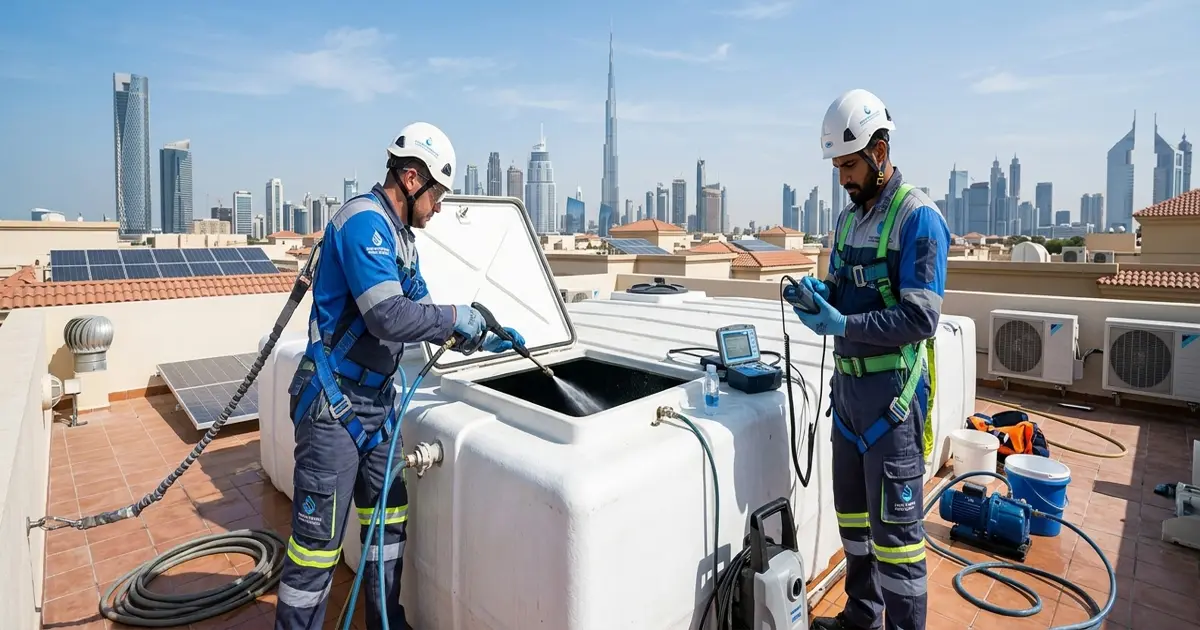
Villa water tank cleaning in Dubai is more than a routine chore. It is a critical health and safety measure that every villa owner needs to take seriously. Most residents never see what happens once the technicians arrive. The process is detailed, equipment-driven, and governed by strict hygiene standards. In this post, we take you behind the scenes of an actual villa water tank cleaning visit so you understand every step involved and why it matters for your family’s wellbeing.
Key Takeaways
- Villa water tank cleaning Dubai involves a structured, multi-step process including inspection, draining, scrubbing, disinfection, and water quality testing.
- Professional water tank cleaning services Dubai use certified equipment and approved disinfectants to meet UAE health standards.
- Regular cleaning prevents bacterial contamination, sediment buildup, and foul odors in your water supply.
The First Step: Pre-Visit Inspection and Safety Assessment
Before any cleaning begins, a qualified technician conducts a full inspection of the tank location, access points, and overall condition. For villas, tanks are typically located on rooftops or underground. The technician notes the tank size, material, inlet and outlet positions, and any visible signs of algae, rust, or sediment accumulation.
This pre-visit assessment shapes the entire cleaning plan. It helps the team determine the right equipment, the volume of disinfectant needed, and whether the tank requires any repair work alongside cleaning. Skipping this step often leads to incomplete cleaning and safety gaps. A thorough inspection is what separates professional water tank cleaning services from a basic wash-down.
According to guidance from the Dubai Health Authority, potable water storage tanks must be inspected and cleaned at least twice a year to prevent microbial contamination and safeguard public health.
Step by Step: What Happens During Villa Water Tank Cleaning Dubai
Once the inspection is complete, the actual cleaning begins in a carefully ordered sequence. Here is exactly what the Freeline team does during a standard villa water tank cleaning Dubai visit.
Draining the Tank Completely
The first physical task is draining all remaining water from the tank. The technician shuts off the inlet valve and connects a submersible pump to remove standing water. For large villa tanks, this can take 20 to 40 minutes depending on the tank volume. No cleaning can begin while water remains inside, as residual water dilutes disinfectants and hides contamination zones.
Scrubbing and Removing Sediment
Once drained, technicians enter or use long-handled brushes and tools to physically scrub all interior surfaces. Sediment, biofilm, algae, and mineral deposits are scrubbed from the floor, walls, and ceiling of the tank. This step is labor-intensive but non-negotiable. Even disinfectants cannot neutralize thick sediment layers without prior physical removal. The debris is then flushed out of the tank before the disinfection stage begins.
High-Pressure Rinsing
After scrubbing, the team performs a high-pressure rinse using clean water. This step washes away any loosened particles, cleaning residue, and dust. Technicians pay close attention to corners, joints, and areas near inlet pipes where contamination tends to accumulate. This stage is often overlooked by non-professional cleaners, which is why hiring a professional water tank cleaning company in Dubai makes a measurable difference.
Disinfection with Approved Chemicals
The team then applies a chlorine-based disinfectant solution to all interior surfaces. The concentration and contact time are calculated based on tank volume and the level of contamination observed. The disinfectant is left to work for a specified dwell time, typically 30 minutes, before the final rinse. This step eliminates bacteria, viruses, and other pathogens that regular scrubbing may not fully address. All chemicals used in professional water tank cleaning services Dubai must comply with UAE regulatory standards for potable water systems.
Final Rinse and Water Quality Testing
After disinfection, the tank is rinsed thoroughly with clean water to remove all traces of chemicals. Technicians then refill the tank partially and conduct a water quality test on-site. They check for chlorine residual levels, pH balance, and turbidity. A clean bill of health from this test confirms the tank is safe for household use. The client receives a written report documenting all findings and the actions taken during the visit.
This end-to-end process is what you get when you book water tank cleaning Dubai services from a certified provider. You can read more about what to expect from this process in our guide on what Dubai residents trust in a top water tank cleaning company.
Equipment Used by Professional Water Tank Cleaning Services Dubai
The quality of a tank cleaning job depends heavily on the tools and technology used. Here is a breakdown of the key equipment deployed during a professional villa tank cleaning visit.
- Submersible pumps: Used to drain water quickly and efficiently from tanks of all sizes.
- High-pressure jet washers: Essential for dislodging stubborn biofilm, algae, and mineral deposits from tank surfaces.
- Industrial scrubbing tools: Long-handled brushes and sponges that reach every corner of the tank without requiring full entry.
- Confined space entry gear: Where tanks require physical entry, technicians use harnesses, breathing equipment, and safety lines to comply with occupational health regulations.
- Water testing kits: Portable devices that measure pH, chlorine levels, and turbidity on-site for immediate quality verification.
- Chemical dosing equipment: Ensures the correct concentration of disinfectant is applied uniformly across all tank surfaces.
This level of technical preparation is what distinguishes a building water tank cleaning Dubai specialist from a general cleaning crew. Every piece of equipment plays a specific role in delivering a safe and compliant result.
Why Regular Villa Water Tank Cleaning Dubai Is Non-Negotiable
Many villa owners delay tank cleaning because the water appears clean. This is a common and dangerous assumption. Bacteria like Legionella and E. coli thrive in warm, stagnant water and produce no visible signs until contamination levels are dangerously high. Dubai’s climate, with temperatures regularly exceeding 40 degrees Celsius, accelerates bacterial growth in water storage tanks.
The World Health Organization states that unsafe drinking water is linked to over 485,000 diarrheal deaths globally each year. Regular cleaning is the most effective preventive measure available to property owners. Beyond health, clean tanks also protect your plumbing fixtures from sediment damage and reduce the risk of foul odors spreading through your water system.
For a deeper look at how contaminated tanks affect your household, explore our detailed resource on the benefits of water tank cleaning for residential properties.
Safety Standards and Compliance During Building Water Tank Cleaning Dubai
Professional tank cleaning teams in Dubai operate under specific health and safety protocols that go beyond basic cleaning. When working on villas, technicians follow confined space entry procedures as outlined by UAE occupational safety guidelines. This includes risk assessment before entry, use of personal protective equipment, and having a standby team member present throughout any confined space work.
All disinfectants used must be approved for potable water systems. Using non-approved chemicals can leave harmful residues that contaminate your water supply, which is far worse than the original problem. Reputable providers like Freeline Maintenance and Services use only approved products and document every chemical batch used during the job for full traceability.
Compliance is not just about paperwork. It is about ensuring the health of everyone in your home. If a cleaning company cannot provide documentation of the chemicals used, the test results, and their technician certifications, that is a serious red flag when selecting any building water tank cleaning Dubai service.
How to Prepare Your Villa for a Tank Cleaning Visit
Villa owners can make the cleaning process faster and more efficient with a few simple preparations. Here is what you should do before the team arrives.
- Notify all household members about the planned water shutdown period.
- Ensure the access hatch to the tank is unlocked and accessible before the team arrives.
- Fill jugs or containers with enough drinking water for your household to last 3 to 5 hours.
- Clear any stored items around the tank access area to give the technicians enough working space.
- Have your last cleaning report available if this is a follow-up visit, as it helps the technician assess changes since the last service.
Being prepared reduces downtime and helps the team complete the job without interruptions. For ongoing property care beyond tank cleaning, our team also offers comprehensive building maintenance and cleaning services across the UAE to keep your villa in top condition year-round.
Conclusion: Trust the Process and Protect Your Home
Villa water tank cleaning Dubai is a precise, safety-critical service that demands skill, proper equipment, and adherence to health regulations. Now that you have seen exactly what happens from the first inspection to the final water quality test, it is clear why cutting corners on this service is never worth the risk. Clean water begins with a clean tank, and that requires a professional team that follows every step of the process with care and accountability. Contact Freeline Maintenance and Services today to schedule your villa water tank cleaning and ensure your household has access to safe, clean water all year round.

AC Duct Cleaning vs HVAC Duct Cleaning: What Is the Real Difference?
AC duct cleaning services in Dubai and HVAC duct cleaning are terms that property owners often use interchangeably. But are they actually the same thing? The short answer is no, and mixing them up can lead to booking the wrong service for your property. Whether you manage a villa in Dubai or a commercial space in Sharjah, understanding exactly what each service covers will save you time, money, and frustration. This guide breaks down the real difference so you can make a confident, informed decision before picking up the phone.
Key Takeaways
- AC duct cleaning focuses on the air distribution network connected to your cooling system, while HVAC duct cleaning covers the entire heating, ventilation, and air conditioning infrastructure.
- Residents searching for hvac duct cleaning services sharjah or Dubai need to specify their system type to get accurate quotes and the correct scope of work.
- Choosing the best ac duct cleaning company in Dubai means finding a provider who can assess your full system and recommend the precise service you actually need.
- Regular ac ventilation cleaning Dubai keeps indoor air quality high and reduces energy consumption in the UAE climate.
Defining AC Duct Cleaning Services in Dubai
AC duct cleaning refers specifically to the cleaning of ductwork and air distribution channels that are part of your air conditioning system. In a typical Dubai residence or office, this means cleaning the supply ducts, return ducts, grilles, and registers that move cooled air throughout the building.
The process involves removing accumulated dust, debris, mold spores, and allergens from inside the ducts. Technicians use specialized brushes, high-powered vacuums, and sometimes antimicrobial treatments to sanitize the interior surfaces. For most Dubai homes and apartments relying purely on split or central AC units without additional heating components, ac duct cleaning services in Dubai is often the exact service required.
The AC duct cleaning services in Dubai offered by professional providers target the pollutants that build up fastest in a hot, dusty environment like the UAE. Regular cleaning of these ducts is not just a comfort measure. It is a health and efficiency necessity.
What HVAC Duct Cleaning Actually Covers
HVAC stands for Heating, Ventilation, and Air Conditioning. When someone requests HVAC duct cleaning, the scope is broader than a standard AC duct clean. It includes the full ventilation infrastructure: supply and return air ducts, plenums, air handlers, coils, drain pans, and sometimes the heating elements where applicable.
In commercial buildings, hotels, hospitals, and large residential complexes across Dubai and Sharjah, HVAC systems are sophisticated networks. Cleaning them requires a more comprehensive approach and often a longer service window. Technicians must inspect and clean components beyond just the ductwork itself, including filters, coils, and mechanical air handling units.
For property managers seeking hvac duct cleaning services sharjah or across Dubai, this typically applies to buildings with centralized air handling systems rather than simple split AC units. The work aligns closely with the professional HVAC AC duct cleaning standards that reputable maintenance companies follow in the UAE.
Key Differences Between the Two Services
Understanding the distinctions helps you ask the right questions and receive accurate pricing. Below are the primary differences property owners in Dubai and Sharjah should note.
- Scope: AC duct cleaning targets the air distribution channels of your cooling system. HVAC duct cleaning covers the entire system including ventilation and mechanical components.
- System Type: AC duct cleaning suits residential splits, cassette units, and basic central cooling setups. HVAC duct cleaning is appropriate for full HVAC systems with air handling units.
- Cost and Time: HVAC duct cleaning is typically more involved and priced higher due to the additional components inspected and cleaned.
- Who Needs It: Homeowners and small office tenants usually need AC duct cleaning. Facility managers, hotel operators, and commercial property owners often require HVAC duct cleaning.
- Frequency: Both services should be performed regularly. In Dubai’s dusty climate, ac ventilation cleaning Dubai is recommended every 12 to 18 months for residential properties and more frequently for high-traffic commercial spaces.
According to guidance from the U.S. Environmental Protection Agency on indoor air quality, duct cleaning should be considered when there is visible mold growth, pest infestation, or significant dust and debris clogging airflow. These guidelines apply universally, including in UAE properties where sand and fine particulate matter accelerate buildup significantly.
Why AC Ventilation Cleaning Matters in the UAE Climate
Dubai and Sharjah experience extreme heat, high humidity during summer months, and persistent fine dust throughout the year. These conditions make ac ventilation cleaning Dubai far more urgent than in moderate climates. Dust and sand particles infiltrate duct systems quickly, reducing airflow, straining your AC unit, and creating an environment where mold and bacteria can thrive.
When ductwork is clogged, your AC system works harder to push conditioned air through the building. This increases energy consumption and accelerates wear on the unit. A clean duct system allows air to flow freely, improving cooling performance and reducing electricity bills. For Dubai properties where AC runs almost year-round, this efficiency gain is financially significant.
Additionally, poor indoor air quality caused by dirty ducts affects the health and comfort of occupants. Allergy symptoms, respiratory irritation, and persistent odors are common signs that your ducts need attention. Scheduling regular ac duct cleaning services in Dubai is a proactive step toward a healthier indoor environment. You can also explore why AC duct cleaning is important for a deeper understanding of the long-term benefits.
How to Choose the Best AC Duct Cleaning Company in Dubai
Finding the best ac duct cleaning company in Dubai requires more than a quick online search. The right provider should be able to inspect your existing system, identify whether you need basic AC duct cleaning or a full HVAC service, and give you a transparent scope of work before starting.
Here is what to look for when evaluating a service provider:
- Technical Assessment: A reliable company will inspect your ducts before quoting. This avoids surprises and ensures the correct service is delivered.
- Certified Technicians: Look for teams trained in HVAC and AC systems who understand Dubai’s regulatory and environmental context.
- Proper Equipment: High-powered vacuums, rotary brush systems, and negative pressure tools are standard for professional duct cleaning.
- Transparent Pricing: Reputable providers give itemized quotes that distinguish between AC duct cleaning and broader HVAC maintenance tasks.
- Service Range: A company offering both hvac duct cleaning services sharjah and Dubai-based AC cleaning gives you flexibility and consistent service quality across locations.
Freeline Maintenance and Services LLC offers comprehensive expert AC duct cleaning services in Dubai for both residential and commercial properties. Their team can assess whether your property needs focused AC duct cleaning or a broader HVAC maintenance approach, helping you avoid paying for services you do not need.
It is also worth reviewing available AC and HVAC filter supply and installation options, as clean filters are an integral part of maintaining clean ducts and system efficiency over time. According to the American Society of Heating, Refrigerating and Air-Conditioning Engineers (ASHRAE), proper HVAC maintenance, including regular filter changes and duct inspections, is essential for energy efficiency and air quality in commercial and residential buildings.
Conclusion
AC duct cleaning services in Dubai and HVAC duct cleaning are related but distinct services. Knowing the difference helps you book the right work, get an accurate price, and keep your property comfortable and healthy. For most Dubai residents with split or central AC units, focused ac duct cleaning is sufficient. For larger commercial properties or full HVAC systems, a more comprehensive service is the right choice. If you are unsure which service applies to your property, reach out to a qualified maintenance provider like Freeline for a professional assessment and transparent recommendation tailored to your needs.
Laundry Duct Cleaning in Dubai: Why Hotels and Facilities Can’t Skip It
Water Tank Cleaning Dubai: How Often Should You Really Do It?
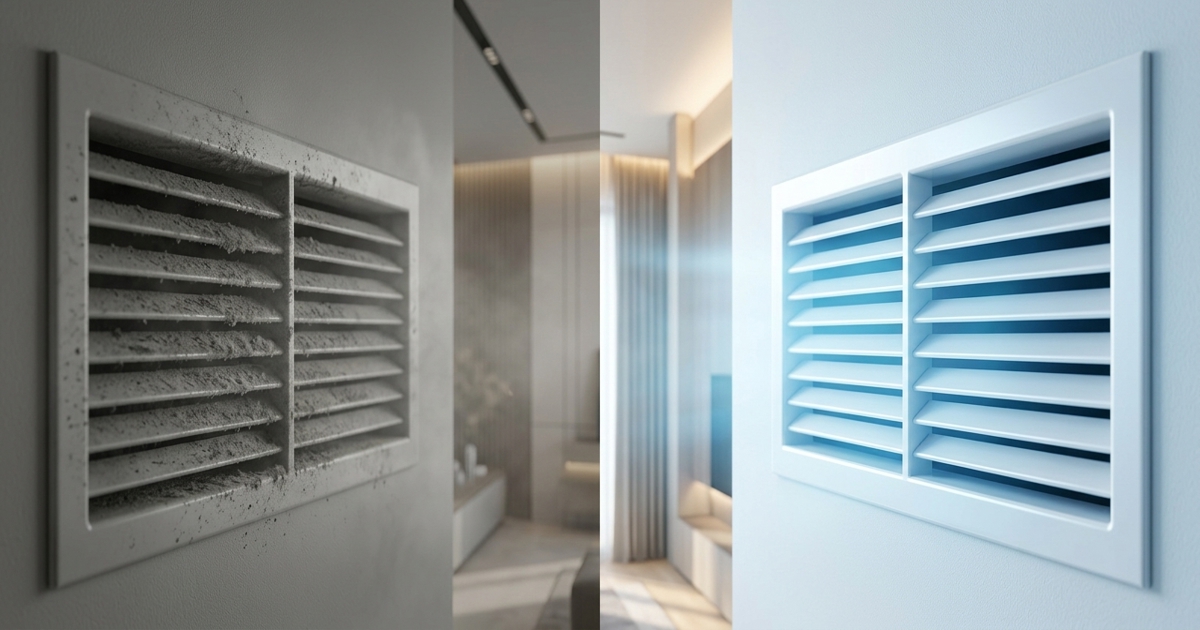
Signs Your AC Ducts Need Immediate Cleaning in Dubai
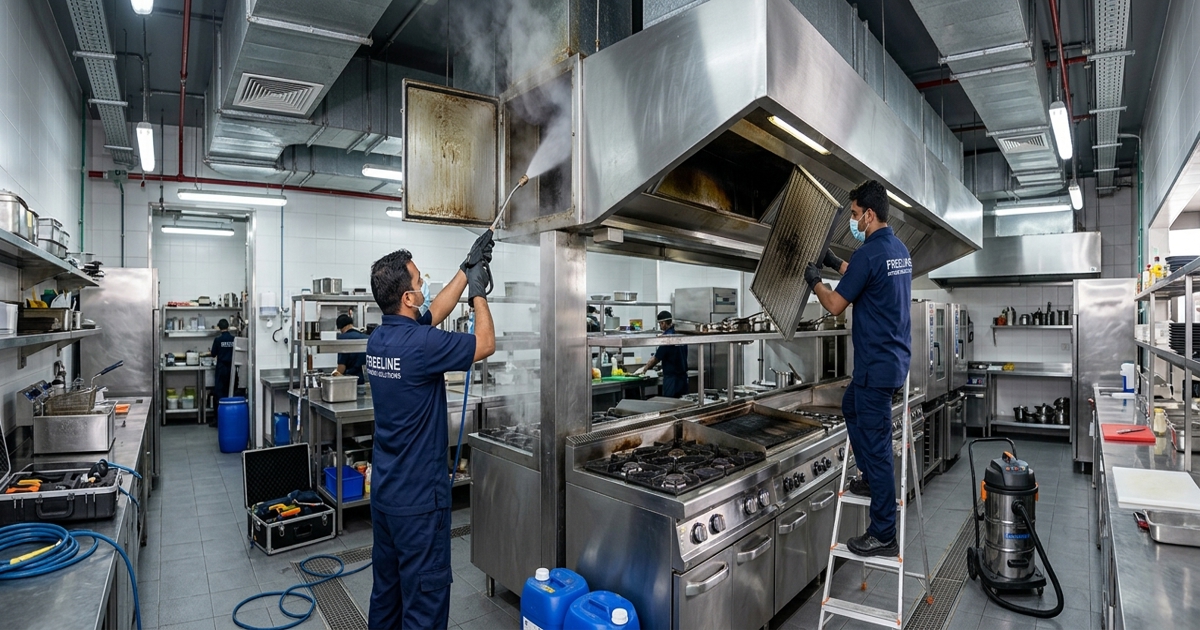
Inside a Commercial Kitchen Duct Cleaning Job: How Freeline Gets It Done
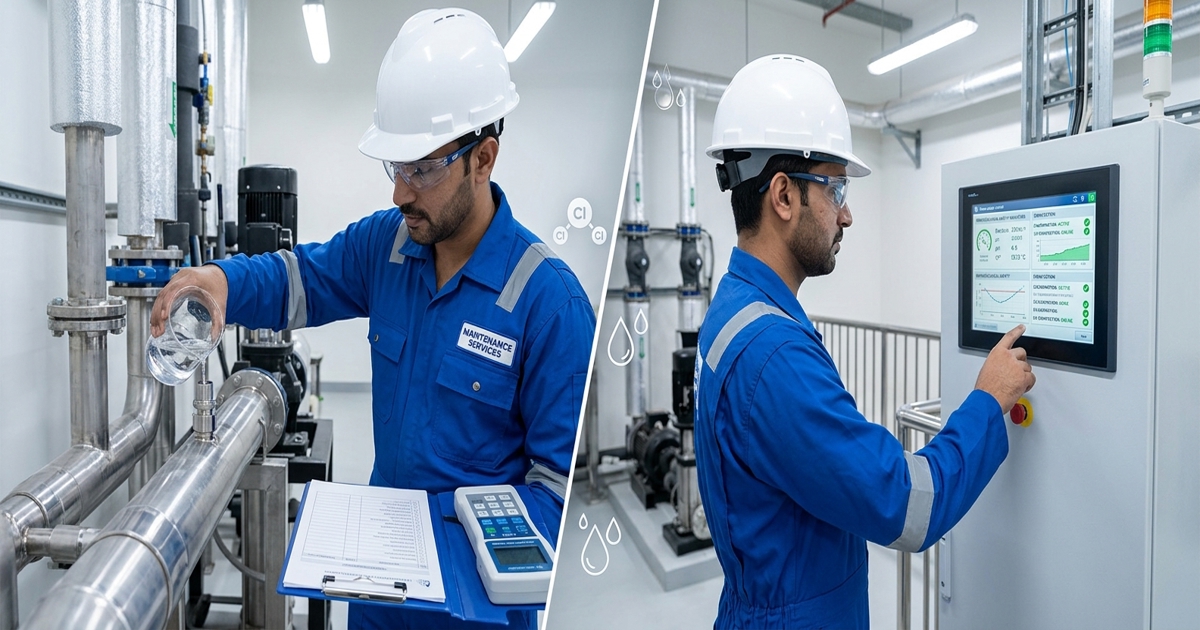
Pipeline Chlorination vs Water Pipeline Disinfection Dubai
