Month: September 2026
Choosing the Best Water Tank Cleaning Company in Dubai
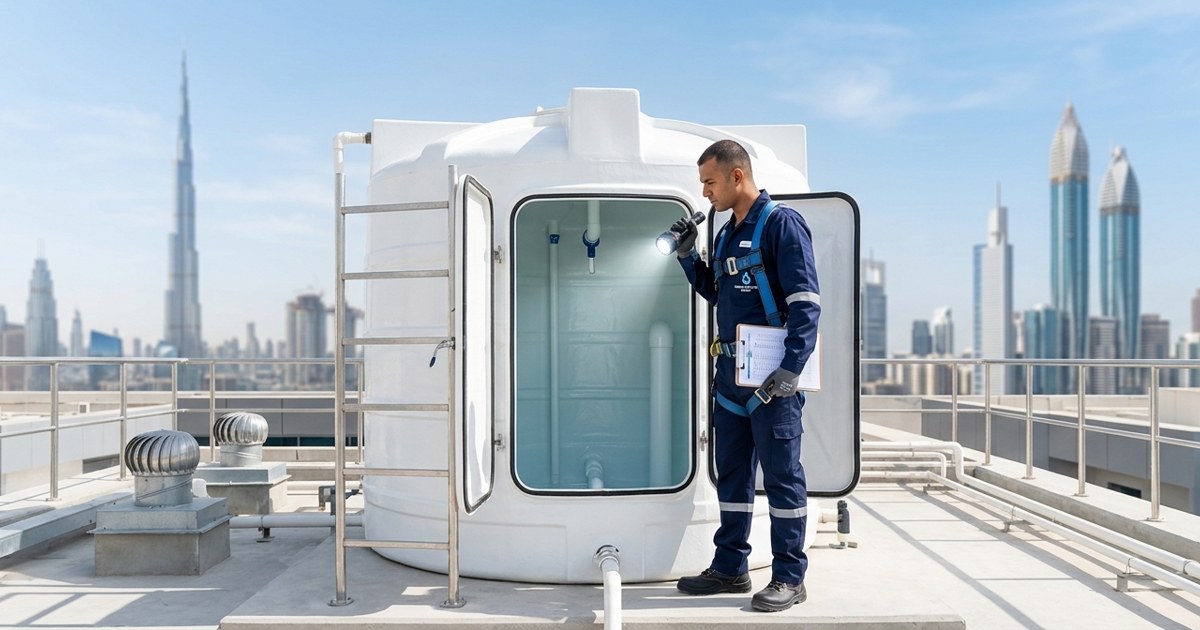
Finding the best water tank cleaning company in Dubai is harder than it should be, because the finished work is invisible. Every provider leaves behind a tank that looks clean and a certificate that says so. The difference between a thorough job and a rinse only becomes apparent in a laboratory result, or six months later when the same complaints return. These are the checks that separate them before you sign anything, covering approval, method, verification and how to read a quotation properly. For the scope Freeline works to, see how Freeline sanitises a stored water system.
Key Takeaways
- Approval status and an accredited laboratory relationship are the two qualifications that are not negotiable. Everything else is preference.
- A method statement issued before the work, naming concentration, contact time and sample points, is the clearest evidence of a real procedure.
- Compare quotations line by line rather than on the total. The cheapest tender usually differs on laboratory testing or on pipework scope.
Start With Approval and Licensing
Water related work in Dubai is overseen by Dubai Municipality, and any company operating on potable water systems should be able to evidence its standing immediately. A provider who needs several days to locate documentation is telling you how frequently that documentation is requested.
Trade licence scope deserves the same scrutiny as approval. A general cleaning licence does not automatically extend to potable water tank cleaning and disinfection, and a mismatch between the licensed activity and the work performed causes difficulty later if a consultant, insurer or purchaser reviews the file.
Insurance is the item owners consistently forget. Work inside a live building water system carries risks of contamination, chemical handling incidents and interrupted supply. Confirming that cover exists and specifically extends to this activity takes one email and prevents an expensive conversation after something goes wrong.
Experience specific to water systems is worth separating from experience in maintenance generally. Tank work sits at the intersection of cleaning, chemistry and documentation, and competence in one of those three does not imply competence across all of them, which is why the questions below focus on method rather than on years in business.
Confined space competency belongs in the same conversation. Entering a water tank is confined space work with genuine hazards, and a contractor without documented procedure for it is exposing your building alongside their own crew. Asking to see that procedure reveals a great deal about how a company operates day to day.
Ask for the Method Before the Price
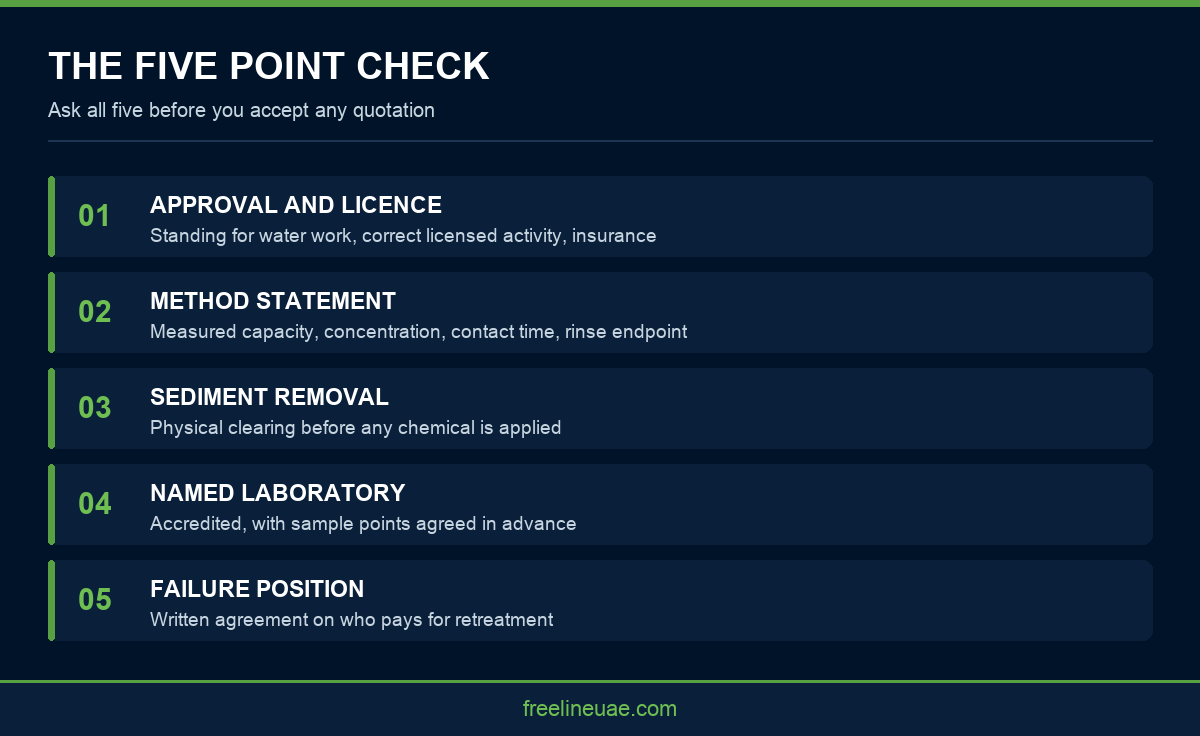
A serious provider issues a method statement before the work rather than an invoice afterwards. It should state tank capacity, the target disinfectant concentration, the intended contact period, the rinse endpoint, the sample locations and the criterion that constitutes a pass.
The capacity figure is the most revealing entry on that document. It requires somebody to have visited and measured, and it determines the chemical quantity. A method statement without it means the dose was estimated rather than calculated, and estimates in this context are almost always underdoses.
Concentration should be stated as a figure rather than described as appropriate or sufficient. A provider comfortable with the chemistry will give a number and explain how it relates to tank volume and to the water quality condition found on arrival, since demand varies considerably between buildings.
Ask specifically what happens to sediment. Sludge on a tank floor consumes disinfectant and shelters organisms beneath it, so physical removal must precede any chemical application. A provider who describes dosing without describing sediment removal has skipped the stage that determines whether the rest works.
The rinse endpoint is the other detail worth pressing. It should be defined by measurement, meaning the tank is refilled once residual has returned to normal supply levels, rather than by elapsed time or by smell. Vague answers here usually indicate the step is rushed in practice.
Check How the Result Gets Proved
Verification is the point at which the market separates most clearly. Ask which laboratory will analyse the samples, whether it is accredited, how many sample sets will be taken and at which outlets. An established relationship produces specific answers without hesitation.
Sample locations should be named in advance rather than chosen on the day. Selecting them after treatment allows the party who performed the work to pick the outlets most likely to pass, which quietly defeats the purpose of independent verification and is impossible to detect afterwards.
Ask what the analysis covers as well as who performs it. Standard bacteriological testing looks for indicator organisms such as coliform bacteria, and a provider should be able to explain what a result means rather than simply forwarding a laboratory sheet to the client.
Two consecutive sample sets taken at an interval are considerably stronger than a single set. One clear result can reflect a favourable outlet or residual disinfectant still present in the bottle, whereas consistent results across identified points describe the system rather than one fortunate moment.
Ask directly what happens if a result fails. A company that does this work regularly will answer without pausing and will already hold a position on who bears the cost of redosing and retesting. A provider treating the question as hypothetical has probably not been tested by one.
Compare Quotations on Scope, Not Total
Pricing varies with tank count and capacity, access difficulty, whether work runs out of hours and whether laboratory analysis is included. Those four variables explain nearly every price gap in a tender, and not one of them is visible in the total at the bottom of the page.
Read the exclusions rather than the inclusions. A quotation covering storage in detail but silent on distribution pipework has addressed half the system at full price, and the untreated half will recontaminate the treated half within days of the building returning to normal use.
Check whether repeat treatment is priced. On older systems a first pass failure is common enough that its commercial treatment should be written down in advance. A quotation that stays silent has not removed that risk from the project, it has simply left it sitting with the building owner.
Consider what else the provider carries. Where tank work sits alongside plumbing and broader building upkeep, one party holds the history for the whole system, which makes a future marginal result interpretable rather than the start of a fresh investigation.
Warning Signs Worth Acting On
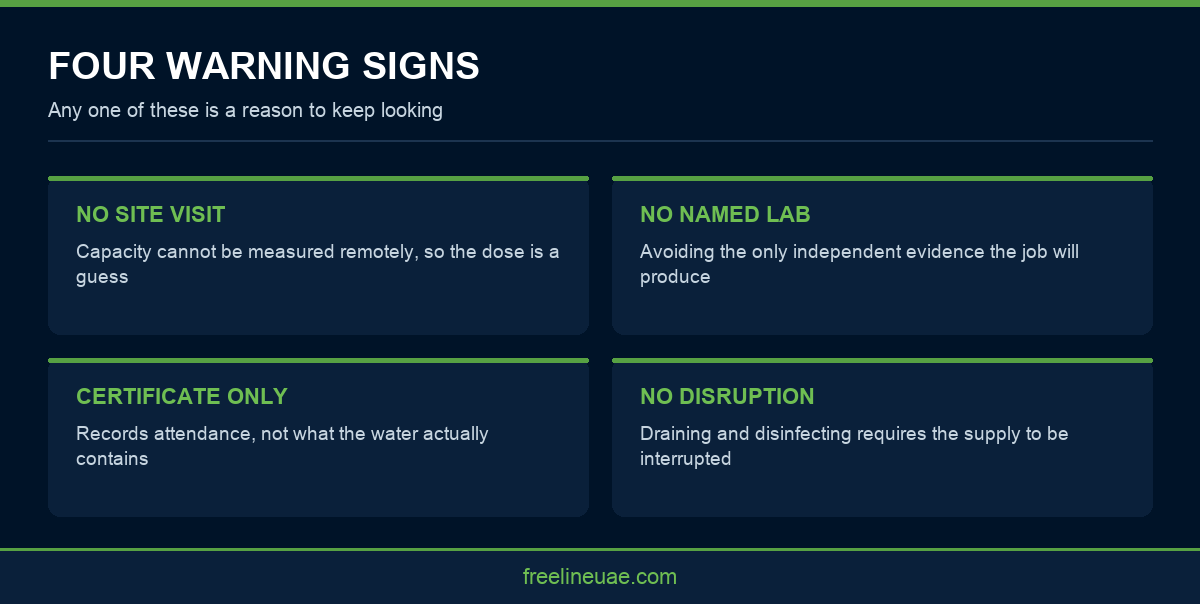
A quotation produced without a site visit is the clearest signal. Tank capacity cannot be established remotely, so a price generated from a phone call is a price for attendance rather than for a defined and calculable piece of work.
Reluctance to name a laboratory is the second. Independent analysis is the only part of the process that is not self reported by the contractor, so a provider steering away from it is steering away from the only objective evidence the job will produce.
A certificate presented as the deliverable is the third. A contractor certificate records that a visit took place. Laboratory analysis records what the water actually contains. Any provider treating those two documents as equivalent is selling paperwork rather than an outcome.
Pressure to sign quickly is a further signal. Tank cleaning is rarely a genuine emergency outside a failed water test, so manufactured urgency usually protects a price from comparison rather than protecting the building from any real risk.
Finally, be cautious of anyone promising no disruption. Cleaning requires the tank to be drained and the supply interrupted for a period, and a provider guaranteeing uninterrupted water has either not understood the request or is planning to compress the stages that make the work effective.
Conclusion
The best water tank cleaning company in Dubai is the one that welcomes these questions, because answering them is how a competent provider distinguishes itself from a cheaper one. Ask for evidence of approval, a method statement with a measured tank capacity, a named accredited laboratory, a scope covering pipework as well as storage, and a written position on retesting. Freeline has delivered water system services across Dubai, Sharjah and Abu Dhabi since 2012. Contact the team for a survey.
Water Tank Cleaning Services in Sharjah: A Practical Guide
Water tank cleaning services in Sharjah face the same underlying problem as anywhere else in the UAE, namely stored water sitting warm for days before anybody uses it. What differs is the building stock. Sharjah carries a high proportion of older residential blocks, villa compounds and shared accommodation, and those buildings tend to have longer service histories, more alterations and less complete documentation. This guide covers what that means in practice, from setting a cleaning interval to verifying the result and choosing a contractor for an older property. For the scope Freeline works to, see how Freeline sanitises a stored water system.
Key Takeaways
- The method is identical across the emirates. What changes in Sharjah is building age, alteration history and how much system documentation actually exists.
- Older buildings carry more sediment, rougher tank surfaces and more undocumented pipework, so surveys matter more and first pass failures are more common.
- Shared accommodation and villa compounds combine high occupancy with limited oversight, which makes a recorded cleaning cycle more valuable than an informal one.
Why Sharjah Buildings Need Their Own Assessment
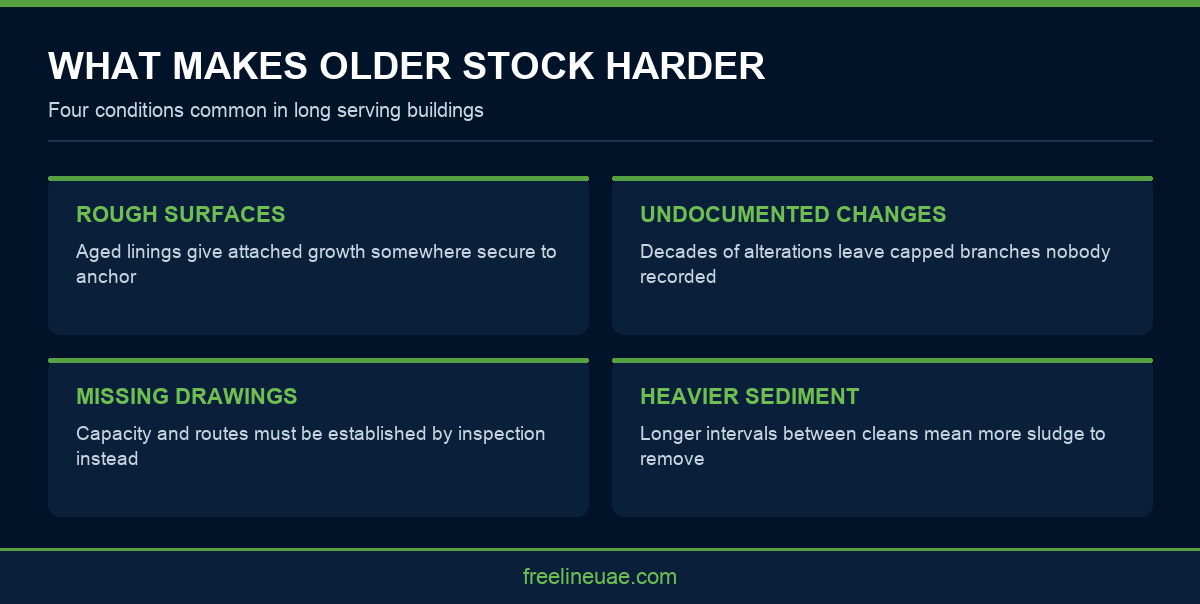
A large share of Sharjah’s residential stock has been in service for decades, and tanks age in ways that affect cleaning directly. Internal surfaces roughen, linings fail in patches, and hairline cracking develops around fittings and seams, all of which give attached growth somewhere secure to anchor itself.
A rough surface is measurably harder to return to a clean condition than a smooth one. Two tanks on identical cleaning schedules can produce very different laboratory results simply because one has a sound lining and the other does not, which is why condition reporting matters as much as the clean itself.
Alteration history compounds this. Older buildings have been reconfigured repeatedly, with units subdivided, outlets added and pipework rerouted, and each change risks leaving a capped branch behind. Those dead legs hold water that never moves and reseed the system after every treatment.
Water chemistry adds another variable in older systems. Ageing pipework contributes corrosion products that discolour water and consume disinfectant, and those deposits are frequently mistaken for a tank problem when the actual source is the distribution plumbing feeding the outlets.
Documentation is often the missing piece. Where drawings are outdated or absent, the survey has to establish tank capacity, isolation points, pipe routes and dead legs by inspection rather than from records, and any quotation issued without that inspection is a price for attendance rather than for defined work.
How Often Tanks Should Be Cleaned
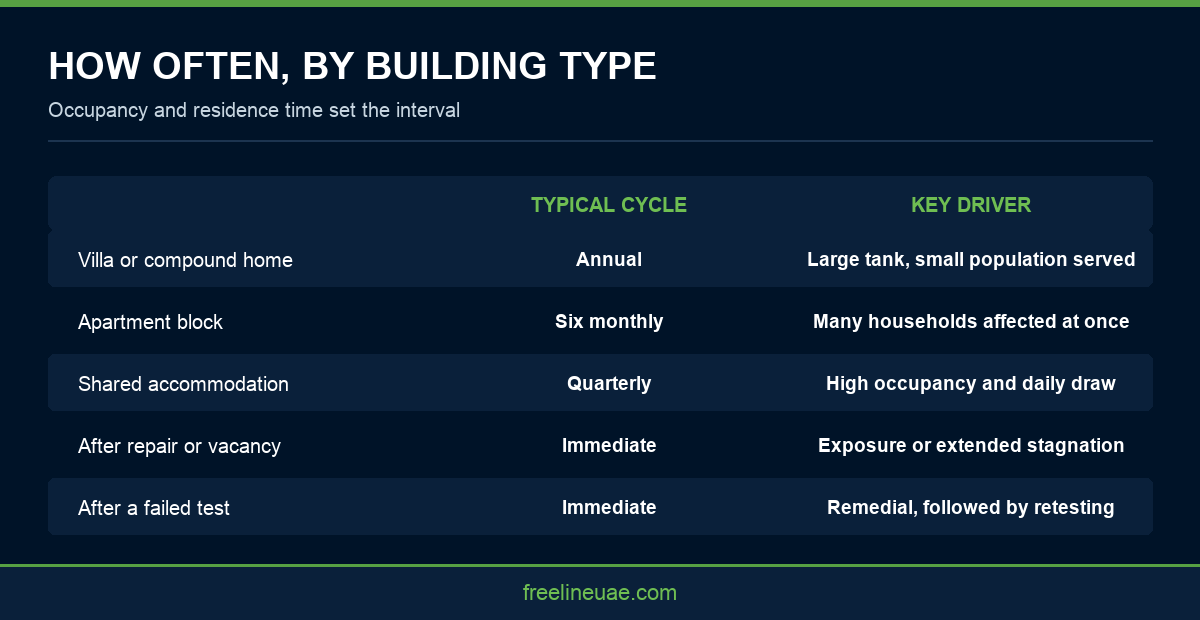
There is no single interval that suits every building, and any contractor offering one has not asked enough questions. The sensible approach starts from building type, adjusts for occupancy and history, then lets laboratory results move the interval up or down over time.
Villas and low occupancy homes commonly work on an annual cycle, because the tank is large relative to daily draw but the population served is small. Apartment blocks usually justify a six monthly cycle, since the consequences of a problem are distributed across many households at once.
Shared and staff accommodation sits at the demanding end. High occupancy, high daily draw and a population with limited ability to raise concerns combine to make a shorter cycle and rigorous documentation genuinely worthwhile rather than merely advisable.
Laboratory results are what make an interval defensible rather than habitual. A building passing comfortably year after year has evidence for extending its cycle, while a building drifting toward marginal results has evidence for shortening it well before an outright failure occurs.
Certain events override the calendar completely. A tank should be cleaned after any internal repair, after a period of vacancy, after suspected ingress and immediately following a failed water test, regardless of when the last scheduled clean took place.
What the Work Should Actually Involve
The sequence is fixed and each stage depends on the one before it. The tank is isolated and drained, sediment is physically removed, internal surfaces are cleaned and disinfected at a stated concentration held for a defined contact period, the tank is rinsed until residual returns to normal supply levels, then refilled and sampled.
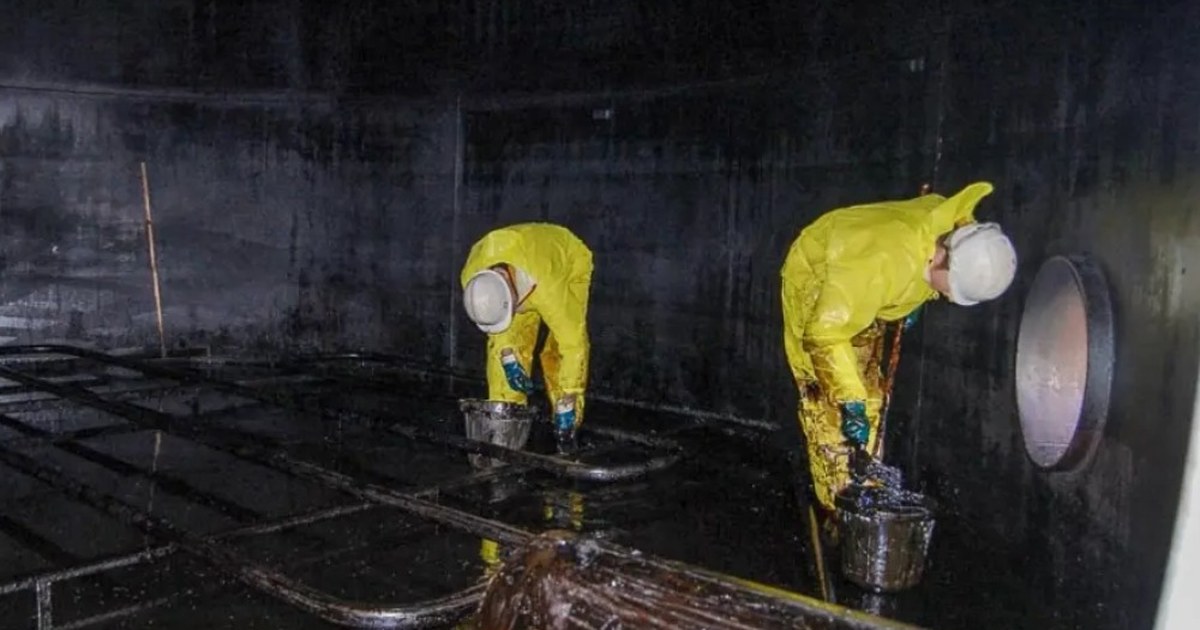
Sediment removal before dosing is the stage most often compressed and the one that determines whether the rest works. Sludge on a tank floor absorbs disinfectant rapidly and shelters organisms beneath it, so a tank dosed over an untouched floor produces a collapsed residual and a failed result.
The rinse endpoint should be defined by measurement rather than by elapsed time or by smell. Refilling early leaves concentrated water in a system that residents are about to use, and it also invalidates any sample taken shortly afterwards by loading the bottle with leftover chemical.
Multiple tank arrangements impose their own sequence. Where a ground level tank feeds a roof tank, the ground tank must be treated first, otherwise the cleaned roof tank is refilled from an untreated source and the work is undone almost immediately.
Condition reporting should accompany every clean. Cracks, failed seals, missing insect screens, corroded hatches and daylight entering the tank all cause recontamination, and a clean that identifies none of them will simply be repeated next year with the same outcome.
Verification and What the Paperwork Should Show
The deliverable is evidence rather than attendance. Bacteriological analysis should show absence of coliform bacteria, issued by an accredited laboratory, with every sample identified by the location it came from rather than listed as a set of anonymous passes.
Sample location determines what a result actually means. A sample drawn at the tank describes the tank, while samples drawn at outlets describe what residents receive, and in a building with contaminated pipework the difference between those two is the entire story.
Two consecutive sample sets taken at an interval are stronger than one. A single clear result can reflect a favourable outlet or residual disinfectant still acting inside the bottle, whereas consistent results across identified points on separate days describe the system rather than a moment.
Interpreting a marginal result needs judgement rather than reflex. A single borderline reading at one outlet is neither an automatic system failure nor simply noise, and the correct response is a targeted resample at that point alongside a comparison point elsewhere in the building.
Records should be kept indefinitely. Water quality questions surface during sales, tenancy disputes, refinancing and insurance reviews, often years afterwards, and a dated series of results held with the condition reports is far more persuasive than anybody’s recollection of work done properly at the time.
Choosing a Contractor for a Sharjah Building
Approval and licensing come first. A company working on potable water systems should evidence its standing without delay, and the licensed activity should actually cover water tank cleaning and disinfection rather than general cleaning, since a mismatch causes difficulty when the file is later reviewed.
Method comes second. Ask for measured tank capacity, the target concentration, the contact period, the rinse endpoint and the named sample points. A capacity figure requires a site visit, so its presence or absence tells you whether the dose was calculated or estimated.
Scope honesty comes third and matters more in older buildings. Storage and distribution form one connected system, so a quotation covering tanks while silent on pipework has addressed half the problem, and in a building with dead legs the untreated half will assert itself quickly.
Where tank work sits alongside broader building upkeep, the records accumulate into a usable history rather than a series of unrelated receipts, which matters most in exactly the older buildings this guide is concerned with.
Continuity is worth more than a marginal saving. A provider returning to the same building holds its history, recognises whether a result reflects deterioration or noise, and can point out that the same hatch seal has now failed twice. Rotating contractors annually on price destroys that information every year.
Conclusion
Water tank cleaning services in Sharjah work best when the age of the building is treated as a variable rather than an afterthought. Insist on a survey that establishes capacity and finds the dead legs, sediment removal before dosing, a measured rinse endpoint, accredited laboratory results with named sample points, and a condition report that identifies what will recontaminate the tank. Freeline serves Sharjah alongside Dubai and Abu Dhabi. Contact the team to arrange a survey.
Water Tank and Pipeline Disinfection: Why Both Together
Water tank and pipeline disinfection are sold as two services and quoted on two lines, which is exactly why so many Dubai buildings buy one and not the other. The tank gets cleaned, the invoice gets paid, and the same complaints return within weeks. The reason is simple and structural. Storage and distribution form one connected system, and treating either half alone leaves a reservoir that recolonises the treated half almost immediately. This article explains why half a scope fails, the order the work must follow, and how to verify that the whole system is genuinely clean. For the scope Freeline works to, see how Freeline sanitises a stored water system.
Key Takeaways
- A tank and its pipework are one system. Clean water from a treated tank entering contaminated pipework is contaminated water by the time it reaches an outlet.
- Order matters as much as scope. Tanks are cleaned first, because dosing a distribution network fed from a dirty tank pushes sediment into the lines being treated.
- Doing both in one mobilisation costs less than two separate visits, because the isolation, the outage notice and the laboratory round trip are all shared.
Why Treating Half the System Fails
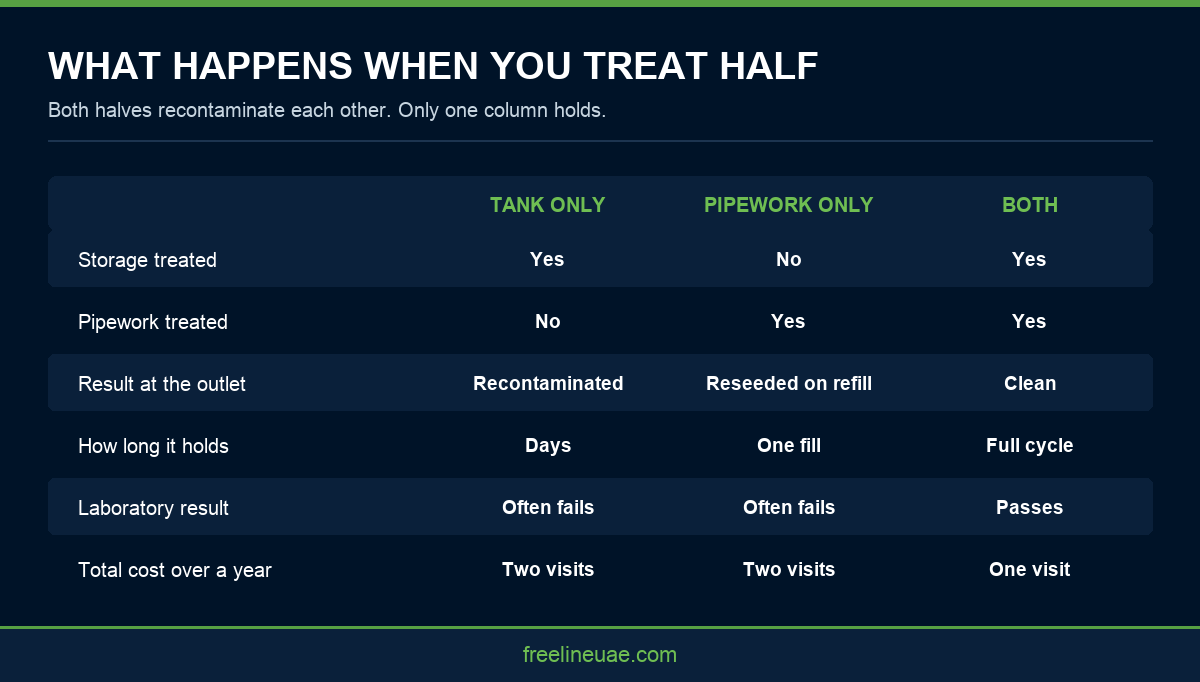
Picture a building where the tank has just been cleaned properly. Sediment removed, surfaces disinfected, laboratory result clear. That water now enters a distribution network whose pipe walls carry an established microbial layer built up over years, and it travels through hundreds of metres of it before anyone drinks it.
The clean water does not sterilise the pipework on its way past. The opposite happens. The biofilm on those walls continuously sheds organisms into whatever flows over it, so the water arriving at an outlet reflects the condition of the pipework far more than the condition of the tank it came from.
The scale of the pipework relative to the tank is what makes this decisive. A building water system holds far more internal surface area in its distribution network than in its storage, so the water supply network inside the building is where most of the microbial habitat actually sits.
The reverse case fails just as reliably. Disinfect the pipework thoroughly, then refill the system from a tank holding years of sediment, and the treated network is reseeded on the very first fill. The chemical was correct, the contact time was correct, and the outcome is still temporary.
Timescales explain why the pattern is so easy to misread. A treated tank feeding untreated pipework can deliver acceptable water for a few days before results drift back, which is long enough for the job to look successful at handover and to have failed by the next test.
This is why owners often report that cleaning made no difference. It frequently did make a difference, briefly, and then the untreated half of the system reasserted itself. Without knowing that the scope was only ever half the system, the reasonable conclusion is that the contractor did poor work.
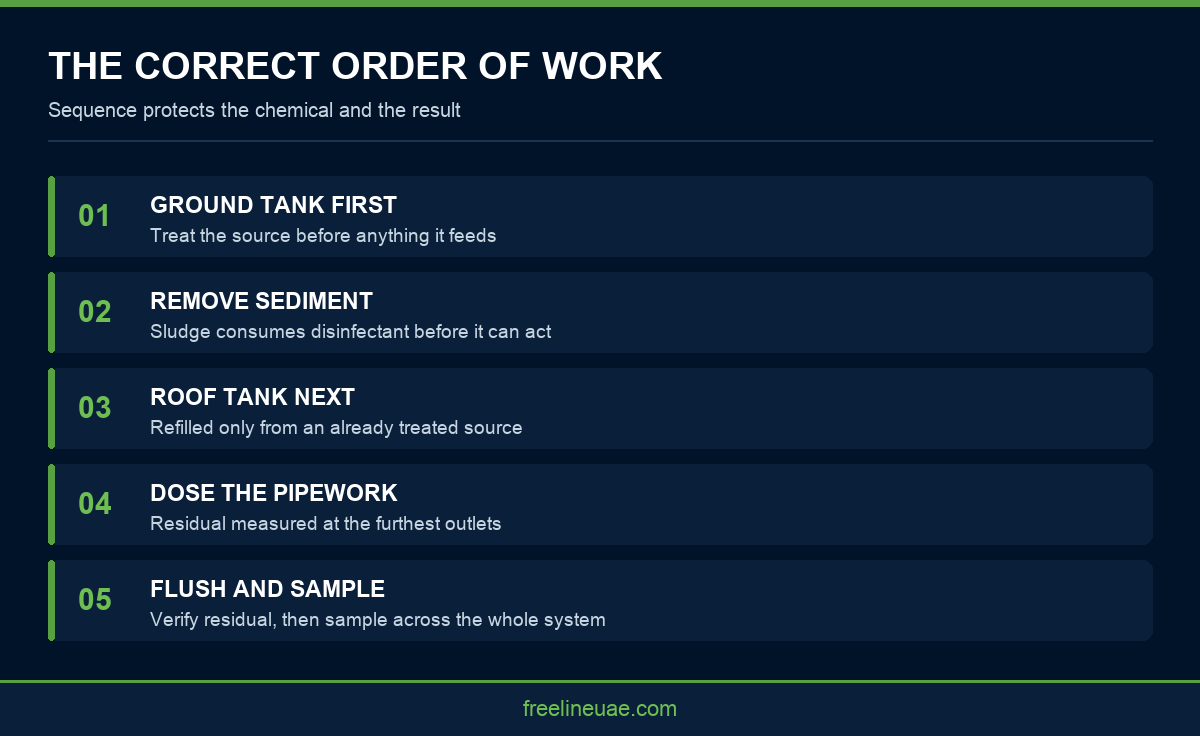
The Correct Order of Work
Tanks come first, and the reason is mechanical rather than chemical. A distribution system dosed while being fed from an uncleaned tank draws sediment straight into the pipework it is trying to treat, which both consumes the disinfectant and deposits material in the lines.
Sediment itself is worth understanding, because it is not merely dirt. It is a mixture of settled mineral solids, corrosion products from pipework and accumulated organic matter, and each of those components consumes disinfectant that was intended for the surfaces underneath.
Sediment removal precedes dosing within the tank stage too. Sludge on a tank floor absorbs chlorine rapidly and shelters organisms beneath it, so a tank dosed over an untouched floor produces a collapsed residual and a failed laboratory result at the end of the contact period.
Once storage is clean, the distribution system is dosed to a stated concentration and held for a defined contact period, with residual measured at the extremities rather than at the dosing point. Only then is the system flushed until residual returns to normal supply levels.
Multiple tank arrangements add a further sequencing rule. Buildings commonly run a ground level tank feeding a roof tank, and the ground tank must be handled first, otherwise the treated roof tank is refilled from an untreated source and the work is undone before anyone has finished writing it up.
Dead Legs and the Problem That Keeps Returning
Some buildings do everything correctly and still fail repeatedly at the same sample points. In most of those cases the explanation is a dead leg, meaning a capped or disused branch that holds water which never moves while remaining connected to the live system.
Dead legs accumulate quietly through ordinary building life. Every alteration that removes an outlet, splits a floor, converts a unit or reconfigures a layout risks leaving a stub of pipework behind, and closing it off feels tidy at the time rather than like storing up a problem.
They cannot be solved chemically. A dead leg will not fill and flush properly during treatment, so it is never adequately dosed, and it then reseeds the treated network afterwards. Repeating the disinfection reproduces the same result at the same cost with the same disappointment.
The answer is physical. Dead legs need identifying during survey and cutting back to the main, which is a plumbing correction rather than a water treatment task. Until that happens, no amount of chemistry will produce a durable outcome in the affected part of the system.
The Commercial Case for One Combined Scope
Combining the work is not simply tidier, it is cheaper. A single mobilisation shares the isolation arrangements, the out of hours labour, the resident notice, the flushing effort and the laboratory round trip, all of which have to be repeated and paid for twice if the scopes are split.
Splitting also creates an accountability gap that owners discover at the worst moment. When the tank contractor and the pipework contractor are different companies and a result fails, each has a credible reason to point at the other, and the building funds a third visit to establish which was right.
Programme length is the other saving. A combined scope completes in one outage, whereas split scopes require two separate shutdowns, two rounds of resident notice and two periods where the building is without water, which occupants notice far more than owners expect.
Reading quotations for this is straightforward once you know to look. A proposal covering storage but silent on distribution has addressed half the system at full price, and the omission is usually visible in what the exclusions section does not mention rather than in what the scope claims.
Where the work sits inside a wider building upkeep arrangement, the same provider holds the history for both halves. That matters when a future result comes back marginal, because the question of whether the building is deteriorating can be answered from records rather than from a fresh investigation.
Proving That the Whole System Is Clean
Verification has to reflect the combined scope, which means sampling cannot stop at the tank. A sample drawn at storage describes storage. Samples drawn at the furthest and least used outlets describe what the distribution network is actually delivering to residents.
Sample points should be named in the method statement before work starts rather than chosen afterwards, and every result must carry its location. A laboratory report showing three passes without stating where the samples came from cannot be compared against anything later and settles very little in a dispute.
Timing follows the same discipline as any disinfection. Sampling before flushing is verified captures leftover disinfectant rather than system condition, which produces a comfortable result from a system nobody has actually assessed. Flush, measure the residual, then sample.
Two consecutive sample sets taken at an interval give a far stronger picture than one. Consistency across identified points on separate days describes a system, whereas a single clear result describes a moment, and it is the system that the building has to live with afterwards.
Conclusion
Water tank and pipeline disinfection belong in the same scope, in the right order, verified across the whole system rather than at the tank alone. Buildings that buy the halves separately usually pay more, wait longer and end up repeating work that was competently performed but incompletely specified. If your last clean covered only the tanks, or the same outlets keep failing after treatment, contact Freeline for a survey covering storage, distribution and any dead legs.

Chlorination, Chlorine Dioxide or UV for UAE Water Systems
Anyone pricing water line chlorination in Dubai will eventually be offered an alternative. Chlorine dioxide and ultraviolet treatment both appear in proposals, usually with a higher price and a persuasive explanation. Sometimes they are the right answer. More often they solve a problem the building does not have. This article compares the three methods on the terms that matter to a building owner, namely residual protection, biofilm penetration, by product formation and what each one actually costs to run. For the scope Freeline works to, see how Freeline sanitises a stored water system.
Key Takeaways
- Only chlorine and chlorine dioxide leave a residual in the system. Ultraviolet treats water at a single point and protects nothing downstream.
- Method should follow the system and the operator. The best method for a building is the one it can run correctly for years, not the most advanced one.
- Chlorination remains the correct default for most Dubai buildings. The alternatives earn their place only where a specific constraint applies.
What a Residual Actually Buys You
The most important property of a disinfectant in a distribution system is not how fast it kills organisms. It is whether anything remains in the water afterwards. A residual is the concentration still present as water travels through the pipework, and it is what protects the system between treatments.
Without it, disinfection is a single moment in time. The water leaving the plant may be clean, but nothing prevents recolonisation of pipe walls further down the network. Given warm conditions and standing water, that recolonisation can begin within days rather than months.
Free chlorine provides this residual cheaply and, importantly, measurably. A technician with a simple test kit can establish the concentration at any outlet in seconds, which makes verification practical rather than theoretical.
Measurability compounds the benefit. A protection mechanism nobody can check is not a protection mechanism in practice, and building systems are maintained by people under time pressure rather than by specialists in ideal conditions.
This single property explains most of the method selection in building water systems. Techniques that offer no residual can support a treatment programme but cannot replace one, however impressive their performance at the point of application.
Chlorination: The Working Default
Chlorine has been the backbone of water disinfection for over a century for reasons that remain valid. It is effective against a broad range of organisms, inexpensive, straightforward to dose, easy to measure and it leaves the residual that keeps a treated system treated.
Its practical strength in a building context is operational rather than chemical. Staff can be trained to measure it, contractors can verify it on site, and a failed result can be diagnosed by anyone with a test kit. Simplicity is a genuine engineering virtue when a system must be maintained for decades.
Cost behaviour matters over a building lifetime as well. Chlorine is inexpensive per treatment and requires no dedicated generation equipment, so the cost of a programme stays roughly proportional to the work done rather than carrying a fixed overhead that must be justified every year.
The main objection concerns by product formation. When chlorine reacts with organic matter it can produce trihalomethanes and related compounds. This is a real consideration and worth managing, particularly where source water carries organic load.
It should be kept in proportion, though. As noted in the technical literature on water chlorination, the World Health Organization has stated that the health risks from these by products are extremely small in comparison with the risks associated with inadequate disinfection.
Chlorine Dioxide: The Specialist Option
Chlorine dioxide is a genuinely different chemical rather than a variant of chlorine, and it has advantages that matter in specific situations. It penetrates established biofilm more effectively, remains active across a wider pH range and forms substantially fewer trihalomethanes.
It also leaves a residual, which places it in the same category as chlorine rather than alongside ultraviolet. For a building with a persistent biofilm problem that chlorination has repeatedly failed to clear, it is a legitimate escalation rather than an upsell.
There is a diagnostic value in the escalation too. If chlorine dioxide clears a system that chlorination could not, the difference confirms biofilm as the underlying cause, which tells the building something useful about why the problem developed in the first place.
The costs are real. It must be generated on site rather than delivered ready to use, which means equipment, maintenance and a competency requirement that does not disappear after commissioning. Handling controls are tighter, and the consumables cost more.
The honest test is whether the building can sustain it. A system requiring on site generation and trained oversight will drift out of control in a property that struggles to keep its insect screens in place. Matching the method to the operator matters more than matching it to the pathogen.
Ultraviolet: Effective and Frequently Misapplied
Ultraviolet germicidal irradiation inactivates organisms as water passes a lamp. It adds no chemicals, alters no taste, produces no by products and works quickly. On those terms it is an appealing technology and it is frequently proposed on exactly those terms.
The limitation is decisive for pipework. Ultraviolet treats only the water flowing through the unit at that moment. It leaves nothing behind, so it cannot act on biofilm already established downstream and offers no protection to the distribution network beyond the lamp.
Lamp maintenance is the other practical constraint. Output falls over time and the unit continues to run and look operational long after it has stopped delivering an effective dose, so scheduled lamp replacement and monitoring are not optional extras.
It is also sensitive to water clarity. Suspended solids shield organisms from the light, so performance depends on the water arriving clear. In a system carrying sediment from an uncleaned tank, effectiveness falls precisely when it is needed most.
None of this makes ultraviolet a poor technology. It makes it a supplementary control, well suited to protecting a specific outlet or a defined point of use, and unsuited to replacing a residual based programme across a whole building.

Choosing a Method for Your Building
Method selection is a decision with a long tail, so it deserves more scrutiny than a line on a quotation.
Start with the problem rather than the product. If the system has never been treated and carries ordinary accumulated growth, chlorination correctly dosed and properly verified will resolve it. Reaching for an alternative before surveying the system is selling rather than diagnosing.
Rule out the ordinary explanations before blaming the chemistry. A failed result far more often reflects a dead leg, an isolation valve that did not hold, sediment left in a tank or sampling carried out too early, and none of those are solved by changing method.
Escalate on evidence. If two properly executed chlorinations at correct concentration and contact time have both failed at the same points, biofilm penetration is a plausible explanation and chlorine dioxide becomes a reasoned choice rather than a speculative one.
Budget for verification rather than for product. Money spent on accredited laboratory analysis and on measuring residual at the extremities buys more certainty than money spent upgrading the disinfectant while leaving the verification unchanged.
Consider the operating burden honestly. Ask who will run the system in three years, what training they will have and what happens when that person leaves. A method that degrades gracefully under imperfect operation is worth more than one that performs brilliantly under ideal conditions.
Finally, treat the tank and the pipework as one system whichever method is chosen. Sediment in storage will consume any disinfectant, so water tank cleaning and disinfection should precede treatment of the distribution plumbing rather than follow it.
Conclusion
Water line chlorination in Dubai remains the correct default for the great majority of buildings, because it is effective, measurable and leaves the residual that protects the system between visits. Chlorine dioxide is a reasoned escalation where biofilm has defeated properly executed chlorination, and ultraviolet is a useful supplement at defined points rather than a replacement. If you have been offered an alternative method, ask what specific constraint it addresses. Contact Freeline for a survey and an evidence based recommendation.

Water Tank Cleaning in Dubai: A Complete Owner’s Guide
Water tank cleaning in Dubai is the single most neglected maintenance task in the emirate’s buildings. Water arrives treated at the property boundary, then sits in a tank for days before anyone drinks it. Everything that goes wrong with building water quality begins in that pause. This guide covers how often tanks should be cleaned, what a correct clean actually involves, how the result is proved, and how to tell a competent contractor from an expensive one. For the scope Freeline works to, see how Freeline sanitises a stored water system.
Key Takeaways
- Tank cleaning is a five stage process ending in laboratory analysis. A clean without a test result is an activity, not an outcome.
- Frequency should follow building type and occupancy rather than a single universal interval, because residence time is what drives risk.
- The tank and the distribution pipework form one system. Cleaning either alone leaves a reservoir that recontaminates the other within days.
Why Stored Water Is the Weak Point
Water supplied to a Dubai property is treated and monitored before it reaches the boundary. The supply network is rarely the source of a building level complaint. Risk enters the moment water stops moving.
Understanding where the risk sits also clarifies who owns it. Once water crosses the boundary it becomes part of privately owned infrastructure, and responsibility for its condition rests with the building rather than with the supplier. That distinction matters when a complaint turns into a dispute.
Storage introduces exactly that pause. Moving water carries a disinfectant residual and offers little opportunity for growth. Standing water loses that residual, warms toward ambient temperature and becomes hospitable. A tank sized generously for peak demand can hold several days of supply in a partly occupied building.
This is the reason water tank cleaning in Dubai is treated as a core building service rather than an optional extra. The risk is created by the storage arrangement itself, not by anything the supplier did or failed to do upstream.
Occupancy makes this counterintuitive. A building at partial occupancy draws less water than designed, so residence time increases at precisely the moment budgets are tightest. Quality problems therefore tend to surface during quiet periods rather than busy ones.
The tank material and age matter alongside the water. Older tanks develop surface roughness, hairline cracking and failed linings, all of which give attached growth somewhere to anchor. A rough surface is measurably harder to return to a clean state than a smooth one, which is why two tanks on identical cleaning schedules can produce very different results.
Design also plays a part. Tanks with poor inlet and outlet geometry develop dead zones where water effectively never exchanges, no matter how much the building draws. A tank can be turning over on paper while a third of its volume sits undisturbed for weeks, and that fraction becomes the reservoir that reseeds the rest after every clean.
Temperature compounds it. Ambient heat pushes cold water systems into the range where microbial growth accelerates, and tanks on roofs or in unshaded plant areas run warmer still. The combination of long residence time and elevated temperature is what makes tank hygiene a UAE specific priority rather than a generic one.

How Often Should a Water Tank Be Cleaned
Owners frequently ask whether water tank cleaning in Dubai needs to happen on a fixed schedule at all. It does need a schedule, but the schedule should be evidence led rather than inherited from whoever cleaned the tank last.
There is no single universal figure that fits every building, and any contractor offering one has not asked enough questions. The useful way to set an interval is to start from building type, adjust for occupancy and history, then let laboratory results move it up or down.
Laboratory results are the feedback loop that makes an interval defensible. A building that consistently passes on a six monthly cycle has evidence for stretching it. A building that fails at three months has evidence for tightening it and for investigating why. Setting the interval once and never revisiting it wastes money in the first case and risk in the second.
Cost per visit falls as the interval shortens, which surprises most owners. A tank cleaned regularly carries little sediment and cleans quickly. A tank left for three years requires sludge removal, extended disinfection and often a repeat treatment, so the deferred saving is usually spent in a single catch up visit.
Certain events override the calendar entirely. A tank should be cleaned after any internal repair, after a period of vacancy, after a suspected ingress, and immediately following a failed water test regardless of when the last clean took place.
Residential and villa properties
Villas and low occupancy homes typically hold a large tank relative to daily draw, which lengthens residence time. Many owners clean once a year and find that adequate, provided the tank is sound and sealed.
The exception is a property that stands empty for part of the year. A villa left for a season should be cleaned and disinfected before it is reoccupied rather than on its usual anniversary.
Apartment buildings and towers
Multi occupancy buildings usually justify a shorter interval, commonly twice a year, because the consequence of a problem is distributed across many households and the tanks are larger and harder to inspect informally.
Buildings with a history of complaints, visible sediment or repeated test failures should move to a planned quarterly cycle until results stabilise, then step back.
Labour accommodation and staff housing
Hotels and serviced apartments sit in a similar category for different reasons. Occupancy swings sharply through the year, so residence time varies week to week, and reputational exposure from a water quality incident is disproportionate to the cost of a shorter cleaning cycle.
Accommodation blocks combine high occupancy, high draw and a vulnerable population. These properties benefit from the shortest intervals and the most rigorous documentation, and they are the properties where a lapse carries the greatest consequence.

What a Correct Tank Clean Involves
Multiple tank installations add a coordination problem. Buildings commonly run a ground level storage tank feeding a roof tank, and treating one without the other simply reintroduces the problem on the next fill. Both must be handled in the same operation, ground tank first, so that the treated roof tank is not refilled from an untreated source.
The order is not negotiable. Cleaning before dosing, dosing before rinsing, rinsing before sampling. Every shortcut in that sequence produces a job that looks identical and proves nothing.
Chemical selection belongs to this stage as well. Concentration is chosen against tank volume and the condition found on arrival rather than applied from a standard figure, because sediment and biological load consume disinfectant before it can act on the surfaces. A tank cleaned thoroughly beforehand needs a lower dose than the same tank dosed over an untouched floor.
The rinse deserves more attention than it usually receives. Residual is measured rather than judged by smell or by elapsed time, and the tank is refilled only once the reading has returned to normal supply levels. Refilling early leaves concentrated water in a system that residents are about to use.
Access and safety sit alongside the method. Water tanks are confined spaces, and entry requires competent procedure, ventilation and supervision. A contractor who treats tank entry casually is a liability regardless of how well they clean.
Condition reporting should accompany the clean. Cracks, failed seals, missing insect screens, corroded access hatches and light ingress are all found during a clean and all cause recontamination. A clean that fixes nothing and reports nothing will be repeated next year with the same result.
Draining and sediment removal
The tank is isolated, drained and the residual sludge removed. Sediment matters more than it looks, because it consumes disinfectant and shelters organisms beneath it. A tank dosed over an uncleaned floor produces a collapsed residual and a failed result.
Surface cleaning and disinfection
Internal surfaces are scrubbed to remove biofilm, the attached microbial layer that regenerates a tank far faster than free floating contamination. Surfaces are then disinfected at a measured concentration held for a defined contact period.
Rinse, refill and sampling
The tank is rinsed until residual returns to normal supply levels, refilled, and sampled for laboratory analysis. Sampling before the rinse is verified captures disinfectant rather than condition, which produces a clean result that means very little.
Proving the Result With Laboratory Testing
The deliverable of a tank clean is evidence, not attendance. Bacteriological analysis should show absence of coliform bacteria, which are the standard indicator organisms for this purpose, and results should be issued by an accredited laboratory rather than asserted on a contractor letterhead.
Sample location must be recorded. A sample drawn at the tank tells you about the tank. Samples drawn at outlets tell you what residents actually receive, and the difference between the two is often the whole story in a building with contaminated pipework.
It is worth understanding what the analysis does and does not tell you. Bacteriological testing uses indicator organisms, which demonstrate whether conditions allowing contamination exist rather than screening for every possible pathogen individually. That is entirely standard practice and it is sufficient for building water, but it means a pass describes conditions rather than certifying absolute purity.
Chemical parameters can be added where a building has a specific concern, covering items such as hardness, chlorine residual or metals from ageing pipework. These are worth requesting once to establish a baseline rather than at every visit, since they change slowly and add cost each time.
Two consecutive sample sets taken at an interval are better practice than a single set. One clear result can reflect a favourable outlet or lingering disinfectant, whereas consistent results across identified points describe the system rather than a moment.
The World Health Organization notes that microbiologically contaminated drinking water transmits diseases including diarrhoea, cholera, dysentery and typhoid. That is a global statement rather than a UAE one, but it explains why the indicator organisms are the ones laboratories look for.
Interpreting a borderline result is where inexperienced providers struggle. A single marginal reading at one outlet is not automatically a system failure, and it is not automatically noise either. The correct response is a targeted resample at the same point alongside a comparison point, rather than either dismissing it or re treating the entire building on one number.
Keep the certificates. Water quality questions surface during sales, refinancing, tenant disputes and insurance reviews, often years later, and a dated record is far more useful than a recollection.
Why the Pipework Matters as Much as the Tank
A tank and its distribution pipework form one connected system. Cleaning the tank and leaving the risers untouched simply feeds clean water into a contaminated network, and the benefit disappears within days.
The economics reinforce the point. Treating tank and pipework together in one mobilisation costs meaningfully less than two separate visits, because the isolation, the outage notice and the laboratory round trip are shared. Splitting them looks cheaper line by line and is almost always more expensive in total.
This is the most common structural error in the market. It is also the easiest to spot in a quotation, because a scope covering the tanks and silent on the pipework has addressed half the problem at full price.
Where pipework is implicated, the corrective work is pipeline disinfection carried out to a stated concentration and contact time. Where the pipework carries physical deposits or repeated blockage, the issue moves into plumbing territory and needs mechanical rather than chemical attention.
The sequencing question comes up in every quotation. Tanks are cleaned before pipework is disinfected, because dosing a distribution system fed from a dirty tank simply pushes sediment into the lines you are trying to treat. Doing it in the wrong order wastes the chemical and usually produces a failed result at the far outlets.
Symptoms help locate the problem before anyone opens a hatch. Complaints confined to upper floors or to one riser point toward pipework. Complaints appearing across the whole building simultaneously, particularly after a supply interruption, point toward the tank. Neither is conclusive, but the pattern tells a surveyor where to sample first.
Dead legs deserve explicit mention. Capped branches left from past alterations hold water that never moves, and they reseed a treated system after every clean. Identifying them is a survey task, and removing them is the only permanent answer.

Choosing a Water Tank Cleaning Company in Dubai
Buying water tank cleaning in Dubai well is mostly a matter of asking four questions in the right order, and price is deliberately the last of them.
Regulatory standing comes first. Water related work in Dubai is overseen by Dubai Municipality, and a company operating in this field should be able to evidence its approval immediately. A provider who needs several days to find documentation is telling you how often it is asked for.
Approval status should be checked rather than accepted verbally, since it is the one qualification that cannot be improvised on site.
Method is second. Ask what concentration is used, how long it is held, where samples will be taken and which accredited laboratory will process them. Specific answers indicate a procedure. Vague answers indicate improvisation.
Scope honesty is third. Tanks and pipework should appear in the same quotation, and any exclusions should be legible without a phone call. Where a provider also handles building upkeep, the records accumulate into a history rather than a series of unrelated receipts.
Reporting quality is the fourth question and the one that separates providers most reliably. Ask to see an anonymised example report from another building before appointing anyone. A provider proud of their documentation will send one immediately, and a provider who cannot produce an example is telling you what yours will look like.
Price is last, and it is the least informative number in the process. Cost varies with tank count and capacity, access difficulty, whether work runs out of hours and whether laboratory analysis is included. A quotation materially below the rest of a tender usually differs on that final item.
Insurance and confined space competency are the two items owners forget to ask about. Tank entry is confined space work, and a contractor without documented procedure for it is exposing your building as well as their own crew. Asking to see the procedure takes one email and tells you a great deal about how the company operates.
Continuity is worth more than most owners expect. A provider returning to the same building holds the history, recognises whether a result represents deterioration or noise, and can tell you that the same hatch seal has now failed twice. Rotating contractors annually on price alone destroys that information every year.
Freeline has delivered water system services across Dubai, Sharjah and Abu Dhabi since 2012, covering tank cleaning, disinfection and the associated services under one coordinated scope.
Keeping a Tank Clean Between Visits
Most recontamination has a physical cause rather than a biological one. A missing insect screen, a failed hatch seal, a cracked lid or daylight entering the tank will undo a clean long before the next scheduled visit.
Sediment returns faster in some buildings than others, and the rate is worth tracking. A tank that shows significant sludge six months after a clean is either receiving sediment from upstream, suffering ingress, or being fed from an untreated ground tank. Recording sludge depth at each visit turns a vague impression into a trend that can be acted on.
Light is worth singling out. A translucent tank or an ill fitting cover admits enough daylight to support algal growth, which then feeds everything downstream of it. This is cheap to fix and frequently ignored.
Insect screens are the cheapest item on any condition report and the one most often found missing. A screen costs almost nothing, fails silently and admits exactly the contamination the clean was paid to remove.
Overflow and vent protection matters equally. Both are openings to the outside world, and both are routes for insects and dust unless screened and maintained. These items should appear on the condition report after every clean.
Inspection between cleans costs almost nothing and catches most of these faults early. A brief visual check of hatches, screens, seals and the surrounding area, recorded with a date, will identify a failed cover long before the water quality reflects it. This can sit within a routine building upkeep walk rather than requiring a separate visit.
Roof plant conditions deserve a look too. Tanks sitting in full sun run warmer than those under cover, and shading or insulation can meaningfully reduce the temperature the stored water reaches. Where a tank is being replaced anyway, position and shading are worth deciding deliberately rather than by default.
Finally, watch the operating pattern. Tanks that are oversized for actual demand hold water too long, and where occupancy has fallen permanently the practical answer may be to reduce stored volume rather than to clean more often. That is a design conversation, and it saves money in every year that follows.
Conclusion
Water tank cleaning in Dubai is straightforward when it is treated as a measured process and unreliable when it is treated as a visit. Insist on sediment removal before dosing, a stated concentration and contact time, a verified rinse, accredited laboratory analysis with named sample points, and a condition report that identifies what will recontaminate the tank. If your building is overdue, has failed a test or has never had the pipework assessed alongside the tank, contact Freeline for a survey and a scoped proposal.
